

March 27, 2026
As the current business cycle comes under pressure from an Oil price shock, investors have been forced to move beyond consideration of equities on a Growth vs. Value spectrum. Inflationary dynamics complicate monetary policy by taking easing off the table. This poses a challenge to traditional low vol. and dividend exposures which see volatility increase when interest rates are pressured higher. Prospect of recession risk complicates Value stock selection by elevating “Value Trap” dynamics for companies with weaker balance sheets.
Investors increasingly agree on one core principle: cash flow matters more than accounting earnings in environments like the present. But how that principle is implemented in ETF portfolios varies meaningfully.
There is an important distinction between:
- Explicit cash flow ETFs, which directly screen for free cash flow yield or generation, and
- Cash flow proxies, such as quality and dividend strategies, which capture cash flow indirectly through profitability, balance sheet strength, or payout discipline
Understanding that divide is critical for portfolio construction.
At the center of this evolution are four ETFs—COWZ, VFLO, VFQY, and SCHD—each representing a different interpretation of cash flow as a factor.
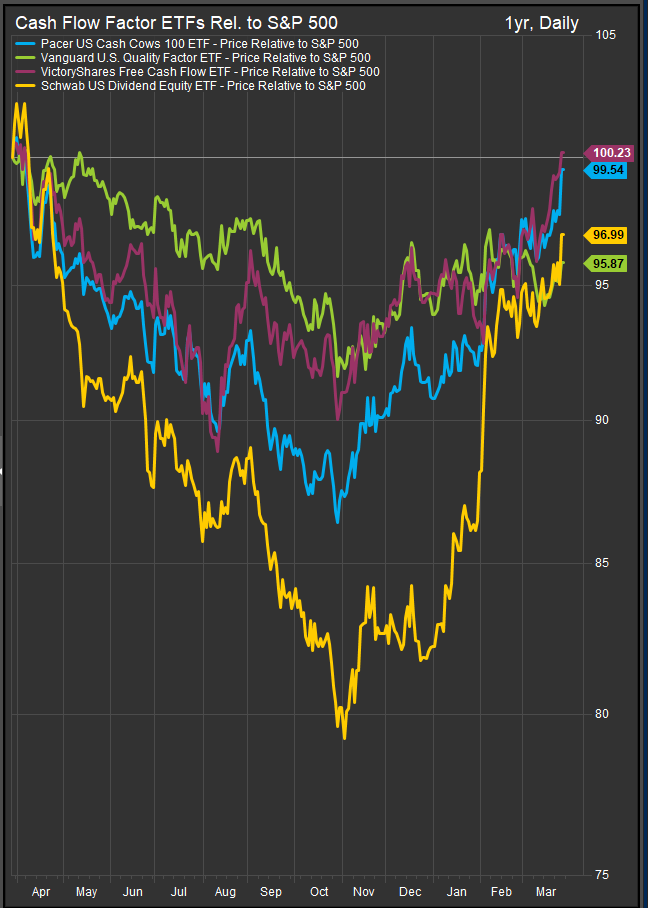
Explicit Cash Flow: Yield vs. Durability
COWZ — Cash Flow as Deep Value
COWZ is the defining product in the explicit cash flow ETF category, screening for companies with the highest free cash flow yield.
What It Captures
- Cash flow as a valuation signal
- Companies where cash generation is high relative to price
How It Behaves
- Structural tilts toward:
- Energy
- Industrials
- Materials
- Strong performance in:
- Inflationary environments
- Commodity upcycles
- Value-led rotations
Role in Portfolios
- Tactical allocation
- Inflation hedge
- High-conviction factor exposure
COWZ expresses cash flow in its most aggressive form—identifying where the market may be underpricing current cash generation.
VFLO — Cash Flow as a Core Allocation Lens
VFLO enters the same category but takes a notably different approach than the Pacer “Cash Cows” complex.
What Differentiates VFLO
- Emphasizes consistent free cash flow generation, not just extremes
- More balanced sector exposure
- Designed for scalability and lower volatility
How It Behaves
- Less cyclical than COWZ
- Reduced concentration in commodity-sensitive sectors
- More stable across market regimes
Role in Portfolios
- Core equity allocation with a cash flow tilt
- Complement to traditional value or blend exposure
- Foundation for multi-factor portfolios
VFLO reframes the cash flow factor—from a tactical deep value trade to a core equity filter focused on durability and diversification.
Cash Flow Proxies: Quality and Income
While explicit cash flow ETFs screen directly on free cash flow, a large portion of the market accesses the factor indirectly through quality and dividend strategies.
VFQY — Cash Flow Stability via Quality
VFQY captures cash flow through profitability and balance sheet strength, rather than yield.
What It Captures
- Companies with:
- High returns on capital
- Low leverage
- Stable earnings
How It Behaves
- Tilt toward:
- Technology
- Healthcare
- Outperforms when:
- Growth is scarce
- Markets reward earnings consistency and resilience
Role in Portfolios
- Core quality exposure
- Downside mitigation
- Complement to cyclical strategies like COWZ
- VFQY focuses not on how much cash is generated today, but on how sustainably it can be generated over time.
SCHD — Cash Flow Realized Through Dividends
SCHD represents the income-oriented endpoint of the cash flow spectrum.
What It Captures
- Companies with:
- Strong dividend histories
- Financial strength
- Cash flow sufficient to support and grow payouts
How It Behaves
- Lower volatility
- Broad sector exposure with a defensive tilt
- Outperformance in:
- Economic slowdowns
- Risk-off environments
Role in Portfolios
- Income generation
- Defensive allocation
- Portfolio ballast
SCHD translates cash flow into realized shareholder return, emphasizing consistency and capital discipline.
A Unified Framework
| Dimension | COWZ | VFLO | VFQY | SCHD |
| Implementation | Explicit FCF Yield | Explicit FCF (Balanced) | Quality Proxy | Dividend Proxy |
| Core Signal | Valuation (cheap cash flow) | Durability of cash flow | Stability of cash flow | Distribution of cash flow |
| Cyclicality | High | Moderate | Low–Moderate | Low |
| Portfolio Role | Tactical / macro | Core | Defensive growth | Income / defense |
Final Takeaway
The growing focus on cash flow is less about choosing a single “best” ETF and more about deciding which dimension of cash flow you want to own:
- COWZ → cash flow as mispriced value
- VFLO → cash flow as a core portfolio filter
- VFQY → cash flow as quality and resilience
- SCHD → cash flow as shareholder return
Together, they form a layered framework that allows investors to express views across valuation, stability, income, and macro regime sensitivity—all rooted in the same fundamental driver: cash generation. For today’s markets, where equities can get caught between inflation and recession dynamics, it is important to have a tool kit of tailored exposures for navigating the subtle differences in macro regimes.
Sources
- ETF sponsor materials and fact sheets:
- COWZ (Pacer ETFs)
- VFLO (VictoryShares / Victory Capital)
- VFQY (Vanguard)
- SCHD (Charles Schwab)
- Index methodology documents:
- Russell 1000 + Pacer Cash Cows Index methodology
- Nasdaq Victory U.S. Large Cap Free Cash Flow Index methodology
- Vanguard U.S. Quality Factor Index methodology
- Dow Jones U.S. Dividend 100 Index methodology
- Industry data and analytics:
- ETF Database
- Morningstar
- FactSet
