



The Russell 3000 Value Index is often described as a cheap-stock basket. In practice, it is a macro portfolio: heavy in financials and industrials, still meaningfully exposed to health care and tech, and broad enough that the top 10 names do not dominate the whole index.
Largest sector weights
(FactSet sector mapping of the Russell 3000 Value Index, as of Mar. 31, 2026)
| Sector | Weight |
| Financials | 20.2% |
| Industrials | 13.4% |
| Health Care | 11.7% |
| Information Technology | 11.5% |
| Energy | 7.8% |
| Communication Services | 7.7% |
| Consumer Staples | 7.3% |
| Consumer Discretionary | 7.1% |
| Utilities | 4.7% |
| Materials | 4.4% |
| Real Estate | 4.2% |
Source: FactSet/Columbia Threadneedle, Russell 3000 Value Index, as of Mar. 31, 2026.
Largest company weights
(Share classes shown separately, as in the index data)
| Company | Weight |
| Berkshire Hathaway | 2.79% |
| JPMorgan Chase | 2.54% |
| Alphabet Class A | 1.99% |
| Exxon Mobil | 1.88% |
| Amazon | 1.79% |
| Johnson & Johnson | 1.72% |
| Alphabet Class C | 1.62% |
| Walmart | 1.48% |
| Micron Technology | 1.34% |
| Procter & Gamble | 1.09% |
Top 10 combined: 18.24%. Source: FactSet/Columbia Threadneedle, Russell 3000 Value Index, as of Mar. 31, 2026.
The first thing to understand about the Russell 3000 Value Index is that it is not a pure “banks and oil” index, even though financials are its largest sector at 20.2% and energy is a meaningful 7.8%. Industrials are 13.4%, health care 11.7%, and information technology still accounts for 11.5%. The largest names reinforce that point: Berkshire Hathaway and JPMorgan sit at the top, but so do Alphabet, Amazon, and Micron. This is a broad all-cap value benchmark, not a museum of old-economy stocks, and its top 10 holdings are only 18.24% of the index, which makes it far less single-name driven than many investors assume. In Q1 2026, that mix mattered: the Russell 3000 Value Index gained 2.23% while the Russell 3000 fell 3.96% and the Russell 3000 Growth Index lost 9.54%.
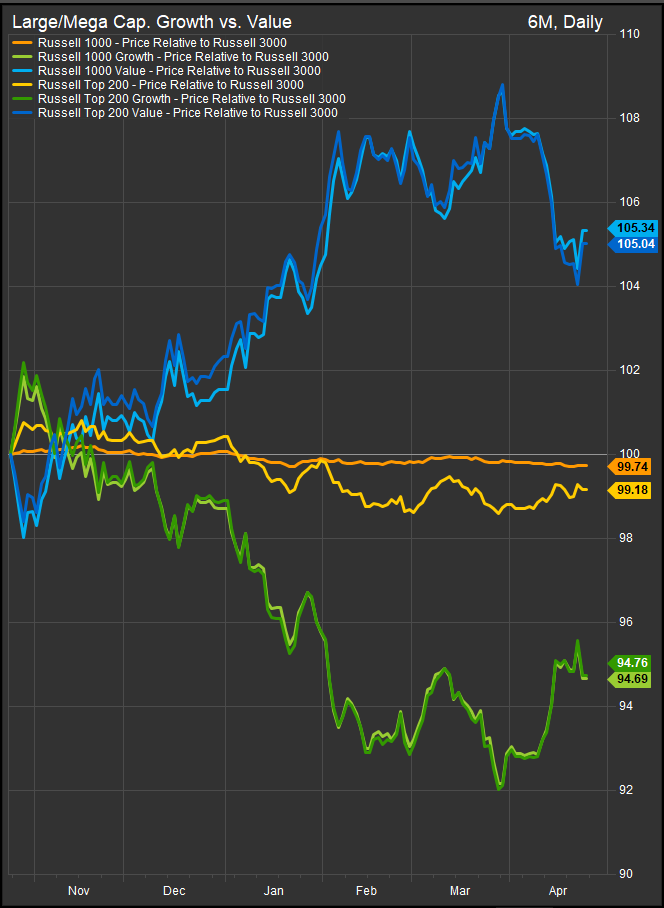
Renewed interest in AI exposures has Value stocks retracing in the near-term. A healthy bull trend supports both styles.
That composition also explains why Value keeps surprising investors who think it should have no exposure to mega-cap growth franchises. FTSE Russell’s style methodology uses one value measure, book-to-price, and two growth measures, I/B/E/S forecast medium-term growth and historical sales-per-share growth. When a company does not fall cleanly into one bucket, FTSE Russell can allocate part of its market capitalization to both value and growth. That is why Alphabet and Amazon can show up meaningfully in Value, and why the Russell 3000 Value Index should be read as a style-tilted cross-section of corporate America rather than a narrow anti-tech bet.
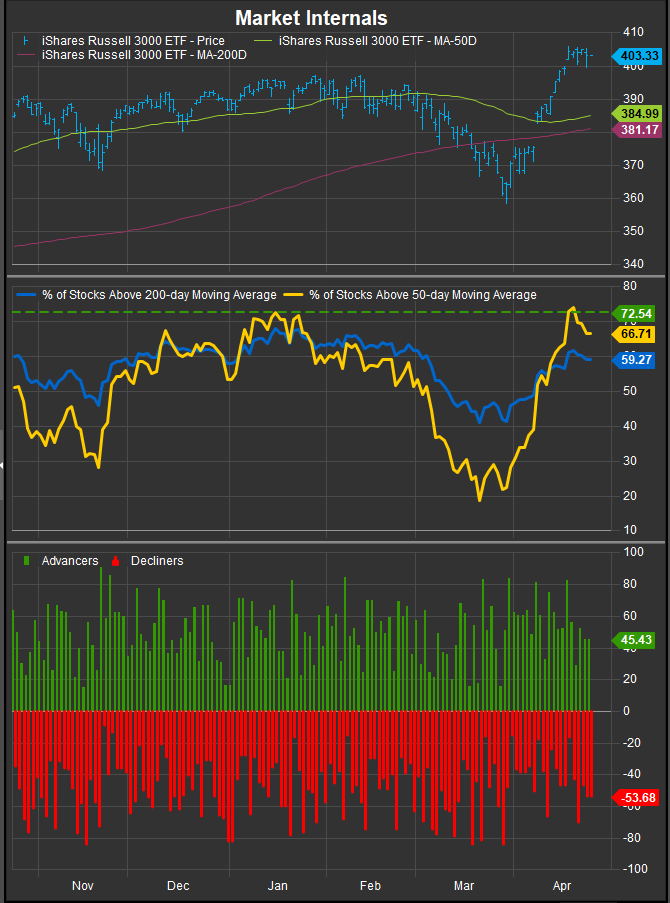
One way to think about Value and Growth in a bull trend: Value works when earnings are plentiful. Growth works when earnings are scarce. Value stocks are a bellwether for the real economy.
From a macro perspective, the cleanest support for Value would be a backdrop of firmer nominal growth, sticky-but-contained inflation, and a yield curve that steepens for healthy reasons rather than recessionary ones. Financials are the largest sector, so banks, insurers, and diversified financials want better credit conditions, steadier loan demand, and a friendlier curve. Industrials and materials want a capex cycle, stronger manufacturing, and infrastructure demand. Energy wants commodity prices that stay firm without crushing end demand. The latest macro prints are at least directionally compatible with that setup: the Fed held the federal funds target range at 3.5% to 3.75% in March, CPI rose 3.3% year over year in March with energy up 12.5%, and both ISM manufacturing and services remained in expansion territory at 52.7 and 54.0, respectively.
In other words, Value tends to work best when the market is broadening rather than hiding. A “healthy steepener” would help the index more than many investors realize because its biggest sector is financials. A manufacturing and capital-spending rebound would help because industrials are the second-largest sector. Moderately firm energy prices help because energy remains a top-five exposure. And because the index still owns pieces of Alphabet, Amazon, and Micron, Value does not need tech to collapse; it simply needs leadership to widen beyond a handful of long-duration growth stocks. That is the more subtle bull case for Value: not anti-growth, but pro-breadth.
The clearest headwind, by contrast, would be either a genuine growth scare or a return to a narrow disinflationary, duration-led market. The latest official GDP release showed real GDP rising at just a 0.5% annual rate in Q4 2025, so the economy did not enter 2026 with much cushion. If that softness turns into weaker credit, slower hiring, or poorer loan growth, the index’s 20.2% financials weight becomes a problem quickly. If commodity prices roll over, the energy and materials support fades. And if long yields fall because growth is deteriorating, the market is likely to reward a small group of high-duration growth franchises more than a diversified value benchmark whose largest single holding is still under 3%.
There is also a more specific headwind embedded in the composition itself: health care is 11.7% of the index, consumer staples 7.3%, and real estate plus utilities add another 8.9%. That makes the benchmark more balanced than the “cyclical value” label suggests, but it also means Value can look indecisive when the macro is indecisive. If growth is too soft for banks and industrials, yet inflation is too sticky for defensives to command premium multiples, the index can stall in the middle. Value usually wants one of two things: either a clean reflationary broadening, or a mild slowdown with stable rates and no credit accident. What it does not want is stagflation severe enough to hit consumers and credit at the same time.
The bottom line is that the Russell 3000 Value Index is best understood as a bet on macro normalization and earnings breadth. Its sector structure says “financials, industrials, health care, and energy.” Its top holdings say “Berkshire, JPMorgan, Exxon,” but also “Alphabet, Amazon, Micron.” That mix should do well in a world of stable policy, decent nominal activity, and broader market leadership. It should struggle in a world of collapsing yields, worsening credit, or another narrow dash back into a few mega-cap growth winners. Right now, Value still has a macro case, but it is a broadening case, not a bunker case.
Sources:
- Columbia Threadneedle Investments — Russell 3000 Value Index sector weights, top holdings, and quarterly performance data (FactSet-based index breakdown).
- FTSE Russell — Methodology for style classification and allocation between value and growth segments.
- Federal Reserve — Monetary policy decisions and interest-rate backdrop.
- Bureau of Economic Analysis — GDP growth and macroeconomic conditions.
- Institute for Supply Management — ISM manufacturing and services indicators for economic activity trends.
Additional Charts and Data sourced from FactSet Research Systems Inc.
This article is for informational purposes only and should not be construed as investment advice.
