
China’s equity market is being pulled in two directions. The macro cycle remains soft, but the AI and automation supply chain is booming. That explains why broad China benchmarks continue to struggle while select AI-linked hardware and optical-networking names have surged.
The business-cycle data show the split. May industrial output rose 4.5% year-over-year, helped by exports and advanced manufacturing, while retail sales fell 0.6%, the first monthly decline since December 2022. Fixed-asset investment also contracted, and property investment remains under pressure. This is not a broad consumer-led recovery. It is a supply-side, industrial-policy and capital-spending cycle sitting on top of weak household demand.
That matters for equity performance. Broad China ETFs and indexes are still heavily exposed to internet platforms, banks, consumer cyclicals, property-linked businesses and old-economy sectors. Those groups need stronger consumption, higher confidence and a healthier property market. By contrast, the strongest stock performance is coming from companies tied directly to AI servers, optical modules, industrial robotics, data-center equipment and domestic technology substitution.
Alibaba and Tencent capture the index-level problem. Both are investing aggressively in AI, but investors are not yet treating that spending as clean earnings leverage. Alibaba’s cloud business grew 38%, and AI-related products represented 30% of external cloud revenue, but the company still missed quarterly revenue expectations and has indicated AI spending will exceed its prior multi-year target. Tencent also reported 9% revenue growth, but revenue and profit missed estimates as the company continued to invest heavily in AI.
For these platform companies, AI is both a growth opportunity and a margin question. Alibaba still faces weak consumer demand, cautious e-commerce spending and competition across platforms. Tencent has strong gaming and advertising assets, but AI investment adds cost in a crowded model environment. The market is asking whether AI will lift profitability soon enough to offset capex, pricing pressure and slower domestic demand.
Foxconn Industrial Internet, Eoptolink and other AI supply-chain winners sit in a different part of the cycle. They are not dependent on Chinese consumers spending more online. They benefit from hyperscalers, cloud providers and model developers spending more on compute, networking, servers and data-center infrastructure. Foxconn’s parent reported first-quarter revenue up 29% and net profit up 19%, with AI server demand driving growth and expectations for AI server rack shipments to more than double this year. Eoptolink is tied to the optical-module bottleneck, with high-speed transceivers and data-center interconnects becoming increasingly important as AI clusters scale.
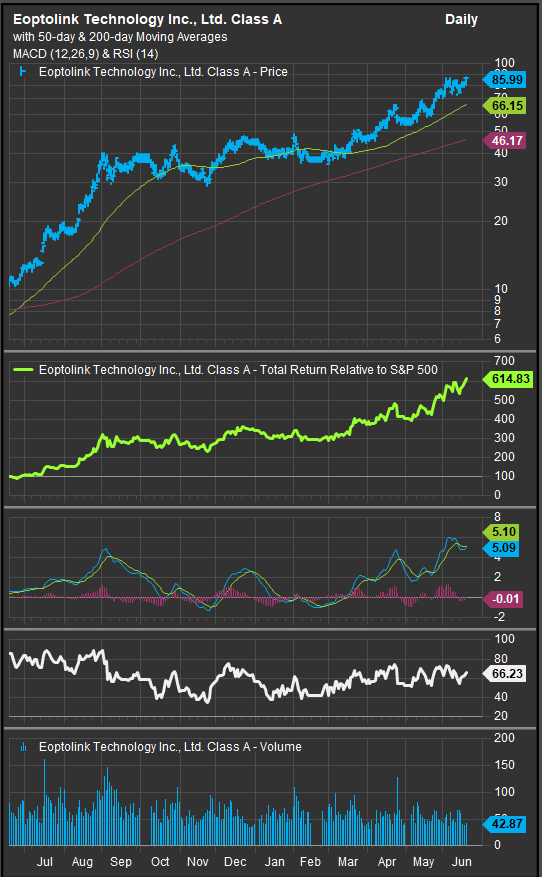
Charts: The disconnect in the US and the Asian AI bull market is high demand for the capability (e.g. optical stocks like Eoptolink Technology), but lack of downstream synergy (e.g. BABA, below).
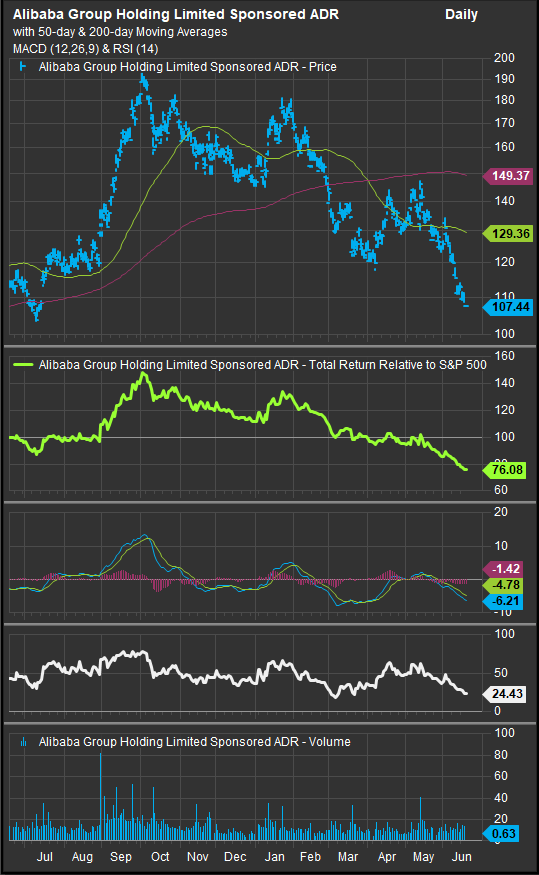
That is the key equity-market message: China’s AI winners are closer to the bottlenecks than to the consumer. Optical modules, AI servers, memory, networking, power equipment, robotics and automation have more visible demand than e-commerce, social media or digital advertising. The stock market is rewarding revenue visibility and scarcity, not just AI branding.
Policy is reinforcing the split. Beijing is pushing AI integration into consumption, services, robotics and industrial upgrading, but the strongest near-term impulse is still manufacturing-led. Government support for technological self-reliance, U.S. export controls and the need to localize AI infrastructure all support domestic hardware and automation suppliers. At the same time, those same constraints make it harder and more expensive for platform companies to scale frontier AI services.
This is also why China’s AI rally is less index-friendly than the U.S. AI rally. In the U.S., AI leadership is concentrated in mega-cap benchmark weights such as Nvidia, Microsoft, Broadcom, Meta, Amazon and Alphabet. In China, the purest AI infrastructure beneficiaries are often A-share or supply-chain companies, while many of the largest index weights remain Alibaba, Tencent, Meituan, JD.com, financials and state-linked cyclicals. The winners are not always the biggest benchmark constituents. Mag7 stocks are worth keeping a close eye on as performance domestically is bifurcating in a similar fashion.
For investors, the conclusion is that broad China beta may not be the best expression of China’s AI cycle. Broad funds can remain hostage to weak consumption, property stress, policy uncertainty and platform-margin concerns. More targeted technology, internet, A-share and automation-linked exposure may be better positioned to capture the AI and industrial-upgrading theme, though those areas carry higher valuation and crowding risk.
The opportunity is in targeted exposure to the new-economy capex cycle: AI servers, optical modules, industrial robotics, advanced manufacturing, power infrastructure and selected technology supply-chain companies. The risk is that many of these winners have already priced in aggressive growth assumptions. Any slowdown in global AI capex, export-control escalation, margin compression or capacity overbuild could trigger sharp reversals.
What we’re seeing in China is a potential preview for the US. AI capex is now a compulsory race to build capability. AI execution is still extremely speculative, and the market isn’t convinced that legacy industry leaders will master it.
| Ticker | ETF | Approx. focus | Notes |
| MCHI | iShares MSCI China ETF | Broad China equity | Broad offshore/onshore-access China exposure; iShares reports 574 holdings, P/E of 13.72, and YTD NAV total return of -9.64% as of June 16. (BlackRock) |
| KWEB | KraneShares CSI China Internet ETF | China internet / platform tech | Focuses on China internet and internet-related companies; KraneShares frames it as exposure to China’s digital economy and AI-leading internet firms. (KraneShares) |
| FXI | iShares China Large-Cap ETF | Hong Kong-listed China large caps | Large-cap H-share exposure; includes many benchmark-heavy platform, financial and consumer names. (BlackRock) |
| ASHR | Xtrackers Harvest CSI 300 China A-Shares ETF | Onshore A-shares / CSI 300 | Tracks the 300 large- and mid-cap A-share stocks listed in Shanghai and Shenzhen. (etf.dws.com) |
| GXC | SPDR S&P China ETF | Broad China | Tracks the S&P China BMI Index; State Street lists AUM around $460M as of June 17. (SSGA) |
| KBA | KraneShares Bosera MSCI China A 50 Connect ETF | Large-cap A-shares | More focused on mainland A-share leaders than broad offshore China internet exposure. |
| CNYA | iShares MSCI China A ETF | Broad A-share access | Broader China A-share exposure than CSI 300-style products; ETFdb lists it in the China ETF universe. (ETF Database) |
| PGJ | Invesco Golden Dragon China ETF | U.S.-listed China ADRs | Smaller, more ADR-focused vehicle; Invesco reported market value around $97M as of June 9. (Invesco) |
| CNXT | VanEck ChiNext ETF | China growth / innovation A-shares | More focused on ChiNext-style growth and innovation exposure; higher beta and narrower than broad China ETFs. |
Source list
- Reuters on China’s May activity data: industrial output rose 4.5% y/y, retail sales fell 0.6%, and fixed-asset investment weakened, showing the split between industrial production and domestic demand.
- Reuters on China’s 618 shopping festival: weak consumer demand, property-market pressure and AI’s rising role in retail, with analysts expecting only modest single-digit festival growth versus 15% in 2025.
- Reuters on China’s Ministry of Commerce AI-consumption measures: 17 measures to integrate AI into goods and services consumption, including consumer electronics and humanoid robots.
- Reuters on Alibaba: quarterly revenue rose 3% but missed expectations; cloud revenue rose 38%; AI-related products represented 30% of external cloud revenue.
- Reuters on Tencent: Q1 revenue rose 9% to 196.5B yuan, but missed estimates; net profit of 58.1B yuan also missed expectations amid higher AI investment.
- Reuters on Foxconn: Q1 profit rose 19% to T$49.92B, with AI demand driving growth and the company expecting AI server rack shipments to more than double this year.
- Foxconn company release: Q1 2026 revenue rose 29%, gross profit rose 30%, operating profit rose 63%, and net profit rose 19%.
- Reuters on Zhongji Innolight’s planned Hong Kong listing: potential raise of up to $7B, reflecting strong investor demand for Chinese AI optical-module exposure.
- Eoptolink company materials on its 6.4T near-packaged optical transceiver for AI data-center interconnects.
Disclaimer: This material is for informational and educational purposes only and should not be considered investment advice, a recommendation to buy or sell any security, ETF or market, or a solicitation to engage in any investment strategy. China-focused equities and ETFs may involve elevated volatility, liquidity risk, currency risk, regulatory risk, geopolitical risk, accounting risk, concentration risk and sensitivity to changes in policy, tariffs, export controls, domestic demand, property-market conditions and global technology spending. Company and ETF data are based on sources believed to be reliable but have not been independently verified. Past performance is not indicative of future results. Investors should consult their own financial, tax and legal advisers before making investment decisions.
