

Nvidia’s latest earnings report removed one of the largest questions hanging over the equity market: the AI capital-spending cycle is not close to exhaustion. The company forecast roughly 70% revenue growth for fiscal 2028, far above consensus expectations, while Data Center revenue more than doubled and management described demand as remaining supply-constrained. Amazon’s commitment to deploy another 2 million Nvidia GPUs in 2027 and 2028 further suggests that hyperscaler spending is extending rather than peaking.
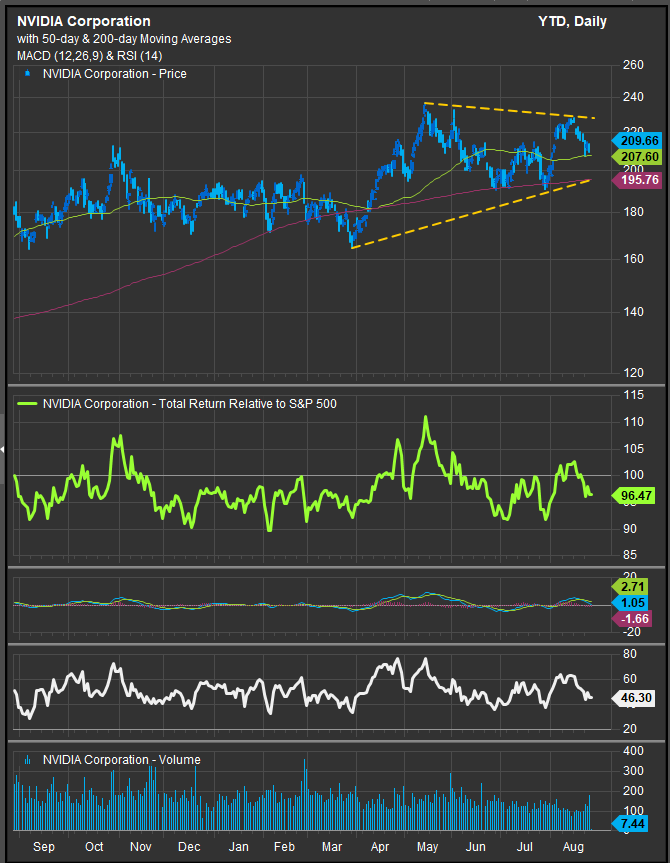
Chart: NVDA has been in an intermediate-term consolidation pattern since May. The technical read is that the chart improves materially on a move above $230 which would confirm the uptrend. Stock is >7% higher in the pre-market this morning.
For sector investors, however, the August 27 ETF flow data sends a more complicated message. Investors were already rebuilding semiconductor exposure before Nvidia reported, but they were simultaneously withdrawing capital from broad Technology and QQQ while adding aggressively to biotechnology, dividends, gold, defense and electrical infrastructure. That combination is important. AI remains the strongest secular earnings story, but it is no longer the only leadership story. Investors appear to be positioning for a second half in which growth remains strong but inflation, interest rates and Federal Reserve policy remain uncertain.
| Vanguard Sector Proxy | Thematic Signal | Sector Implication |
| VGT – Information Technology | Semiconductor inflows rebound; cyber/software monetization improving | Constructive, but increasingly selective |
| VIS – Industrials | Defense, infrastructure and electrification attracting capital | Strong positive confirmation |
| VHT – Health Care | Biotech flows accelerate sharply | Emerging leadership |
| VPU – Utilities | AI power demand supports grid investment; rates remain headwind | Improving fundamentals, Fed-sensitive |
| VDE – Energy | Energy security remains important; midstream stronger than oil services | Constructive but selective |
| VCR – Consumer Discretionary | Amazon AI spending strong; housing/auto flows only beginning to stabilize | Mixed |
| VOX – Communication Services | AI platforms remain powerful, but broad internet flows weak | Stock-specific rather than sector-wide |
Information Technology: Nvidia Strengthens VGT, but Broad Tech Flows Say “Be Selective”
The strongest fundamental argument still belongs to Vanguard Information Technology ETF (VGT). Nvidia’s guidance indicates that AI infrastructure spending has years rather than quarters left to run, while recent results from CrowdStrike, Salesforce, Okta and Synopsys show AI demand spreading from hardware into cybersecurity, enterprise software and chip-design tools. The ETF flows began anticipating that result. Semiconductor funds attracted approximately $2.4 billion during the latest week, reversing the aggressive redemptions seen earlier in August. SMH gathered roughly $2.0 billion, SOXX another $294 million and SOXQ approximately $105 million. Semiconductor ETFs now retain more than $20.5 billion of YTD inflows.
Yet VGT itself lost approximately $781 million during the week, while QQQ experienced roughly $2.6 billion of withdrawals. That divergence suggests investors are not simply rebuilding broad megacap Technology exposure. They are specifically returning to the parts of the AI ecosystem where earnings visibility has improved.
Software confirms the distinction. The category attracted approximately $91 million this week and $763 million over one month, but the money concentrated in cybersecurity. CIBR received about $165 million and BUG another $78 million, while broad software ETF IGV lost roughly $164 million. For VGT, the implication remains positive, but the character of the trade has changed. Nvidia validates the semiconductor cycle, while cybersecurity and enterprise software demonstrate improving AI monetization. Broad Technology can continue to outperform, but the flows increasingly favor earnings-backed AI exposure over undifferentiated growth.
Industrials: VIS May Have the Best Second-Order AI Setup
The strongest sector-level confirmation outside Technology is increasingly visible in Vanguard Industrials ETF (VIS). Defense ETFs attracted approximately $93 million during the latest week, $462 million over one month and $1.83 billion YTD. Electrical-infrastructure exposure is even stronger: electrification funds gathered roughly $134 million this week and $298 million over one month, with YTD inflows approaching $6.8 billion.
Meanwhile, infrastructure ETFs returned to modest weekly inflows after losing assets over the prior month. These flows reflect several overlapping catalysts. Nvidia’s growth forecast implies continued construction of data centers, transmission systems and electrical infrastructure. The administration’s new restrictions on foreign-made grid equipment add a domestic-manufacturing dimension to that investment cycle. Meanwhile, continuing Middle East tensions and concerns about U.S. weapons inventories reinforce demand for aerospace and defense equipment.
The important distinction is that Industrials can participate in AI without requiring investors to pay directly for AI software or semiconductor valuations. Data centers still need switchgear, transformers, cooling systems, engineering, construction and power-management equipment. For sector investors, VIS increasingly represents a picks-and-shovels extension of the AI cycle, while defense provides an independent demand stream. That combination gives Industrials one of the broadest fundamental foundations in the current sector map.
Health Care: VHT Is Developing a New Source of Leadership
The biggest change in market leadership remains biotechnology. Biotech ETFs attracted approximately $764 million during the latest week and more than $1.0 billion over one month, extending YTD inflows above $2.2 billion. XBI alone gathered roughly $570 million, while ARKG received approximately $148 million and IBB another $55 million. That matters directly for Vanguard Health Care ETF (VHT) because biotechnology represents about 22.8% of the fund, alongside pharmaceuticals, medical equipment, managed care and life-sciences businesses.
Biotech’s improving position is not primarily an AI story. Clinical successes, accelerating pharmaceutical M&A and improving pipeline values are driving the fundamental move. But AI can improve drug discovery and development productivity, while a less hawkish Fed would disproportionately benefit the long-duration valuations of early-stage biotechnology companies. That makes VHT particularly interesting in the current environment. Unlike VGT, it does not require continued multiple expansion in the market’s largest growth stocks. Unlike traditional defensive Health Care allocations, it now contains a genuine emerging growth engine. Biotech has not displaced AI as the market’s dominant structural theme, but its accelerating flows suggest Health Care is becoming a credible source of portfolio leadership rather than merely a defensive hedge.
Utilities: VPU Has the AI Demand Story—and the Fed Problem
AI’s enormous electricity requirement continues to improve the structural argument for Vanguard Utilities ETF (VPU). Electrification ETFs remain one of the strongest YTD flow categories in the thematic universe, and GRID alone attracted approximately $126 million this week. The data-center investment cycle requires significantly more generation, transmission and grid reliability regardless of which semiconductor or software company ultimately wins. The difficulty is interest rates. Utilities are capital-intensive businesses, so higher borrowing costs can offset some of the benefit from stronger electricity demand. That makes Friday’s Jackson Hole speech unusually relevant for VPU. July inflation remained elevated, and markets continue to price meaningful odds of additional Fed tightening by year-end. Investors are looking to Chair Kevin Warsh for clarity on whether the Fed intends to lean against persistent inflation or allow market-driven tightening to do more of the work.
The fundamental story for Utilities is improving faster than the macro valuation backdrop. VPU therefore looks increasingly attractive as a long-term beneficiary of AI power demand, but its near-term performance remains unusually dependent on the direction of long-term yields.
Energy: VDE Still Has Support, but the Market Is Choosing Cash Flow Over Maximum Beta
The geopolitical backdrop continues to support Vanguard Energy ETF (VDE), but the thematic flows show investors becoming more selective about how they express the trade. Traditional energy ETFs experienced modest weekly outflows, driven largely by continued redemptions from oil-services exposure. OIH lost approximately $62 million this week despite the persistence of Middle East supply risk. Midstream is behaving better. MLP and pipeline ETFs have attracted approximately $571 million over one month and $1.9 billion YTD. The latest week was modestly positive overall.
That difference reflects a changing Middle East story. Strait of Hormuz traffic has improved somewhat as Qatar, Kuwait and other producers find ways to move more barrels, while Iraq is offering buyers alternative export arrangements. These developments reduce the probability of an immediate extreme oil-price spike even though geopolitical risk remains high. For VDE, that means the sector still benefits from energy security and constrained global supply, but the strongest investment argument increasingly rests on cash generation and scarcity value rather than a simple bet on permanently higher crude prices.
Consumer Discretionary: VCR Gets an AI Boost from Amazon, but the Consumer Signal Is Mixed
Vanguard Consumer Discretionary ETF (VCR) has one of the more unusual relationships with the AI trade because Amazon gives the sector substantial exposure to cloud and data-center investment while Tesla provides exposure to autonomy and robotics. Amazon’s planned deployment of another 2 million Nvidia GPUs strongly supports the AWS infrastructure thesis, while Tesla’s Cybercab rollout keeps autonomous mobility in focus. Yet the broader consumer thematic evidence is less compelling. Housing and automotive ETFs did attract approximately $192 million this week, largely through ITB, but the group remains negative over both one month and YTD. Higher financing costs continue to constrain housing affordability and large-ticket consumer purchases. VCR therefore remains highly dependent on its largest growth companies rather than on a broad improvement in consumer cyclicals. A less hawkish Fed would materially improve the sector setup; persistently high long-term rates would leave a much more uneven opportunity.
Communication Services: VOX Needs Earnings More Than Thematic Flows
The thematic backdrop is least convincing for Vanguard Communication Services ETF (VOX). Internet and metaverse-related ETFs lost approximately $16 million this week, $80 million over one month and almost $3.0 billion YTD. That is a persistent rejection of broad internet-platform exposure despite continued advances in artificial intelligence. The distinction is that VOX’s largest companies have much stronger fundamentals than many speculative internet businesses. Alphabet and Meta can use AI to improve advertising, engagement and cloud services, but regulatory pressure remains substantial and investors increasingly require evidence that massive AI investments generate measurable returns.
VOX therefore remains a company-fundamentals trade rather than a broad thematic-flow trade. The sector can perform well, but it currently lacks the breadth of confirmation visible in Technology, Industrials or Health Care.
Thematic Thursday: The Sector Message
Nvidia’s quarter significantly strengthens the case that AI remains the dominant secular investment cycle. For sector investors, however, the more important development is that the benefits are spreading—and the portfolio response is becoming more diversified.
VGT remains the most direct sector expression of AI earnings, with semiconductors again attracting capital and cybersecurity showing increasingly visible monetization. VIS may offer the strongest second-order opportunity, combining AI infrastructure with defense and domestic industrial investment. VHT is emerging as the most important new source of leadership, supported by biotechnology fundamentals and potential rate sensitivity.
VPU offers an increasingly compelling structural power-demand story but remains vulnerable to higher yields. VDE retains geopolitical and energy-security support, although investors prefer cash-generating infrastructure to maximum oil beta. VCR and VOX remain more dependent on their megacap constituents than on broad sector-level flow confirmation.
That is the central sector message heading into Jackson Hole: investors are not leaving growth. They are broadening the definition of growth. Nvidia has reinforced confidence in the AI cycle. The Fed will determine how widely investors are willing to spread that confidence across the rest of the market.
Thematic ETF return and fund-flow data through August 26, 2026. CSV data sourced from FactSet Research Systems Inc.
