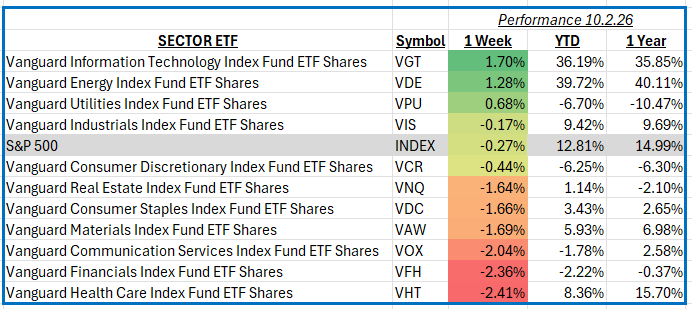
COMMENTARY:
The S&P 500 declined 0.27% for the week ending October 2, as a strong Friday rally was not enough to offset earlier losses. Investors balanced a weaker-than-expected September employment report against elevated Treasury yields and continued concerns about economic growth. Employers added just 29,000 jobs in September versus expectations of roughly 90,000, while unemployment edged higher to 4.2%, reinforcing expectations that the Federal Reserve may have less reason to raise interest rates in the near term. At the same time, enthusiasm surrounding artificial intelligence remained a powerful force, helping technology stocks outperform even as market breadth remained relatively narrow.
Information Technology was the strongest-performing sector, gaining 1.70%. Semiconductor and AI-related companies provided much of the leadership, with Nvidia, Applied Materials and Lam Research among the largest contributors. Nvidia gained 3.9%, while Applied Materials and Lam Research advanced 11.3% and 10.2%, respectively. Strong demand expectations for AI-related memory and computing infrastructure continued to support semiconductor stocks, highlighted by Micron’s upbeat revenue outlook. Technology’s gain was the largest positive difference versus the S&P 500, outperforming the index by 1.97 percentage points.
Energy gained 1.28% as geopolitical tensions and elevated fuel prices continued to support the industry. Exxon Mobil, Marathon Petroleum and Valero Energy were among the strongest contributors, rising 2.1%, 7.3% and 4.9%, respectively. Refining companies benefited from exceptionally strong margins amid disruptions to global fuel supplies, while the G-7’s decision to release emergency crude and diesel reserves provided some near-term relief to energy markets.
Utilities rose 0.68%, reflecting continued investor interest in defensive, income-oriented companies amid economic uncertainty. NextEra Energy, Entergy and Xcel Energy were notable contributors, with Xcel gaining 2.3% for the week and NextEra also benefiting from renewed attention to power demand associated with data centers. A recently announced $22.3 billion Texas energy infrastructure project involving NextEra underscores the growing connection between utilities, natural-gas generation and the expanding AI data-center economy.
Financials fell 2.36%, pressured by weakness in major banks and financial-services companies. JPMorgan Chase, Bank of America and Mastercard were among the notable contributors, with JPMorgan down 3.1% and Bank of America down 5.2% for the week. Higher Treasury yields and concerns about economic growth weighed on rate-sensitive financial shares, while investors also looked ahead to the beginning of third-quarter bank earnings season.
Health Care was the weakest sector, declining 2.41%, with Johnson & Johnson, Eli Lilly and Merck among the largest drags. The three stocks fell 5.6%, 3.4% and 3.0%, respectively. Drug-pricing, regulatory and competitive concerns remained important themes, while healthcare-specific news included continued developments involving obesity treatments and pharmaceutical approvals. Health Care trailed Financials by just 0.05 percentage point and finished 2.14 percentage points below the S&P 500.