The S&P 500 enters the new week near an all-time high, but the headline index is increasingly masking a much weaker market underneath. The attached long-term breadth chart shows the S&P 500 near 7,723 and still comfortably above its 50-day and 200-day moving averages, while only about 24% of stocks are above their 50-day moving average and roughly 42% are above their 200-day moving average. Recent sessions have also featured substantially more decliners than advancers. That combination is important because the weakness is not occurring after a large index decline; it is occurring while the capitalization-weighted benchmark remains close to record territory. Historically, breadth can remain narrow for extended periods, especially when leadership is exceptionally strong, but low participation near index highs has often been a precursor to correction because the market has fewer stocks available to absorb disappointment when the leaders finally pause.
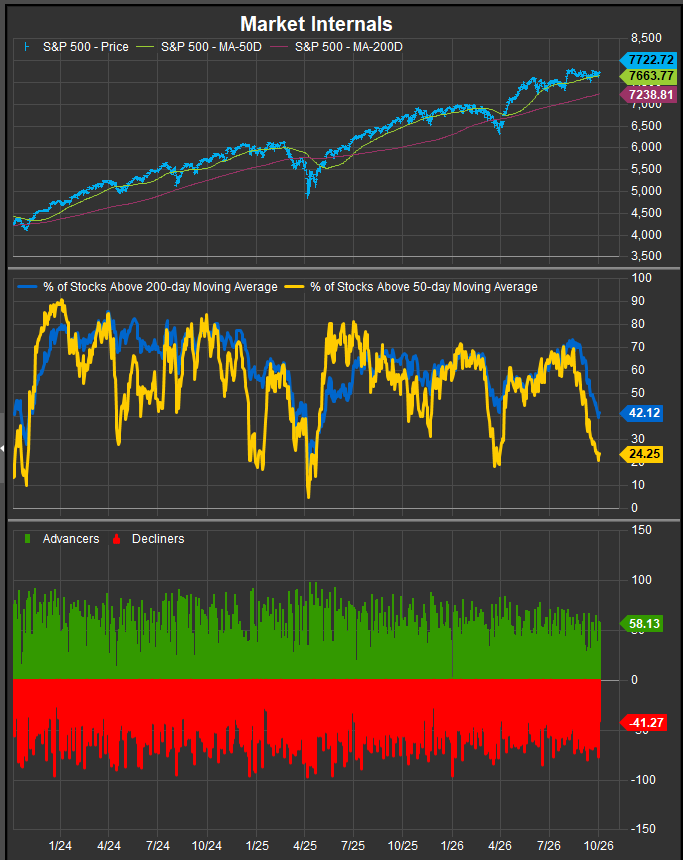
Chart: The last time our 50-day m.a. breadth reading was this low while the &P 500 was still near highs was November 2025. Correction followed shortly after.
The reason the S&P 500 can look so healthy despite such poor breadth is the extraordinary size of the AI complex. AI is no longer just a semiconductor trade. It now spans chip designers, memory, semiconductor equipment, hyperscalers, networking, power generation, utilities, engineering, cooling, data centers and the financing ecosystem supporting all of that investment. Weekend headlines again underscored the scale of the buildout, including estimates that global AI infrastructure spending could eventually reach tens of trillions of dollars, while investors continue to allocate capital toward AI-linked equities despite elevated bond yields. Pasted markdown That scale matters because the largest companies tied to this cycle now carry enough index weight to offset weakness across broad swaths of the market. In effect, the S&P 500 can continue making new highs even while many of its constituents are already in their own corrections.
That does not make the current setup immediately bearish, but it does make it more fragile. The attached chart should be viewed less as a market-timing signal and more as a measure of the market’s shrinking margin for error. Breadth at depressed levels after a 10%-15% index decline can be a sign of selling exhaustion. Breadth at depressed levels while the index is near an all-time high is different; it suggests that leadership is narrowing and that the benchmark is increasingly reliant on a relatively small group of companies to sustain the advance. The key question is whether the rest of the market begins to catch up to AI leadership or whether AI eventually catches down to the rest of the market. The weekend package already identified weak breadth and the prolonged underperformance of the equal-weight S&P 500 as one of the central bearish features of the current tape. Pasted markdown
The most constructive bullish pivot would be a decline in crude oil accompanied by credible progress toward Middle East de-escalation. Iran continues to keep the Strait of Hormuz closed pending negotiated conditions, attacks on shipping remain a live risk, and military tensions are still elevated, but diplomacy remains a viable path rather than a theoretical one. Pasted markdown The G7’s planned release of emergency oil and diesel inventories is also aimed at relieving price pressure. Pasted markdown A durable drop in crude would matter well beyond Energy because it would ease headline inflation, improve household purchasing power, reduce transportation and input costs and, most importantly, give the Treasury market a reason to rally. For sector investors, lower oil combined with lower long-term yields would create the cleanest path toward better breadth because it would improve the setup for rate-sensitive and cyclical groups such as Financials, Industrials, Consumer Discretionary and Real Estate without requiring Technology to weaken.
A second bullish pivot would be a sustained decline in long-duration Treasury yields. September payrolls rose only 29,000, unemployment edged higher and wage growth softened, all of which strengthened the case for the Fed to remain patient in October. Pasted markdown Yet the initial bond rally faded quickly. That is a key tell. If softer growth data cannot generate a durable decline in yields, then inflation concerns, fiscal supply and term-premium pressure are dominating the cyclical slowdown narrative. Conversely, if the 10-year begins to move lower as growth cools without triggering a recession scare, the market could broaden rapidly. That would be especially constructive for sectors that have struggled under higher discount rates even as the mega-cap AI complex has continued to outperform.
The clearest bearish pivot remains a disappointment in AI operating fundamentals. The market is no longer simply rewarding AI exposure; it is pricing in extraordinary execution. The bullish weekend narrative still rests on strong memory demand, infrastructure spending, hyperscaler capex and continued bottlenecks in key parts of the supply chain. Pasted markdown The problem is that these expectations are already very high. Investors should therefore focus less on AI announcements and more on operating economics: accelerator utilization, data-center deployment rates, cloud capex growth, memory pricing, networking demand, backlog conversion and evidence that AI spending is actually producing incremental revenue or durable margin expansion. If hyperscalers begin talking about longer payback periods, lower utilization, slower deployment or more disciplined capital spending, that would not remain an isolated company story for long. Given the concentration of the index, it could become a market-level event very quickly.
Investors should also watch four additional pivots. First, the bond market itself may become the most important confirmation signal. If increasingly weak economic data continue to fail to pull yields lower, equity valuation pressure will intensify because the discount-rate problem is not being solved by slower growth. Second, credit needs to be monitored closely. The weekend headlines noted both rising investment-grade yields and wider concern about financing risks tied to AI and data-center investment. Pasted markdown Narrow breadth can persist for some time, but narrow breadth accompanied by material credit-spread widening would be more concerning because it would indicate that financial conditions are deteriorating beyond the equity market itself. Third, consumer weakness could become a more important earnings problem. Wage growth has been soft, confidence has deteriorated and consumers are increasingly being asked to maintain spending in an environment where inflation is still outrunning income growth. Pasted markdown Nike’s disappointing FY27 guidance despite a low expectations bar is one recent example of how quickly weak forward demand can be punished. Pasted markdown Fourth, inflation remains the decisive macro pivot. A benign CPI report could validate the softer labor data and allow yields to decline; another upside inflation surprise would leave the Fed constrained, keep real rates high and force the market to lean even harder on AI earnings growth.
For the sector ETF operator, the next several weeks are less about guessing whether the S&P 500 is about to rise or fall and more about watching which side of the divergence resolves first. If crude falls, Middle East diplomacy improves, inflation cools and Treasury yields retreat, breadth should begin to recover and leadership could broaden into Financials, Industrials, Consumer Discretionary and Real Estate while Technology remains structurally strong. If instead yields remain elevated, credit conditions worsen, consumer fundamentals soften and inflation refuses to cooperate, the market will become even more dependent on AI to carry the index. And if those pressures coincide with weaker-than-expected AI operating fundamentals, today’s breadth readings would become far more ominous.
The S&P 500 does not currently need hundreds of stocks to make new highs. It needs a relatively small number of enormous companies to keep doing so. That has been enough to support the index. It may not be enough to protect it from a correction if leadership finally breaks.
Sources:
U.S. Bureau of Labor Statistics (BLS) — September Employment Situation / nonfarm payrolls, unemployment rate, labor-force participation and average hourly earnings. The markdown cites the payroll figures through a StreetAccount recap rather than linking directly to BLS. Pasted markdown
Federal Reserve / Federal Reserve Bank of Cleveland — President Beth Hammack’s comments regarding the October policy decision and incoming data. The markdown links to Reuters rather than an official Fed transcript or release. Pasted markdown
OPEC / OPEC+ — November oil-production policy and output targets. The markdown references the decision through Reuters. Pasted markdown
International Energy Agency (IEA) — coordination of the announced emergency oil and diesel stock release. Pasted markdown
G7 governments / French Presidency — announcement and details of the proposed emergency petroleum-product release, including comments attributed to French President Emmanuel Macron. Pasted markdown
White House / Office of the Director of National Intelligence — reported creation of the “Super Intelligence Force” addressing AI risks and U.S. technological leadership. The actual markdown source is Bloomberg, not an official release. Pasted markdown
U.S. Department of Energy — reported ~$4.2 billion loan to Vistra to support nuclear generation. The markdown links to Reuters. Pasted markdown
Government of Iran / Iranian officials — conditions for reopening the Strait of Hormuz and statements concerning diplomacy and potential retaliation. These appear through Reuters/CNBC rather than Iranian government documents. Pasted markdown
U.S. government / Department of Defense — reported military deployments, carrier movements and missile-defense deployments in the Middle East. Those facts are presented through media reporting rather than Pentagon releases. Pasted markdown
Nike investor relations / SEC filings — fiscal Q1 results, FY27 guidance and the Pace cost-savings program. The markdown summarizes these through StreetAccount rather than linking Nike’s earnings release or filing. Pasted markdown
Company investor-relations materials from Micron, Nvidia, HPE, TSMC, OpenAI and Google would be the appropriate primary sources for the AI-related earnings, capex, product and operating claims mentioned in the bullish-week recap, although the markdown itself does not provide those primary links.
Disclaimer
This material is for informational and educational purposes only and should not be considered investment advice, a recommendation to buy or sell any security, or an offer or solicitation to engage in any investment strategy. Market commentary reflects conditions and information available at the time of publication and may change without notice. References to sectors, ETFs, securities, economic indicators and market scenarios are illustrative and do not represent a complete analysis of all relevant risks. Past performance and historical market relationships are not guarantees of future results. Investors should consider their own objectives, risk tolerance, liquidity needs and tax circumstances and consult an appropriate financial professional before making investment decisions.