





COMMENTARY:
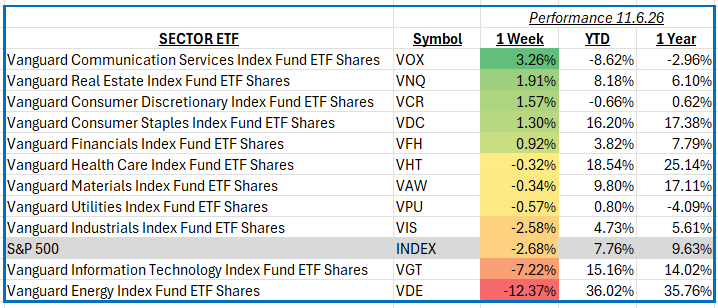
The S&P 500 declined 2.68% for the week ending November 5, 2026, as investors reassessed technology valuations, artificial intelligence (AI) spending, and the economic implications of the U.S. midterm elections. Technology shares faced significant selling pressure amid concerns about the sustainability of AI-related investment and the potential returns from massive data-center expenditures. Political uncertainty added to volatility following Democratic victories in the midterm elections. Meanwhile, stronger-than-expected employment data suggested continued economic resilience but raised questions about the Federal Reserve’s future interest-rate decisions.
Communication Services was the strongest-performing sector, gaining 3.26% and outperforming the S&P 500 by 5.94 percentage points. Gains in major internet and digital advertising businesses helped support the sector despite broader concerns about AI valuations. Alphabet and Meta Platforms remained important market drivers as investors weighed their substantial AI investments against their advertising revenue and growth prospects. Netflix and other major communication and entertainment companies also provided exposure to digital media and subscription-based businesses. Investors continued to evaluate whether AI-related spending would translate into sustainable earnings growth, particularly for companies operating large technology platforms.
Real Estate advanced 1.91%, supported by investor interest in income-producing assets amid shifting expectations for interest rates and economic growth. Real estate investment trusts benefited from the potential for lower borrowing costs over time, although Treasury yields remained sensitive to economic data and Federal Reserve policy expectations. Property owners with diversified portfolios and dependable rental income attracted attention as investors considered alternatives to high-growth technology stocks. Data-center real estate also remained relevant to the broader AI investment theme, although concerns about the costs and financing of technology infrastructure contributed to market uncertainty.
Consumer Discretionary gained 1.57%, demonstrating relative resilience during a difficult week for equities. Investors continued to assess consumer spending, corporate earnings, and the outlook for household demand. Amazon benefited from its combination of e-commerce and cloud-computing operations, while Tesla remained sensitive to changing expectations for electric-vehicle demand and technology investment. Other retailers and consumer-oriented businesses faced the challenge of balancing revenue growth against operating costs and potentially tighter financial conditions. Market participants remained focused on whether consumer demand could sustain corporate earnings momentum.
Information Technology fell 7.22%, while Energy declined 12.37%, making Energy the weakest of the two sectors. Technology shares suffered as investors questioned the valuations and financing requirements associated with AI infrastructure. Semiconductor companies, including Nvidia, AMD, and Intel, experienced substantial volatility as investors reassessed future demand and profitability. Energy stocks faced additional pressure from falling crude oil prices amid hopes for progress toward a diplomatic resolution of U.S.-Iran tensions. Weakness across oil producers and related businesses compounded concerns about commodity prices and earnings prospects.
Overall, the week highlighted the risks of concentrated market leadership, changing interest-rate expectations, and geopolitical uncertainty. Although select sectors delivered positive returns, investors remained cautious as they reassessed valuations and the outlook for corporate earnings.
