The market got everything it said it was waiting for — a Nvidia beat-and-raise, a record-breaking Anthropic IPO, an Oracle funding all-clear — and sold every one of them. The S&P 500 fell on all five sessions, dropped 8.6% to 6,910, and closed in correction territory for the first time since the April 2025 tariff shock. The Nasdaq Composite lost 10%, its worst week since March 2020, and gave back its entire 2026 gain. The Philadelphia Semiconductor Index fell roughly 17%. The VIX nearly doubled to about 40.
For sector investors, the headline matters less than the shape of the decline. All 11 sectors fell, but this was not a recession trade. It was a de-rating of the AI complex, and of everything that had been priced as a derivative of it, spreading outward from semis into the power, industrial and infrastructure names that had been the market’s favorite “rotation” beneficiaries.
What Broke: The AI Trade Meets Its Constraints
For most of the past two years, the AI trade has been priced as a demand story. This week the market repriced it as a constraints story: capital, regulation and governance all at once.
Regulation. On Monday, the Commerce Department’s Bureau of Industry and Security designated Indonesia, Malaysia, Singapore, Thailand and Brazil as “unacceptable risk of diversion” destinations, requiring export licenses for advanced chips and targeting foreign data centers that rent AI compute to Chinese firms. By Friday, Nikkei reported that at least two of Nvidia’s server partners had suspended shipments to Southeast Asian clients — an already constrained supply chain now shut off from one of the fastest-growing data center hubs in the world. Singapore said it was “studying the details” and engaging Washington. This is the part of the AI build-out that was supposed to diversify demand away from the U.S. hyperscalers. It just got a lot harder to underwrite.
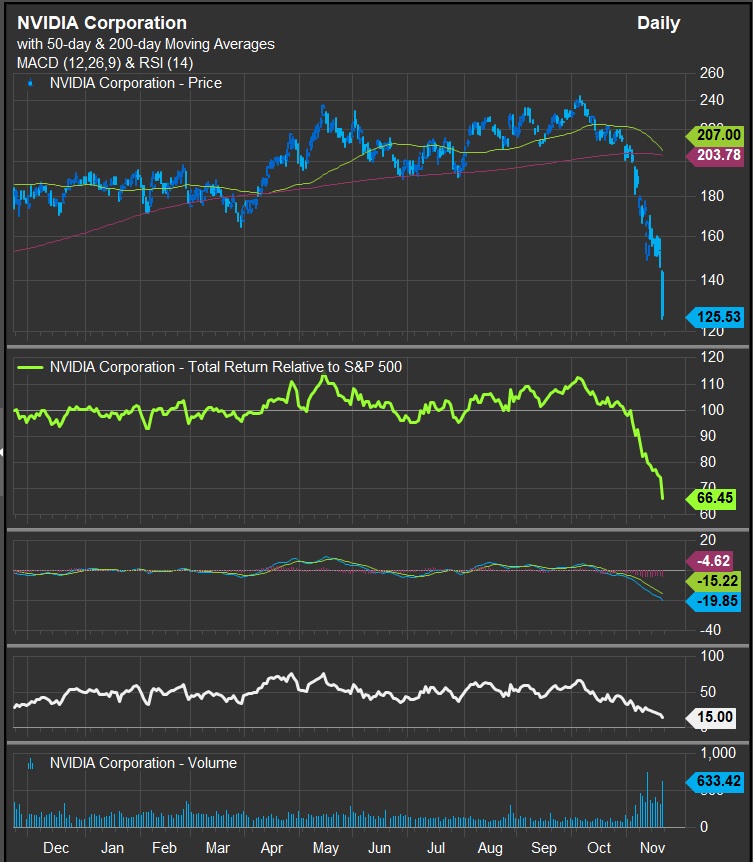
Governance and accounting. The SEC’s civil probe into Nvidia, first reported Tuesday as a disclosure inquiry, widened Friday when Reuters reported it is examining potential accounting issues. Nvidia shares hit intraday lows on the headline, down about 9% on the day, and finished the week down roughly 23% — after a quarter in which revenue grew 103%. Add the California Attorney General’s review, Treasury Secretary Bessent’s public demand for answers from the board within ten days on whether advanced chips were knowingly sold into China, and the company’s decision to file its 10-Q “in the coming weeks” rather than alongside earnings, and the market is now pricing a governance discount on the most important stock in the index.
Capital. Nvidia signaled it is dialing back its “bank of AI” role — the vendor financing and equity backstops that have quietly underwritten demand from neoclouds and model labs. AMD was hit by a Hunterbrook short report that tied China exposure to the broader circular-financing debate. When the supplier is also the lender, tighter terms at the top ripple down the entire customer stack.
The Clearing Events That Didn’t Clear
The bulls had a checklist, and on paper it was ticked off.
- Nvidia delivered $115.8 billion in quarterly revenue, well above guidance, guided Q4 to $130 billion, and raised its fiscal 2028 growth outlook to about 75% from 70% — despite fears it might pull the outlook entirely after Jensen Huang’s exit.
- Anthropic priced the largest IPO in history above its range at $83, opened at $111.50 and briefly touched a $2 trillion-plus valuation.
- Oracle said it has secured all the funding it needs to fulfill its OpenAI contract, called itself the first hyperscaler fully funded for this investment cycle, reaffirmed positive free cash flow in the back half of fiscal 2028 and targeted more than $30 billion of FCF in fiscal 2029 — a remarkable turn from roughly negative $24 billion of FCF in fiscal 2026.
And yet. The S&P fell 2% the day Anthropic debuted, and the selling accelerated Friday. Two mechanics matter here. First, a record IPO is a record supply event: funds raising cash to buy the new issue sold existing AI exposure to pay for it. Second, a consensus that “the bounce starts once the clearing events pass” leaves the path of least resistance pointing down when they pass and nothing changes. Good news that is fully expected is not a catalyst — it is an exit.
The Oracle statement deserves a second look, though. A hyperscaler declaring itself fully funded, with vendor financing “in place” and self-funded growth from FY29, is precisely the kind of capital-discipline signal the AI trade will eventually need. It didn’t matter this week. It may matter more in the next one.
Sector Scorecard
| S&P 500 Sector | Proxy ETF | Week |
|---|---|---|
| Technology | XLK | -12.5% |
| Communication Services | XLC | -8.0% |
| Materials | XLB | -7.5% |
| Industrials | XLI | -7.4% |
| Financials | XLF | -7.0% |
| Energy | XLE | -6.9% |
| Consumer Discretionary | XLY | -6.3% |
| Health Care | XLV | -6.2% |
| Real Estate | XLRE | -4.3% |
| Utilities | XLU | -3.1% |
| Consumer Staples | XLP | -2.1% |
| S&P 500 | -8.6% |
Sector index returns, week ended Nov. 20; ETF returns may differ slightly.
Three things stand out:
- The AI derivatives broke with the leaders. Memory and storage were hit hardest (Sandisk, Micron and Marvell all fell more than 20%). AI-power plays in industrials and utilities — Vertiv, GE Vernova, Constellation Energy — fell 13% to 18%. The “rotation” trade into the picks-and-shovels of AI turned out to be the same trade wearing a different sector label, and it was already under valuation scrutiny before this week.
- Defensives worked, but only the real ones. Staples were the clear relative winner, with Walmart, P&G and Costco barely moving. Health care, often treated as a safe haven, fell 6.2% with UnitedHealth down sharply. Defensive by label is not the same as defensive by cash flow.
- Breadth was better than the index. Small caps and the equal-weight S&P 500 fell less than the cap-weighted benchmark. In a genuine growth scare, small caps usually lead to the downside. This looks like a de-rating of concentration, not a bet on recession.
Implications for Sector Investors
1. Separate the AI earnings story from the AI multiple story. Nvidia raised guidance and lost a quarter of its value. Several firms now note that the multiple compression in semis implies negative EPS growth, while forward estimates are still rising. The Nasdaq 100, tech sector and chip index are at multi-year lows relative to forward earnings. That gap does not close until the governance and export-control overhangs get clearer, but it is the raw material of the next leg up.
2. Treat “AI-adjacent” as AI exposure. The power, cooling, electrical-equipment and memory names in industrials, utilities and tech fell as hard as or harder than the chip leaders. Investors who rotated into VIS or VPU for diversification from the AI trade should check what is actually inside those funds. Equal-weight versions of the sector funds offer a cleaner way to own the sector without owning the AI concentration.
3. Defensives earned their keep — favor quality over labels. Staples did what they are supposed to do. Health care did not, largely because of idiosyncratic managed-care risk. In a risk-off tape, the steadiest cash flows matter more than the sector name.
4. Energy is a supply story. With the geopolitical premium unwinding and surplus forecasts building, energy equities are not the hedge against Middle East risk they were earlier in the year. Any re-escalation would be the upside surprise, not the base case.
Outlook
The bear case is coherent: regulatory, governance and financing constraints are hitting the AI complex simultaneously, and the “clearing events” are behind us. The bull case is coherent too: hedge funds have been net sellers of semis for an extended stretch, CTAs have flipped net short the Nasdaq 100, valuations have reset faster than earnings, the consumer is holding up, and strategists’ 2027 S&P 500 targets cluster around 8,700 — roughly 25% above Friday’s close.
When positioning is this washed out, sharp relief rallies are likely. But a durable bottom in the AI complex probably needs one of two things: clarity on the Nvidia investigation and 10-Q or a workable licensing path for Southeast Asian data centers. Until one of those arrives, we would expect leadership to stay narrow and defensive, with breadth — equal weight and small caps — continuing to outperform the cap-weighted indices.
What we are watching in the holiday-shortened week ahead: Black Friday and Cyber Monday spending reads; Nvidia’s board response to Washington’s ten-day deadline and the timing of its 10-Q; any guidance from Commerce on the license process for Southeast Asia; and whether the equal-weight S&P can hold its relative strength if mega-caps stage a bounce.
The tape told us something important this week: the market is no longer paying for AI demand. It is paying for AI certainty. Sector investors should position for that distinction.
Sources
- Reuters, “US SEC’s Nvidia probe is examining potential accounting issues, sources say,” Nov. 20, 2026
- Nikkei Asia, “Nvidia server suppliers halt Southeast Asia shipments over US curbs,” Nov. 2026
- Oracle, corporate statement on X regarding OpenAI contract funding, Nov. 2026
- Wall Street Journal (via InvestmentNews and Benzinga), reporting on SEC civil probe of Nvidia disclosures, Nov. 17, 2026
- Al Jazeera, “US moves to block China’s remote access to AI chips amid Nvidia scandal,” Nov. 17, 2026
- South China Morning Post, “Southeast Asia scrambles as US chip curbs threaten AI data centre boom,” Nov. 2026
- NVIDIA, Q3 Fiscal 2027 earnings release and conference call, Nov. 17, 2026
- Fox Business, NPR and TechRepublic, coverage of Anthropic’s Nasdaq IPO, Nov. 18–19, 2026
- AI Weekly / Bloomberg, coverage of Oracle free cash flow targets, 2026
- STL News, The Closing Print and Atrani Capital, weekly U.S. market and sector performance summaries for Nov. 16–20, 2026
- Edward Jones, Daily Market Recap, Nov. 2026
- Myrtle Tree Investment Research weekly market notes
Important Disclosures
The information in this commentary is drawn from sources believed to be reliable, including third-party news and market data, but its accuracy and completeness are not guaranteed. Opinions and outlooks reflect the author’s views as of the date of publication and are subject to change without notice. Any references to specific companies, sectors or exchange-traded funds are for illustrative purposes only. Sector and index returns cited are for the periods stated, do not reflect fees or expenses, and may differ from the returns of any ETF tracking them. Indexes cannot be invested in directly.
This commentary is for informational purposes only and does not constitute investment advice.