


February 17, 2026
S&P futures are down 0.2% following a week in which equities finished mostly higher Friday but closed lower overall. The Nasdaq fell more than 2% last week, marking its fifth straight weekly decline. The Mag 7 dropped over 3%, while banks were also pressured. AI-disruption concerns weighed on trucking, CRE brokers, wealth managers, data services, and office REITs, while Utilities, Real Estate, Materials, Energy, and Consumer Staples outperformed.
Overnight, Asian markets were mixed in thin Lunar New Year trading. European equities are up ~0.2%. Treasuries are firmer with yields down 2–3 bp. The dollar index is up 0.2%. Gold is down 2%, silver off 4.3%, Bitcoin futures lower by 1%, and WTI crude up 0.9%.
The macro narrative is largely unchanged. Focus remains on AI disruption risk, Mag 7 underperformance, elevated single-stock volatility, and defensive rotation. At the same time, January employment and inflation data were solid, productivity trends are improving, and earnings growth remains double-digit. Geopolitical tensions and white-collar job displacement concerns continue to simmer.
On today’s calendar: February Empire State manufacturing and the NAHB housing index. Fed Governor Barr speaks at 12:45 on AI and labor markets, followed by Daly at 14:30 on AI and the economy. The rest of the week includes durable goods, housing starts, industrial production, FOMC minutes (Wednesday), initial claims and trade data (Thursday), and Q4 GDP, PCE inflation, flash PMIs, and University of Michigan sentiment (Friday). Multiple Fed speakers are scheduled throughout the week, and SCOTUS could release an IEEPA tariff ruling.
Corporate Highlights
- Apple (AAPL) – Holding product event on 4-Mar; new MacBook Pros expected among announcements.
- Micron Technology (MU) – Financial press reports company plans to spend $200B to address AI memory bottlenecks.
- Anthropic – Axios reports Pentagon may cut business ties and designate firm a “supply chain risk” over model limitations.
- Alibaba Group (BABA) – Unveiled major upgrade to flagship AI model, Qwen3.5.
- Warner Bros. Discovery (WBD) – Reportedly considering reopening negotiations with PSKY amid regulatory concerns tied to NFLX deal.
- Danaher Corporation (DHR) – FT reports company nearing $10B acquisition of Masimo Corporation (MASI).
- ZIM Integrated Shipping Services (ZIM) – To be acquired by Hapag-Lloyd for $4.2B.
- Norwegian Cruise Line Holdings (NCLH) – Boosted by report activist Elliott has taken a 10%+ stake.
- Tripadvisor (TRIP) – Activist Starboard reportedly planning to nominate majority slate to board.
Overall tone remains cautious, with rotation dynamics and AI disruption debates continuing to drive relative performance beneath a broadly stable macro backdrop.
Markets ended a volatile week on a steadier note (Dow +0.10% | S&P 500 +0.05% | Nasdaq -0.22% | Russell 2000 +1.18%) following a broadly in-line January CPI report that modestly reinforced the soft-landing narrative. Headline CPI rose 0.2% m/m, easing from December’s 0.3% pace and matching consensus expectations, helped by lower energy prices. Core CPI increased 0.3% m/m, also in line, while the 2.5% y/y reading marked the lowest annual core inflation print in nearly five years. Concerns around residual seasonality proved unfounded, and Treasuries rallied across the curve, with 2-year and 10-year yields both declining 5 bps to 3.41% and 4.05%, respectively.
The rate move supported defensives and rate-sensitive sectors. The yield curve flattened, the dollar was little changed (DXY 96.85), and commodities strengthened—gold surged 2.2% to $5,056 while silver gained 3.0%. Bitcoin futures rebounded 5.2%, though remain lower week-to-date.
The week’s broader macro narrative remained complex. January nonfarm payrolls (+130K vs 65K consensus) suggested labor stabilization, while December retail sales disappointed (headline flat m/m; control group -0.1%). Consumer balance sheet concerns resurfaced with NY Fed data showing 4.8% of debt in delinquency. Meanwhile, deficit projections widened after the CBO estimated cumulative deficits through 2035 would exceed prior estimates by $1.4T.
Policy headlines leaned incrementally constructive. Reports of potential tariff relief on steel and aluminum, combined with upbeat commentary from the BofA Financials Conference around C&I loan momentum and improving CEO sentiment, provided some offset to persistent concerns around AI-driven labor disruption and margin compression.
Sector Highlights
Sector performance reflected the week’s “broadening out” theme. Rate-sensitive defensives led, with Utilities (+2.69%) and Real Estate (+1.48%) outperforming as yields declined. Materials (+1.10%), Healthcare (+1.01%), Industrials (+0.83%), and Energy (+0.54%) also advanced.
Underperformance was concentrated in Communication Services (-0.76%) and Technology (-0.52%), as mega-cap growth remained pressured amid continued scrutiny of AI capex returns and competitive disruption risk. Financials (-0.07%) were modest laggards despite better macro takeaways midweek, reflecting softness in larger banks and insurers.
Breadth was firmly positive (NYSE 2.7:1), and the equal-weight S&P outperformed, underscoring rotation away from index-heavy mega-cap concentration.
Information Technology
AI-related earnings were a bright spot despite broader mega-cap sluggishness.
- Applied Materials (AMAT) rose 8.1% following a strong beat and guidance for >20% semiconductor equipment growth in 2026, citing AI-led demand across foundry/logic and advanced packaging.
- Arista Networks (ANET) gained 4.8% after raising 2026 growth guidance by 5pp to 25%, highlighting AI-driven networking demand.
- Twilio (TWLO) advanced 2.0% on strong organic growth and FCF upside.
- On the downside, Pinterest (PINS) fell 16.9% on weaker European revenues and softer margin outlook.
Mega-cap tech remained pressured, with NVDA and AAPL among the notable drags as investors continued reassessing AI capex intensity and potential white-collar automation risks.
Consumer Discretionary
Results were mixed amid evidence of softer retail momentum.
- Airbnb (ABNB) gained 4.7% on strong bookings and margin expansion.
- Expedia Group (EXPE) fell 6.4% despite beating Q4 metrics, as 2026 growth guidance disappointed.
- Rivian (RIVN) surged 26.6% on improved gross margins and reaffirmed R2 delivery timeline.
- DraftKings (DKNG) declined 13.5% following softer 2026 guidance.
- Wynn Resorts (WYNN) rose 5.1% as Las Vegas performance offset Macau softness.
Housing-linked names strengthened, highlighted by Tri Pointe Homes (TPH), which jumped 26.8% on a $4.5B acquisition by Sumitomo Forestry.
Financials
Performance was subdued, with pressure in larger-cap banks and insurers.
- Coinbase (COIN) rallied 16.5% despite earnings softness, as investors focused on profitability resilience and stablecoin momentum.
- Exchanges and custody banks outperformed within the group, benefiting from volatility-driven activity.
Industrials
Mixed results reflected ongoing short-cycle uncertainty.
- Ingersoll Rand (IR) gained 4.6% on better Q4 profitability and constructive M&A commentary.
- Cohu (COHU) fell 6.7% on an inventory charge despite stable demand commentary.
- Aerospace, machinery, and engineering services names generally benefited from AI infrastructure and data center-related demand trends.
Healthcare
Biotech and managed care were firm.
- Moderna (MRNA) rose 5.3% after beating expectations and reaffirming 2026 growth.
- Vertex Pharmaceuticals (VRTX) added 5.7% despite mixed earnings, supported by franchise stability.
- Dexcom (DXCM) gained 7.6% on earnings upside and steady guidance.
Communication Services
Pressure in digital advertising and AI-disruption narratives weighed on performance, particularly among social media and internet platforms.
Energy
Crude settled flat at $62.84. Energy equities modestly outperformed the index amid stabilization in oil prices and strength in energy infrastructure and power-generation names tied to AI-related electricity demand.
Eco Data Releases | Tuesday February 17th, 2026

S&P 500 Constituent Earnings Announcements | Tuesday February 17th, 2026
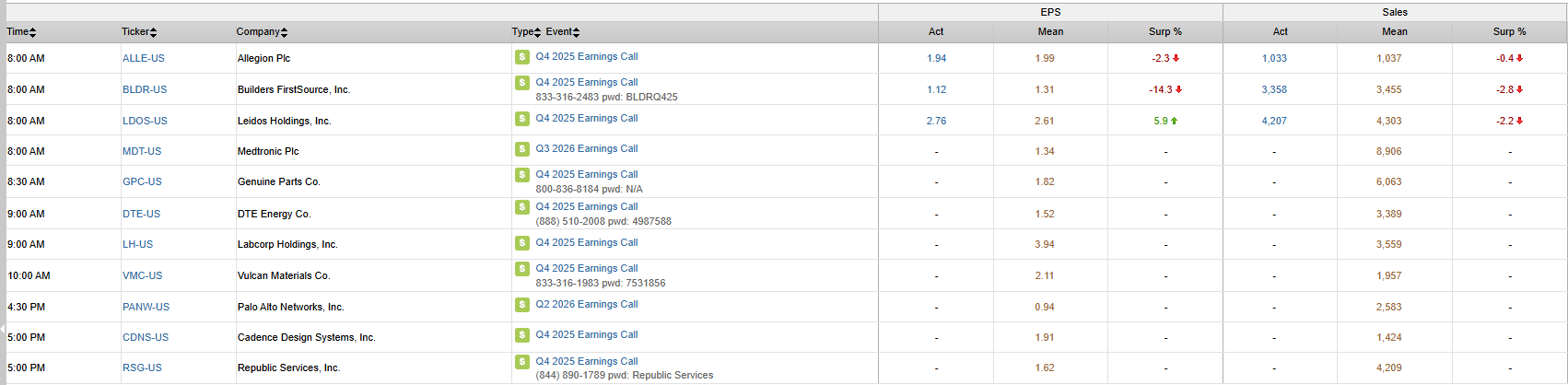
Data sourced from FactSet Research Systems Inc.
