



The AI trade faces a focused test after the close today, with Super Micro Computer (SMCI) and CoreWeave (CRWV) both scheduled to report earnings. This is not just another semiconductor-adjacent earnings night. It is a direct read-through on whether AI server demand, GPU cloud capacity and hyperscaler infrastructure spending remain strong enough to keep the AI buildout at the center of sector leadership.
The setup is simple: demand expectations are already high, but the market is becoming more selective about how that demand translates into margins, cash flow and balance-sheet risk. AI infrastructure spending is still rising, with Nvidia announcing this week that it is partnering with major financial institutions to create compute-financing platforms aimed at raising more than $500 billion for AI infrastructure. Reuters also noted that Big Tech AI infrastructure spending is expected to exceed $730 billion this year.
That supports the long-term demand story. But it also raises the bar. Investors no longer need companies to prove that AI server demand exists. They need proof that AI demand can be delivered profitably, financed responsibly and converted into durable revenue.
Why SMCI Matters
SMCI is the AI server execution test. The company already gave investors a preview on July 21, saying fiscal fourth-quarter revenue would likely come in near the low end of its prior $11.0 billion to $12.5 billion guidance range. That was a negative signal for near-term revenue conversion. But the same update included two important positives: expected gross margins of 15% to 17%, far above prior guidance, and more than $60 billion of new orders during the quarter.
That combination is why tonight matters. If SMCI can show that the revenue shortfall was a timing issue rather than a demand issue, and if it can defend the higher margin profile, the stock can help stabilize the AI hardware trade. If the report points to supply-chain friction, customer timing delays, working-capital pressure or margin volatility, investors may treat the $60 billion order figure as less immediately valuable.
What is priced in for SMCI is volatility, not full confidence. Options pricing suggested the stock could move up to 12% in either direction by the end of the week, while analysts expected roughly $11.55 billion in fiscal fourth-quarter revenue and adjusted EPS of $0.94. The same report noted that SMCI was nearly 40% below its June highs, reflecting investor concerns around a recent fundraising effort and lingering skepticism toward the story.
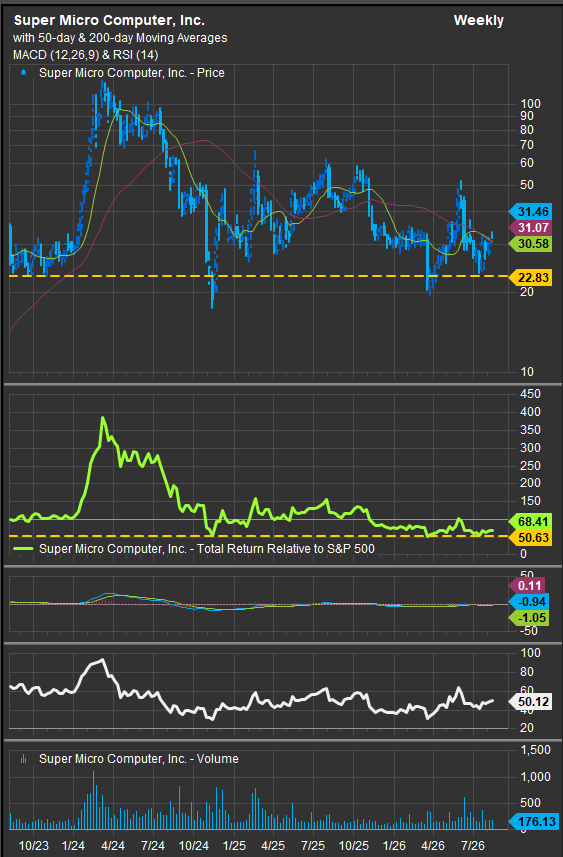
Chart: SMCI has retraced to long-term support after a big run-up in 2023. This week’s results should be a good indication of whether the most speculative AI names are gaining real fundamental traction.
For SMCI to keep the AI trade on the front burner, the report needs to show three things: backlog conversion, margin durability and clean guidance. The market will likely look past a revenue miss if management can show that demand remains supply-constrained rather than customer-constrained. It will be less forgiving if higher backlog comes with weaker cash conversion or another round of financing questions.
Why CoreWeave Matters
CoreWeave is the AI cloud-capacity test. The company is one of the cleanest public-market gauges of demand for outsourced GPU compute. CoreWeave is scheduled to discuss second-quarter results today at 5:00 p.m. ET, and investors are looking for evidence that revenue growth, contracted capacity and customer demand are keeping pace with the cost of its rapid buildout.
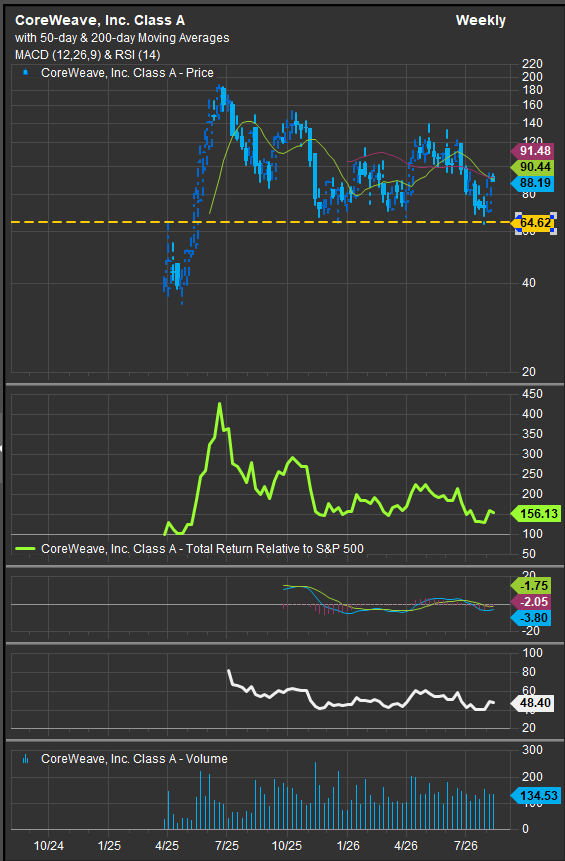
Chart: CRWV is a newer entrant with the same technical signature as SMCI. Speculation has given way to skepticism, but the stock is poised to rally with a clear catalyst.
The demand backdrop is strong. In Q1, CoreWeave reported revenue of $2.078 billion, up from $982 million a year earlier, and disclosed revenue backlog of $99.4 billion. Management also said the company had surpassed 1 GW of active power and expanded contracted power to more than 3.5 GW.
That scale is impressive, but it comes with a financing test. CoreWeave’s Q1 release showed a net loss of $740 million, interest expense of $536 million, and adjusted EBITDA of $1.157 billion. The company also highlighted an $8.5 billion delayed-draw term loan facility and a $2 billion common-stock investment from Nvidia.
That is the core tension around CRWV: the company may be sitting on massive demand, but the market is watching whether that demand can support the debt, depreciation and power commitments required to scale. Barron’s reported that analysts expect CoreWeave to post roughly $2.6 billion in Q2 revenue, representing about 111% year-over-year growth, while profitability is not expected until 2028.
For CoreWeave to keep the AI trade moving, it needs to show more than backlog. It needs to show activated capacity, high utilization, rising revenue visibility, progress toward operating leverage and a financing structure that does not make growth feel circular. The market wants to know that AI cloud demand is expanding faster than the company’s capital burden.
What the Market Already Believes
The market is already pricing in strong AI server demand. That is why SMCI’s $60 billion order disclosure did not fully repair sentiment, and why CoreWeave’s nearly $100 billion backlog does not eliminate concern about cash burn. The debate has shifted from “Is there demand?” to “Can this infrastructure cycle earn its cost of capital?”
Reuters analysis earlier this summer showed why that question matters. Hyperscalers including Microsoft, Alphabet, Amazon, Meta and Oracle are expected to spend more on capex than they generate in free cash flow by 2027, with current-year capex estimates for the group rising from roughly $485 billion in January to around $730 billion in July.
That is the macro overhang for the AI trade. Infrastructure spending is still booming, but investors are increasingly asking whether AI revenue, cloud utilization and productivity gains can grow fast enough to justify the spending. As one market strategist quoted by Reuters put it, companies need to show AI is driving incremental revenue, expanding margins and improving cash flow over the next two to three years, or investors will begin questioning whether the cycle has gone too far.
What Results Need to Show
To keep AI infrastructure leadership intact, SMCI and CRWV need to deliver a shared message: demand remains real, supply remains tight and unit economics are improving.
For SMCI, the key metrics are revenue guidance, gross margin, backlog conversion, customer concentration, working capital and whether the $60 billion order figure is translating into near-term shipments. The ideal report would show that the low-end revenue outcome was caused by timing, not weakening server demand.
For CoreWeave, the key metrics are Q2 revenue growth, backlog growth, activated power, utilization, capital spending, interest expense, adjusted EBITDA margin and guidance. The ideal report would show that CoreWeave is adding capacity fast enough to meet demand without letting financing costs overwhelm the model.
For the broader AI trade, investors need confirmation that the server supply chain remains demand-constrained, not financing-constrained. Nvidia’s $500 billion compute-financing initiative reinforces the scale of the opportunity, but it also highlights how capital-intensive the next phase has become.
Sector and ETF Read-Through
A clean set of reports would support continued leadership in semiconductors, technology hardware, data-center infrastructure, power equipment, cooling, networking and AI-adjacent industrials. It would also help preserve investor confidence in the broader AI capex cycle that has supported technology and communication services leadership.
The most bullish outcome would be strong CoreWeave guidance, better SMCI margin durability, no signs of server-order cancellations, and evidence that customers are still pulling forward AI infrastructure capacity. That would keep AI infrastructure as a front-burner sector theme.
The more cautious outcome would be a split tape: strong headline demand, but weaker cash flow, lower utilization, delayed deployments or higher financing needs. That would not kill the AI trade, but it would likely narrow leadership toward companies with cleaner margins, stronger balance sheets and less need for external capital.
The bearish outcome would be any sign that AI server demand is decelerating, backlog is becoming less reliable, or customers are delaying capacity commitments. That would shift the market’s focus from “AI scarcity” to “AI overbuild,” and it would raise the risk of a broader reset across semiconductors, server hardware, power infrastructure and AI cloud names.
Tactical Tuesday Takeaway
SMCI and CoreWeave are not being asked to prove that AI is real. They are being asked to prove that the AI infrastructure cycle remains investable at today’s expectations.
The AI trade can stay on the front burner if SMCI confirms profitable backlog conversion and CoreWeave confirms that massive contracted demand is turning into activated, revenue-producing capacity. Strong demand alone is no longer enough. The next phase of the trade requires evidence of execution, utilization, margin stability and financing discipline.
For sector investors, the message is to stay engaged with AI infrastructure, but keep in mind that investors are now demanding tangible results on converting demand into profit. The weakest links are likely to be companies where revenue growth depends on constant capital access, narrow customer concentration or margins that cannot keep pace with infrastructure intensity.
Sources
- Super Micro Computer investor relations
- CoreWeave investor relations and SEC filings
- Reuters AI infrastructure, hyperscaler capex and market reporting
- Barron’s CoreWeave earnings preview
- Investopedia SMCI earnings preview
Disclaimer: This article is for informational and educational purposes only and should not be considered investment advice. Individual stocks and sector ETFs can be volatile around earnings. Investors should consider risk tolerance, valuation, liquidity and portfolio objectives before making investment decisions.
