Semiconductor earnings and infrastructure investment continue to accelerate, but rising financing costs, uneven consumer demand, and inflation are creating a widening divide between AI-driven growth and the broader economy.
The AI Trade Is Stronger Than the Growth Factor
The defining characteristic of the U.S. equity market in 2026 is the extraordinary earnings growth of the artificial intelligence complex relative to the rest of the economy. Yet this week’s factor charts reveal an important distinction: AI-related earnings leadership is not translating into broad Growth-factor leadership. Investors are rewarding companies with exceptional revenue trajectories and exposure to capital investment while simultaneously penalizing businesses facing rising financing costs, weaker consumer demand, and margin pressure.
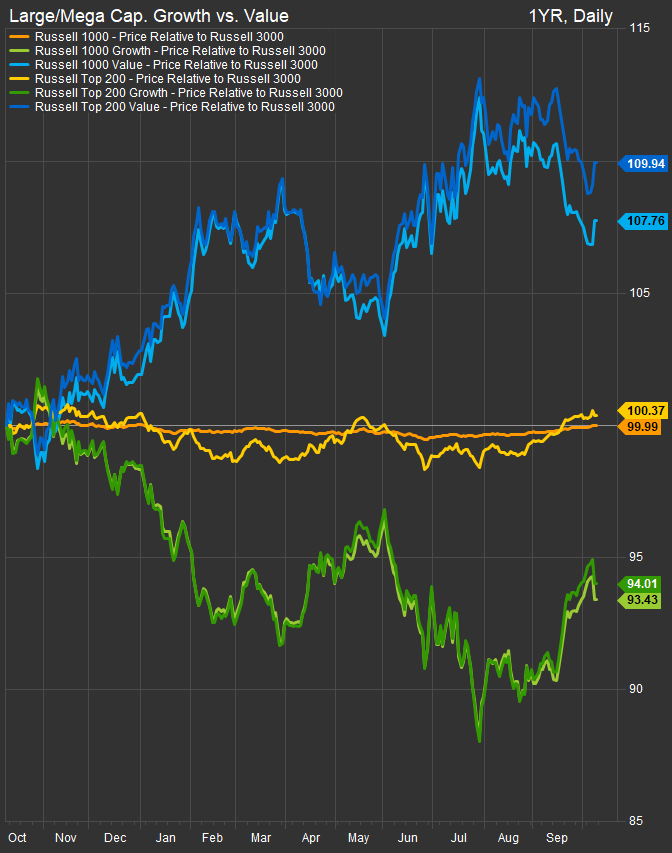
Over the trailing year, the Russell Top 200 Value and Russell 1000 Value indexes have outperformed the Russell 3000 by approximately 9.94% and 7.76%, respectively. Their Growth counterparts have underperformed by approximately 5.99% and 6.57%. Meanwhile, the PHLX Semiconductor Index has outperformed the S&P 500 by an extraordinary 75.90%. This divergence illustrates why conventional Growth-versus-Value classifications are becoming less useful as proxies for the AI investment cycle. Investors are not buying Growth indiscriminately; they are rewarding an increasingly specific collection of businesses whose earnings are being transformed by AI demand.
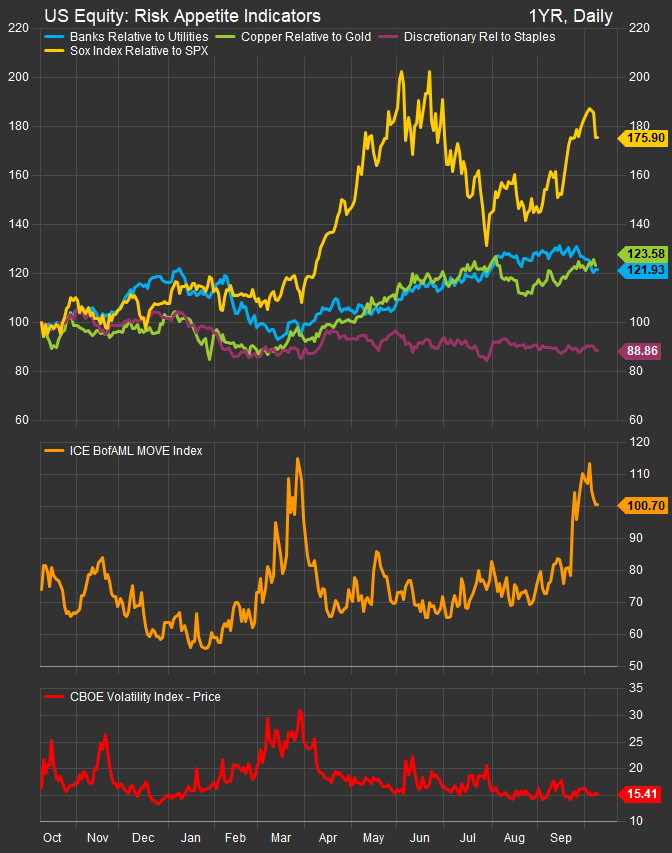
The broader factor complex confirms that speculative appetite has not disappeared. The Invesco S&P 500 High Beta ETF has outperformed the S&P 500 by 16.83%, while the iShares MSCI USA Momentum Factor ETF has generated 7.49% of excess return. Low Volatility has underperformed by 13.72%. Banks have outperformed Utilities by 21.93%, and Copper has outperformed Gold by 23.58%. These relationships are consistent with an economy still experiencing strong nominal growth and substantial capital investment, rather than one already transitioning into recession. The exception is Consumer Discretionary relative to Staples, which has underperformed by 11.14%, suggesting that risk appetite is concentrated in investment-related industries rather than broad household spending.
AI Earnings Are Delivering, but Capital Requirements Are Escalating
This week’s corporate announcements provide compelling evidence that AI infrastructure demand remains exceptionally strong. Taiwan Semiconductor Manufacturing reported September revenue growth of 54.6% year over year, while Samsung Electronics projected third-quarter operating profit of approximately KRW 107.4 trillion, nearly nine times the year-earlier figure. Penguin Solutions reported fiscal fourth-quarter sales growth of 68% and raised its fiscal 2027 revenue outlook to approximately $2.43 billion at the midpoint. Applied Digital reported quarterly revenue growth of 322%, reflecting rapid expansion of its data-center operations, although its $221 million net loss highlights the substantial costs associated with developing that infrastructure.
These results are important because they demonstrate that AI infrastructure spending is generating actual revenues and profits for suppliers. The more difficult question is whether the companies ultimately purchasing that computing capacity can earn attractive returns on increasingly expensive investments. OpenAI illustrated this tension during the week. Reports that its annualized revenue was approaching $50 billion in September initially unsettled investors, given expectations surrounding a $70 billion figure. Subsequent reporting indicated that the company was targeting approximately $70 billion in annualized revenue by year-end. Differences in timing and reporting methodology complicate comparisons, but the larger investment question remains: How quickly can AI applications produce sufficient cash flow to justify the infrastructure being financed today?
The financing announcements are becoming as consequential as the earnings releases. Banks reportedly launched syndication of a $60 billion financing package supporting Anthropic’s access to advanced chips, while Broadcom has been exploring additional multibillion-dollar financing tied to OpenAI’s custom silicon. SpaceX is reportedly seeking approximately $40 billion to purchase Nvidia hardware, and SoftBank is exploring a potential fundraising effort of up to $100 billion from Gulf investors. These proposed transactions follow SoftBank’s completion of $30 billion in additional OpenAI investments earlier this month. At the same time, the withdrawal of AI infrastructure developer Firmus’s planned public offering indicates that private-market demand for computing capacity does not necessarily translate into unlimited public-market appetite for infrastructure valuations.
The AI investment cycle is increasingly becoming a contest between revenue acceleration and the cost of capital. The demand opportunity may remain enormous, but highly leveraged infrastructure projects face a different set of economics than cash-generative semiconductor suppliers and established cloud platforms. Rising credit spreads, debt-service expenses, and potential funding constraints could become more important drivers of AI equity valuations even if end-user adoption continues to grow.
Outside AI, Earnings Growth Is Positive but Uneven
The broader earnings outlook is considerably stronger than conventional recession indicators might suggest. FactSet estimates S&P 500 third-quarter earnings growth of approximately 29.5%, with revenue expected to increase 12.3%. All 11 sectors are projected to deliver positive year-over-year earnings growth, and the number of companies issuing positive earnings guidance has reached a record high. However, Information Technology alone accounts for 44 of the 72 companies issuing positive guidance, while the sector is expected to generate approximately 65% earnings growth.
More revealing is the direction of earnings revisions. FactSet reports that analysts raised third-quarter estimates for Energy by 18% and Information Technology by 3.5%, but reduced forecasts in eight of the eleven sectors, including Materials by 10.2%, Consumer Staples by 4.0%, and Health Care by 3.3%. Consequently, aggregate earnings growth remains exceptional even though the underlying trend across much of the economy is less encouraging.
The week’s consumer earnings reinforce that distinction. PepsiCo reported 3.1% organic revenue growth and only 2% core EPS growth, while reducing its full-year core EPS growth outlook to 2.5%-3.5%, reflecting continued pressure on operating economics. Delta Air Lines reported record September-quarter revenue and resilient travel demand, but its annual outlook must absorb approximately $6 billion in additional fuel costs. Levi Strauss reported 5% organic revenue growth, while Constellation Brands delivered 6% sales growth, demonstrating that selective consumer businesses can still expand through product innovation, market-share gains, and pricing discipline.
For sector investors, these results suggest that the consumer economy is neither collapsing nor experiencing the exceptional acceleration evident in the AI complex. Demand is holding up in selected categories, particularly premium experiences and differentiated brands, but inflation is limiting operating leverage. Reports of softer iPhone demand amid rising memory costs provide a particularly striking example of AI’s economic spillovers: The same semiconductor shortages benefiting hardware suppliers are raising input costs for consumer electronics manufacturers and potentially suppressing end-market demand.
The contrast also extends to Energy, Industrials, Financials, and Utilities. Higher crude prices are supporting Energy-sector earnings and selected refining businesses while simultaneously pressuring transportation companies, consumer purchasing power, and inflation expectations. Financials are benefiting from a comparatively favorable nominal-growth environment, although the upcoming bank earnings season will test credit quality and funding conditions. Industrials retain opportunities tied to aerospace, defense, electrification, and infrastructure investment, but businesses dependent on ordinary manufacturing demand remain more vulnerable. Utilities occupy an especially interesting position: Alphabet’s Google and Constellation Energy announced a long-term agreement supporting 890 megawatts of additional nuclear capacity, yet the broader sector remains vulnerable to elevated bond yields and capital costs.
Why the VIX Is Calm While the Bond Market Remains Unsettled
The third factor chart captures perhaps the most consequential cross-asset contradiction in today’s market. The VIX stands near 15.41, suggesting relatively subdued near-term equity volatility, while the ICE BofA MOVE Index remains elevated at approximately 100.70. Equity investors appear comfortable underwriting earnings growth despite substantial uncertainty surrounding interest rates, inflation, and corporate borrowing costs.
The Federal Reserve’s September meeting minutes explicitly identified heavy private debt issuance for AI infrastructure as a potential contributor to higher Treasury term premiums and yields. Combined with renewed energy-price pressure and persistent inflation, this creates an unusual feedback loop. The AI capital-investment boom supports corporate earnings and economic expansion, but it also contributes to financing demand that may keep rates elevated, compress valuation multiples, and pressure the profitability of the very infrastructure companies driving the expansion.
Quality performance offers an additional warning about the limits of diversification. S&P 500 Quality has outperformed the Russell 3000 by only 1.36%, while mid-cap and small-cap Quality have underperformed by approximately 4.99% and 5.08%, respectively. International Quality has underperformed by 10.56%. The market is not rewarding financial quality uniformly; size, liquidity, earnings visibility, and access to affordable capital matter considerably. Smaller businesses with sound operating fundamentals can still struggle when capital-intensive investment and higher interest rates favor larger competitors.
Sector Positioning: The Next Rotation Depends on Earnings Breadth and Inflation
Our preference remains for businesses with strong realized earnings growth, durable competitive advantages, and sufficient financial flexibility to fund their expansion. Within Technology, that favors selective semiconductor, memory, networking, and infrastructure suppliers where revenue growth and operating cash flow support valuations. The financing announcements argue against treating all AI infrastructure exposure as equivalent, particularly where projected earnings depend heavily on aggressive capacity expansion and inexpensive external financing.
Energy remains a useful portfolio hedge against inflation and geopolitical disruption, even if longer-term oil demand and capital discipline present different challenges across subsectors. Financials can continue benefiting from nominal growth and a resilient credit environment, although rising funding costs warrant monitoring. Industrials and selected power-generation businesses offer attractive longer-term exposure to electrification, defense, and infrastructure investment, but broad-based leadership in Industrials, Utilities, and Real Estate would be more convincing if crude prices and Treasury yields began to stabilize. Consumer Discretionary should remain selective, favoring businesses with pricing power and identifiable volume growth rather than relying on a generalized consumer recovery.
The important pivot points are now increasingly measurable. Continued acceleration in AI supplier revenues and enterprise adoption would support the existing investment cycle, but a deterioration in infrastructure financing terms or disappointing utilization economics could destabilize a heavily concentrated source of market earnings growth. Lower crude prices, improving inflation expectations, and declining bond volatility would create a much more favorable environment for earnings growth to broaden into consumer, industrial, housing-related, and rate-sensitive businesses. Conversely, sustained oil inflation and renewed monetary tightening would risk leaving the non-AI economy increasingly dependent on a narrow set of earnings leaders.
The central investment question is no longer whether AI is growing fast enough to support strong earnings. It is whether the rest of the economy can accelerate before the cost of financing the AI boom undermines the expansion. The next sustainable advance in market breadth will require improvement in earnings revisions outside Technology and Energy—not simply another round of blockbuster infrastructure announcements.
Sources and references
Market and earnings data
- ETFSector.com factor exhibits supplied for October 9, 2026: Growth versus Value, High Beta/Momentum/Low Volatility, Risk Appetite Indicators, and Quality.
- FactSet: Q3 2026 S&P 500 Earnings Season Preview, Positive Earnings Guidance, and October 7 Earnings Estimate Revisions.
AI operating fundamentals and investment
- TSMC September 2026 Revenue Report; Samsung Third-Quarter Earnings Guidance.
- Penguin Solutions Fiscal 2026 Results; Applied Digital Fiscal Q1 2027 Results.
- SoftBank OpenAI Investment Announcement; Reuters, Bloomberg, Financial Times, and Wall Street Journal reporting dated October 6-9, 2026, on proposed AI infrastructure financings, OpenAI revenue expectations, and Firmus’s postponed listing.
Non-AI companies and economic policy
- PepsiCo Third-Quarter Results, SEC Filing; Delta Air Lines September Quarter Results; Constellation Brands Fiscal Q2 Results.
- Google–Constellation Nuclear Agreement; Federal Reserve September Meeting Minutes.
Disclaimer: This material is published by ETFSector.com for informational and research purposes only and does not constitute individualized investment advice, a recommendation to purchase or sell any security, or an offer to provide investment advisory services. Factor and relative-performance charts reflect historical price relationships and may exclude dividends and other components of total return. Earnings forecasts, capital commitments, proposed financing transactions, and other forward-looking statements are subject to uncertainty and revision. Investors should conduct independent due diligence and consider their financial objectives, risk tolerance, and investment horizon before making investment decisions.