
Amazon’s second-quarter results provide the strongest evidence yet that hyperscale AI investment is translating into commercial demand. They also arrive after a severe relative correction in large-cap Growth, creating a more attractive entry point for selective accumulation.
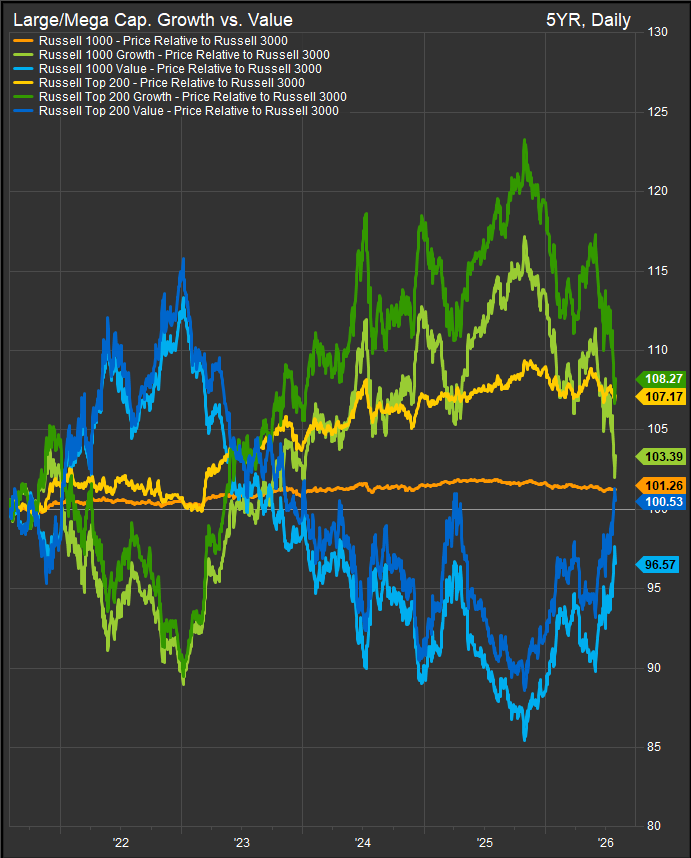
The five-year chart (below) shows how dramatically the factor regime has changed. Russell 1000 Growth and Russell Top 200 Growth relative performance surged through 2024 and early 2025, then reversed sharply. Value moved in the opposite direction: both Russell Value indexes have recovered substantially from their 2025 lows, with mega-cap Value approaching five-year relative highs.
The implication is a broader market rather than an automatic return to concentrated Growth leadership.
Amazon Validates the AI Revenue Cycle
Amazon Web Services revenue increased 37% to $42.2 billion, its fastest growth in 18 quarters, while AWS operating income rose to $16.6 billion from $10.2 billion. Amazon’s AI and internally designed chip businesses each surpassed a $25 billion annual revenue run rate, and AWS contract backlog increased to approximately $496 billion.
These results validate three critical components of the AI thesis:
- Enterprise demand for accelerated computing remains strong.
- Cloud providers are converting AI infrastructure into revenue.
- Custom silicon is becoming a meaningful commercial business rather than simply a cost-control project.
Microsoft supplies an important confirmation. Azure revenue increased 40%, with demand continuing to exceed available capacity. Microsoft’s commercial remaining performance obligation reached $627 billion, up 99% from a year earlier, while paid Microsoft 365 Copilot seats exceeded 20 million.
The results support the AI infrastructure cycle at the hyperscaler level. They do not provide equal validation for every semiconductor, software company, data-center operator or speculative AI developer. Revenue visibility, pricing power and capital efficiency remain essential.
Oversold Growth Has More Than Earnings Support
Near-term accumulation is supported by several confirming signals.
First, valuation and positioning have reset. The S&P 500’s forward multiple has fallen from approximately 23.5 times to 19.5 times, while the Nasdaq’s forward multiple has reportedly declined to 21.8 times, roughly 10% below its 10-year average. CTA positioning has returned toward neutral, and retail flows are near post-pandemic lows.
Second, earnings demand is broadening across the AI supply chain. Amazon, Microsoft and other cloud platforms are still capacity constrained, while Amazon reports that much of its 2027 AWS capacity has already been reserved. AI servers can begin generating revenue relatively quickly once deployed, even though data-center land, power and construction spending occurs much earlier.
Third, the macro backdrop still supports business investment. June core capital-goods orders rose 0.9%, while shipments increased 1.9%. Initial unemployment claims remain below 200,000, and June real consumer spending increased 0.4%. The economy is slowing, but demand has not collapsed.
Finally, the market response has been global. Amazon and Microsoft earnings triggered strong rebounds in memory manufacturers, semiconductor stocks and South Korean technology shares following the recent forced unwind.
The Challenges Remain Substantial
The principal risk is the scale and duration of capital spending.
Amazon increased its 2026 capital-expenditure plan to approximately $220 billion, while trailing 12-month free cash flow fell from a positive $18.2 billion to a $7.6 billion outflow. Microsoft expects roughly $190 billion of calendar-year capital spending, including about $25 billion associated with higher component costs. AI investment is already pressuring cloud gross margins and free cash flow.
Investors must also contend with slower economic growth and restrictive policy. Second-quarter GDP grew at a 1.5% annual rate, below expectations, while core PCE inflation remained 3.3% year over year. The Federal Reserve held rates at 3.50%–3.75%, but three officials reportedly favored an increase, leaving real yields and financing costs as persistent valuation headwinds.
The earnings bar is also high. Strong revenue and EPS beats have generated less share-price outperformance than usual, particularly in Technology, where investors increasingly require revenue acceleration, margin durability and credible returns on capital.
Sector Implications
Information Technology: The results favor semiconductors, memory, networking, custom silicon and data-center equipment, particularly companies with secured orders and visible capacity demand. Speculative software and unprofitable AI exposures remain vulnerable.
Consumer Discretionary: Amazon gains from AWS, advertising, logistics efficiency and retail scale. Its quarter should not be treated as a broad consumer-sector signal, particularly with confidence weakening and the savings rate at only 2.7%.
Communication Services: AI-enhanced advertising and cloud partnerships remain supportive for large digital platforms, although infrastructure commitments will increasingly determine free-cash-flow performance.
Industrials, Utilities and Energy: Data-center construction supports electrical equipment, cooling, engineering and power-generation demand. Rising electricity requirements also reinforce investment in natural gas, nuclear generation and grid infrastructure.
Investment Conclusion
Amazon’s quarter materially strengthens the case for accumulating profitable AI leaders after the recent correction. AWS growth, Azure acceleration, expanding backlogs, capacity constraints and lighter positioning provide meaningful confirmation.
The five-year factor chart argues for balance. Growth is deeply corrected and increasingly attractive, but Value’s recovery remains intact. The preferred positioning is selective Growth accumulation alongside continued exposure to cash-generative Value, industrial infrastructure and power-related beneficiaries.
Sources
- FactSet Research Systems Inc. — Five-year Russell 1000 and Russell Top 200 Growth-versus-Value relative-performance chart supplied for the column.
- Amazon Investor Relations — Second-quarter 2026 results, including 37% AWS growth, $42.2 billion of AWS revenue, $16.6 billion of AWS operating income and declining free cash flow tied primarily to AI infrastructure investment.
- Microsoft Investor Relations — Fiscal third-quarter 2026 results showing 40% Azure growth, $627 billion of commercial remaining performance obligations and cloud demand continuing to exceed available capacity.
- Reuters — Amazon’s increased $220 billion capital-spending plan, strong AWS demand, constrained computing capacity and the positive market reaction to evidence of AI monetization.
- U.S. Bureau of Economic Analysis — Second-quarter GDP growth of 1.5%, continued consumer and business-investment growth, and June personal-income, spending and PCE inflation data.
- Federal Reserve — July 2026 monetary-policy assessment covering elevated inflation, strong capital investment, stable employment and the 3.50%–3.75% federal-funds target range.
Disclaimer: This material is for informational and educational purposes only and does not constitute investment advice or a recommendation to purchase or sell any security. Factor leadership, earnings expectations and market conditions can change rapidly.
A weekly Factor Friday monitor could track whether Growth’s rebound develops into sustained relative leadership or fades into the broader Value rotation.
