The Growth-versus-Value debate has tightened considerably since late July. Value still owns the larger 2026 trend. Vanguard Value ETF (VTV) is up roughly 18.9% year to date, compared with about 9.3% for Vanguard Growth ETF (VUG) through September 3. But the near-term direction has flipped: VUG has gained roughly 2.6% over the past month versus 1.4% for VTV.
Today’s news flow explains why Growth is trying to reassert itself—and why the rotation is not yet secure. The bullish Growth narrative combines accelerating AI commercialization with the possibility that the Federal Reserve pauses its tightening cycle. The Value case rests on the opposite side of the macro ledger: persistently high real yields, an escalating energy shock, resilient nominal growth and a global bond market increasingly unwilling to assume inflation will disappear quickly.
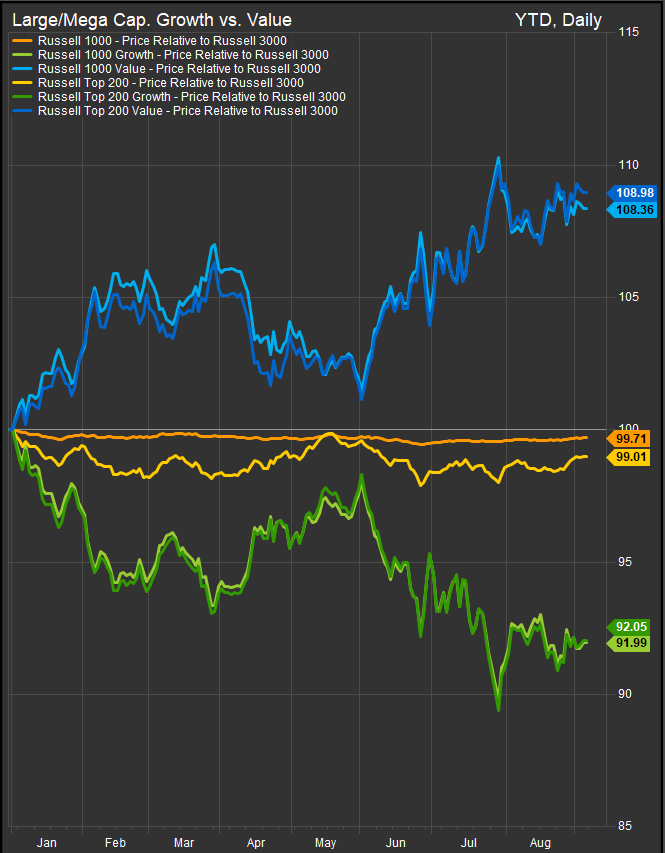
For Factor Friday, the dividing line remains straightforward: Growth can retake leadership if inflation moderates enough to pull long-term nominal and real yields lower. If yields remain structurally high, Value, Quality and current-cash-flow strategies retain the advantage.
Recent Developments Giving Growth More Fundamental Support
The AI story remains exceptionally strong. OpenAI has launched GPT-6 Astra, Anthropic is arranging a $15 billion pre-IPO credit facility, Micron is preparing to double high-bandwidth-memory capacity, and Nvidia continues expanding both its open-source ecosystem and strategic equity investments. Tesla’s Cybercab rollout adds another tangible commercialization story outside the traditional cloud and semiconductor complex. These developments matter because Growth is increasingly being supported by revenue-producing applications and infrastructure investment rather than valuation expansion alone.
Fed Governor Christopher Waller provided an equally important macro catalyst Thursday. Waller said recent inflation data show genuine improvement and that he would support holding rates steady in September if August inflation confirms the trend. He noted that three-month core PCE inflation has declined from a 4.76% annualized rate in February to 3.05% through July. That is precisely what Growth needs: earnings and investment remain strong while the probability of additional monetary tightening declines. The market responded accordingly. Expectations for a September hike fell toward 50/50 after Waller’s remarks, and Growth stocks rallied as Treasury yields eased Thursday.
But Value Still Has the Better Macro Hedge
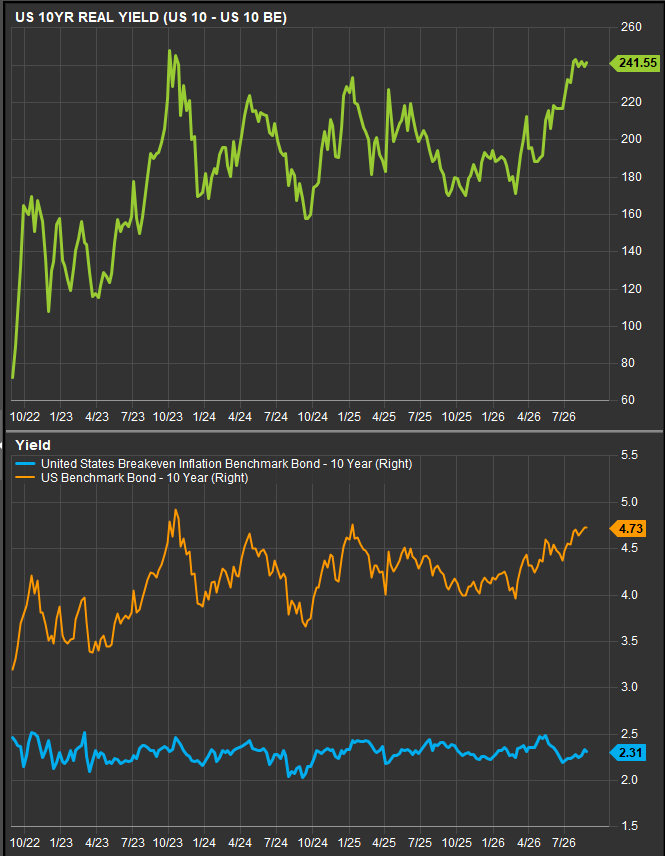
The difficulty is that policy rates are only part of the Growth valuation equation. As of September 3, the Treasury curve remained restrictive: the 10-year nominal yield was 4.77% and the 30-year 5.25%. More importantly for equity valuation, Treasury data put the 10-year real yield at 2.42% and the 30-year real yield at 2.96%. Those real yields remain powerful competition for long-duration Growth stocks.
And unlike earlier in the cycle, the pressure is not solely coming from the Fed. Global sovereign yields have climbed as investors confront fiscal deficits, persistent inflation and enormous corporate borrowing requirements associated with the AI capital-spending boom. The U.S. 10-year briefly reached 4.80% this week even as markets debated whether the Fed might pause. That environment favors stocks whose valuation rests more heavily on current earnings, dividends and free cash flow rather than profits expected far into the future.
It also helps explain why Financials remain competitive. A steeper, higher nominal-rate environment can support banking profitability and capital-markets activity, particularly as AI infrastructure generates enormous financing needs. Energy provides an even more direct Value exposure to the current inflation regime.
Energy Is the Biggest Threat to the Growth Pivot
The Strait of Hormuz remains the most important exogenous inflation risk. Only four commodity vessels were observed crossing the Strait Thursday, compared with a recent ten-day average of about 15. The headline package simultaneously points to a renewed U.S.-Iran escalation cycle and expanding international economic pressure on Tehran. The most important consequence for U.S. inflation may increasingly be diesel rather than crude itself.
Average U.S. diesel prices have reached roughly $5.82–$5.85 per gallon, surpassing the 2022 record. Diesel is embedded throughout freight, agriculture, construction and distribution, meaning sustained price increases can migrate into the cost of food and manufactured goods. That creates an uncomfortable scenario for Growth: underlying inflation may be moderating just as an external energy shock begins working its way through supply chains. Energy equities benefit directly. Financials may benefit from higher nominal yields. Companies with strong present cash flows become comparatively more attractive. Long-duration Growth does not.
Growth vs. Value: What Today’s Headlines Are Saying
| Development | Growth Implication | Value Implication |
| Waller open to September hold | Strong positive | Mild negative |
| Core disinflation continuing | Positive | Neutral/negative |
| GPT-6, HBM expansion, AI investment | Positive | Positive for AI-linked Industrials |
| 10Y real yield at 2.42% | Headwind | Supportive |
| 30Y Treasury above 5.2% | Headwind | Supports current cash flow |
| Record diesel prices | Negative | Positive Energy/inflation hedge |
| Hormuz disruption | Negative via inflation | Positive Energy |
| Global manufacturing improvement | Mixed | Positive Industrials/Materials |
| Yen carry-trade unwind | Negative to high beta | Favors lower-beta/Quality |
| U.S.-China détente | Positive Technology | Positive Industrials |
| Rare-earth export disruption | Negative Technology hardware | Potential Materials support |
The result is not a clean regime signal. Growth has the stronger improving narrative; Value still has the stronger macro protection.
Three Near-Term Events Can Change the Factor Leadership
- Today’s Employment Report
The August jobs report arrives at 8:30 a.m. Eastern. Consensus expects roughly 55,000–56,000 payroll gains, following July’s 23,000 decline, with unemployment holding at 4.1%. A modestly soft report would probably be the best outcome for Growth: weak enough to reduce Fed tightening expectations, but not weak enough to threaten earnings. A strong payroll number accompanied by renewed wage pressure would do the opposite, pushing yields higher and reinforcing Value and Financials. A genuinely poor employment report is more complicated. Rates could fall sharply, initially helping Growth, Utilities and Real Estate, but recession concerns would eventually threaten cyclical earnings.
- August CPI and PPI
This is the larger pivot. PPI arrives September 10 and CPI September 11, immediately ahead of the September 15–16 FOMC meeting. The BLS confirms those release dates, while economists currently expect headline CPI around +0.4% month over month and core CPI around +0.2%. Core near 0.2%, particularly with subdued services inflation, would strengthen Waller’s argument for patience and could pull both nominal and real yields lower. A hotter core reading—especially if transportation and goods prices begin reflecting the energy shock—would revive the September hike narrative quickly.
- Hormuz
The geopolitical outcome may matter almost as much as CPI. A credible U.S.-Iran agreement that restores normal Gulf shipping could rapidly reduce diesel and crude risk premiums. If that pulls inflation expectations, Fed expectations and the Treasury term premium lower together, real yields could finally break downward. That would be the most powerful catalyst for a sustained Growth rotation. Continued escalation produces the mirror image: higher fuel prices, higher inflation uncertainty and higher long-term rates, prolonging Value and Energy leadership.
There Is One More Rate Risk: AI Itself
AI’s success is becoming part of the interest-rate problem. Anthropic is adding a $15 billion credit facility, Nvidia’s strategic investments have reportedly reached almost $100 billion, and hyperscalers continue financing enormous data-center and power requirements. The resulting corporate-debt supply competes for capital with Treasury issuance. Reuters notes that AI borrowing is increasingly one of the forces investors cite when explaining elevated global long-term yields. That creates an unusual feedback loop: the stronger the AI capital cycle becomes, the more capital it demands; the more capital it demands, the harder it can become for long-duration Growth valuations to expand. For Growth to outperform sustainably, earnings growth increasingly has to outrun that discount-rate pressure.
Factor Friday: The Investment Setup
Growth is improving. AI fundamentals remain strong, the one-month relative trend has turned upward and a Fed pause would remove an important headwind. Value remains the YTD leader and the better inflation hedge. Energy, Financials and cash-generative businesses remain favored if yields and commodity prices stay high. Quality may still be the best bridge between them. Companies with Growth characteristics, strong margins and internal cash generation can participate in AI upside without requiring falling interest rates to justify their entire valuation. Momentum remains dependent on rates. Another sustained decline in real yields could quickly restart the Growth/Momentum trade, but another energy-driven Treasury selloff would favor continued breadth and Value.
The Bottom Line
The Growth narrative is gaining fundamental credibility. AI commercialization is accelerating, corporate investment remains strong and Waller has opened a clear path to a September Fed pause. But Growth does not yet control the macro regime. The bond market does. With the 10-year real yield still above 2.4%, the 30-year nominal Treasury above 5.2% and diesel at record prices, Value retains meaningful structural support.
The next two weeks provide an unusually clear decision tree. Soft-but-stable payrolls, core CPI near 0.2% and progress in Hormuz would likely pull rates lower and give Growth a credible path back to leadership. Hot inflation, strong wage growth or further Gulf disruption would reinforce Value, Energy and current-cash-flow factors. For investors trying to identify the next factor regime, the most important chart may not be Growth versus Value. It may still be the 10-year real yield.
Sources
Primary sources include the Federal Reserve’s September 3 remarks from Governor Christopher Waller, U.S. Treasury nominal and real yield curves, and the Bureau of Labor Statistics release calendar and July CPI data.
Disclaimer: This commentary is for informational and educational purposes only and does not constitute investment advice, an offer to sell or a solicitation to purchase any security. Factor performance, economic conditions, interest rates and geopolitical developments can change materially. Investors should consider their objectives, risks, charges and expenses before investing.