


The AI investment cycle remains fundamentally attractive, but rising real interest rates and financing uncertainty are changing the risk/reward equation. We favor diversified factor exposure while Technology consolidates, with stronger conviction in AI emerging if inflation eases and credit spreads tighten.
The AI Trade Is Facing a New Test
Nvidia’s (NVDA) leadership transition has introduced a new source of uncertainty into an AI investment cycle already confronting questions about capital expenditures, financing commitments, and long-term returns. Reports that the company has approximately $164 billion in financial commitments under review have reinforced concerns about the sustainability of the financing arrangements supporting the broader AI infrastructure ecosystem. Yet the market’s response suggests investors are distinguishing between Nvidia-specific uncertainty and the underlying demand for computing capacity. Thursday’s trading saw NVDA decline 4.34%, while Advanced Micro Devices (AMD) gained 5.86% and Broadcom (AVGO) advanced 5.54%. Cisco (CSCO) raised its revenue outlook on accelerating AI networking demand, while Applied Materials (AMAT) reported strong semiconductor equipment demand and substantial free-cash-flow generation.
These developments suggest that investors are not abandoning AI. Rather, they are reconsidering the allocation of capital within the theme while continuing to favor businesses with more predictable earnings, established cash generation, and less dependence on aggressive infrastructure financing.
Our preference is not to chase the latest AI beneficiaries or rotate aggressively into another cyclical sector. It is to maintain a diversified mix of Value, Quality, and Lower Volatility exposures while the AI trade works through its financing and valuation uncertainties.
Where Investors Are Rotating
The relative resilience of established businesses such as Apple (AAPL), Microsoft (MSFT), Berkshire Hathaway (BRK.B), and UnitedHealth (UNH) during the recent AI correction illustrates a broader preference for financial strength and identifiable earnings drivers. Apple offers substantial free cash flow without the same infrastructure spending commitments as the hyperscalers. Microsoft retains considerable operating flexibility through its enterprise software franchise, although it remains an important AI investor. Berkshire provides diversified operating earnings, considerable liquidity, and the ability to deploy capital opportunistically. UnitedHealth offers a company-specific earnings recovery opportunity driven principally by medical-cost management and healthcare operations rather than AI infrastructure spending. These companies are not interchangeable, and several retain considerable valuation or operating risks. Their common attraction is that shareholders are less dependent on an uninterrupted expansion of speculative financing to support the investment thesis.
The factor distinction is increasingly important. Value exposure offers a broader opportunity set outside the most expensive Growth companies. Quality emphasizes profitability, financial resilience, and the ability to sustain investment internally. Lower Volatility provides a degree of protection against the concentrated price swings associated with the AI trade. Investors can express these preferences through diversified ETFs such as Vanguard Value (VTV), iShares MSCI USA Quality Factor (QUAL), and iShares MSCI USA Min Vol Factor (USMV), with Invesco S&P 500 Low Volatility (SPLV) providing another defensive implementation. These strategies have overlapping holdings but different selection methodologies and sector weights; combining them can reduce reliance on any single factor without eliminating equity-market risk.
The opportunity is therefore less about replacing Technology with a single new sector leader and more about building portfolios that can participate in an eventual AI recovery without depending on it for most of their returns.
The AI Opportunity Has Not Disappeared
Nvidia’s difficulties have not invalidated the fundamental investment cycle. Cisco’s stronger guidance, Applied Materials’ earnings, and continuing demand for advanced computing illustrate substantial spending across the semiconductor and networking industries. The concern is whether infrastructure investment can maintain its extraordinary growth trajectory as financing costs rise and investors place greater emphasis on return on invested capital. Nvidia’s potential reassessment of financial commitments could improve its own risk profile while introducing financing challenges for developers dependent on supplier support. That distinction makes the current correction potentially attractive, but not yet sufficiently compelling to warrant an aggressive broad-based increase in AI exposure.
We believe AI-related equities could be accumulated opportunistically at oversold levels, particularly established businesses such as NVDA, AVGO, AMD, and selected infrastructure suppliers where operating fundamentals remain sound. However, a technical rebound driven by short covering, retail dip-buying, or reduced positioning is not equivalent to a durable improvement in the investment outlook.
Our conviction would increase materially if the macroeconomic and credit environment began supporting higher valuations and lower financing costs simultaneously.
Real Rates and Credit Spreads Are the Critical Variables
The most constructive development for AI equities would be declining real interest rates accompanied by tightening corporate credit spreads. Real interest rates are particularly important for Growth valuations because they influence the discount rate applied to future earnings. AI infrastructure developers also face substantial capital requirements before many projects generate sufficient operating cash flow. Lower real yields would improve the present value of expected profits and potentially reduce the financing burden associated with future investment.
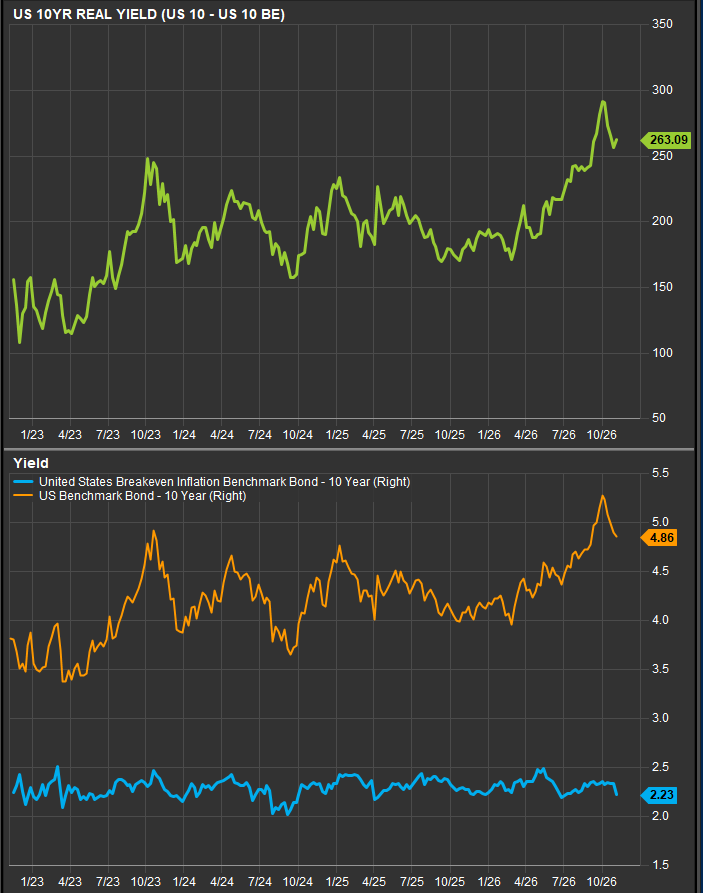
Credit spreads provide a different signal. When spreads widen, lenders are demanding greater compensation for default, liquidity, and refinancing risks. That can offset falling Treasury yields, leaving weaker borrowers with little improvement in their actual cost of capital. The distinction is essential. A Treasury rally driven by deteriorating growth expectations or financial stress may support government bonds without materially improving the economics of AI infrastructure. Conversely, falling real yields alongside narrowing investment-grade and high-yield spreads would indicate that the cost and availability of capital are improving together.
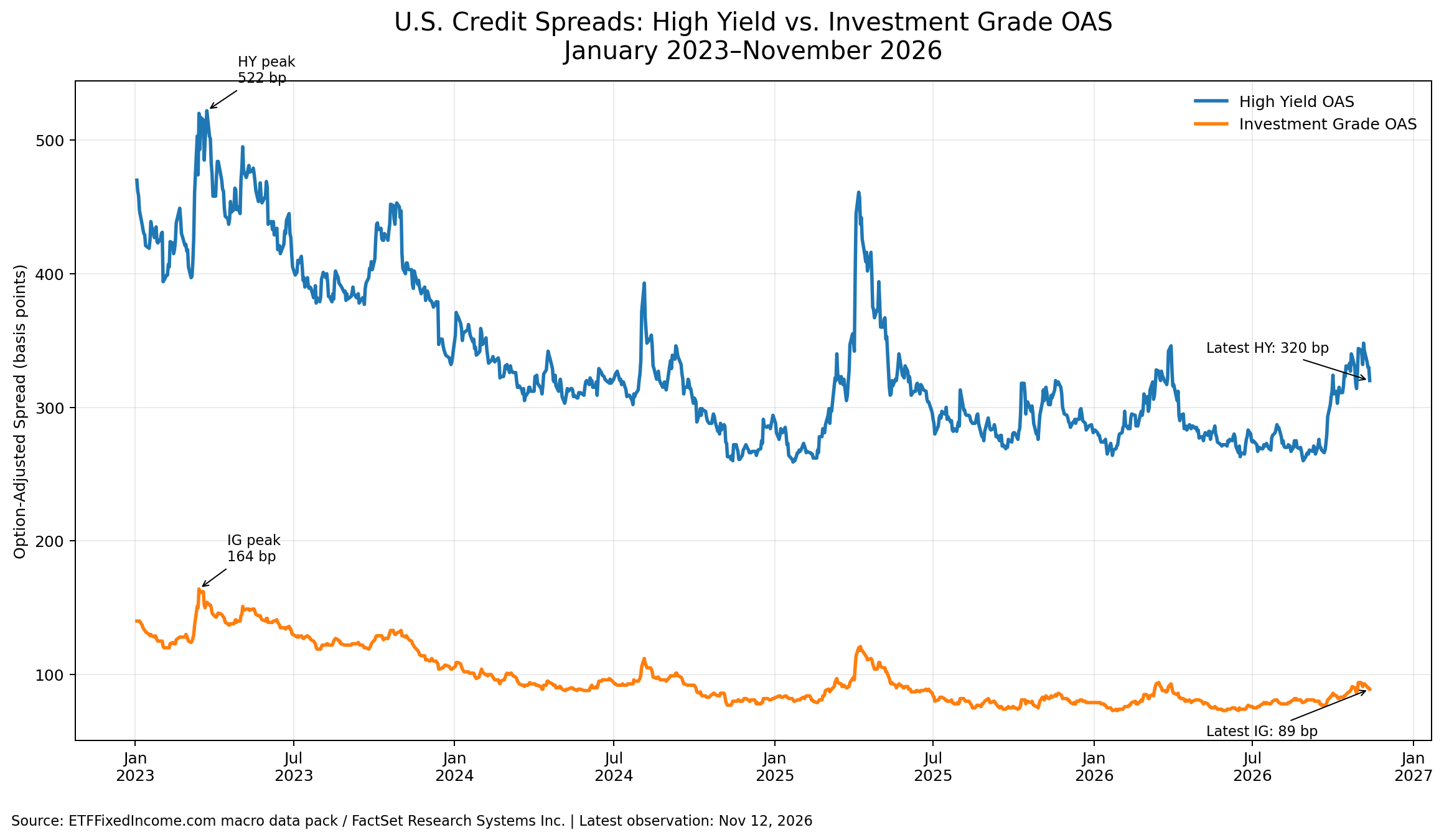
Such a combination would support both valuation recovery and the continuation of capital-intensive AI investment. It would be particularly constructive if accompanied by moderating inflation, stable employment, and continued cloud revenue growth.
For now, inflation remains an obstacle. Federal Reserve officials continue signaling that further tightening may be necessary, while recent consumer-price readings and the rebound in Treasury yields have complicated expectations for monetary relief.
This argues for patience. We see scope for a tradable AI rebound before the macroeconomic environment improves, but greater confidence in a sustained recovery requires evidence that financial conditions are genuinely easing.
Sector Opportunities Beyond AI
Our current sector positioning reflects the same emphasis on diversification and financial resilience.
Health Care (VHT) offers earnings opportunities less dependent on the AI investment cycle. Eli Lilly (LLY), Amgen (AMGN), and Johnson & Johnson (JNJ) provide exposure to pharmaceutical innovation and established healthcare businesses, while UnitedHealth offers a more company-specific recovery opportunity. We favor selectivity given reimbursement pressures, regulatory uncertainty, and differences in earnings visibility across the sector.
Consumer Staples (VDC) provides exposure to businesses such as Procter & Gamble (PG) and Coca-Cola (KO), where established brands, recurring demand, and cash generation can support relative resilience. Lower crude prices could eventually reduce transportation and packaging costs, although food and consumer-goods margins remain exposed to broader inflation.
Financials (VFH) offer selective opportunities through financially strong companies such as Berkshire Hathaway and JPMorgan Chase (JPM). We favor diversified earnings and robust capitalization over more leveraged financial businesses, particularly while the credit cycle remains uncertain.
Energy (VDE) continues to offer geopolitical and inflation protection, but the latest International Energy Agency outlook points toward improving global supply conditions. Sustained crude-price weakness could reduce the case for an aggressive Energy overweight while benefiting consumer and transportation businesses elsewhere in the economy.
Industrials (VIS) retain attractive individual companies, but our process does not currently favor a broad sector overweight. Eaton (ETN), Quanta Services (PWR), and Comfort Systems (FIX) remain beneficiaries of AI infrastructure investment, yet their exposure to the same capital-expenditure cycle limits their effectiveness as diversification away from AI. We would prefer improving sector fundamentals and relative-price confirmation before increasing broad Industrial exposure.
Rate-sensitive Utilities (VPU) and Real Estate (VNQ) also warrant monitoring, but a durable recovery requires more than falling nominal Treasury yields. Lower real rates and stabilizing credit spreads would provide a stronger foundation for those sectors as well.
Investment Conclusion: Diversify Now, Prepare to Accumulate AI Later
The AI investment cycle remains an important long-term growth opportunity, but its current correction is occurring alongside elevated real interest rates, financing concerns, and increasing scrutiny of capital returns. Investors should not assume that every oversold AI security represents an attractive entry point.
Our preferred positioning is a broad mix of Value (VTV), Quality (QUAL), and Lower Volatility (USMV or SPLV) exposures, complemented by selective sector allocations in Health Care, Consumer Staples, and financially resilient businesses. We would retain measured exposure to established Technology companies while avoiding excessive concentration in speculative AI infrastructure and highly leveraged Growth businesses.
The opportunity to rebuild AI exposure could become substantial if valuations continue correcting while earnings and demand remain resilient. However, our conviction would strengthen considerably with evidence of easing inflation, declining real Treasury yields, and tightening corporate credit spreads.
Those developments would signal that the financing environment is becoming more supportive of the next phase of AI investment—not merely that investors are seeking safety in government bonds.
The preferred strategy is to diversify through the shakeout while maintaining the flexibility to accumulate AI exposure when valuations and financial conditions become more favorable together.
The next sustained leadership phase may still include AI. We simply see little reason to rely on that outcome exclusively while the underlying financing and monetary conditions remain unsettled.
Sources and References
Primary corporate sources: Nvidia leadership-transition announcement and SEC filings; Cisco fiscal first-quarter 2027 earnings; Applied Materials fiscal fourth-quarter 2026 results; Microsoft and Alphabet quarterly financial disclosures; Berkshire Hathaway quarterly earnings.
Economic and market sources: Bureau of Labor Statistics, October 2026 CPI; Federal Reserve and U.S. Treasury interest-rate data; ICE BofA corporate credit-spread series; International Energy Agency, November 2026 Oil Market Report.
Market context: FactSet Research Systems Inc., November 13, 2026 morning market and company news package. Reuters and other financial reporting on Nvidia’s management transition, AI investment commitments, semiconductor competition, and financing conditions.
Disclaimer: This publication is provided by ETFSector.com for informational and research purposes only and does not constitute individualized investment advice or a recommendation to purchase or sell securities. Factor and sector preferences reflect current research assessments and are subject to change. Company and ETF references are illustrative, not individualized recommendations. Value, Quality, and Low Volatility strategies may overlap substantially and remain exposed to market losses. Historical performance does not guarantee future results.
