



Energy and free cash flow are winning as rising inflation and tighter financing conditions challenge speculative Growth. The next equity rotation may favor quality earnings over extraordinary revenue projections.
The Market Is Repricing Growth, Not Abandoning It
The most important development in this week’s factor performance is the growing separation between companies benefiting from the AI investment boom and those financing it. Semiconductor demand remains exceptional, but increasing credit-market scrutiny of AI infrastructure is challenging the assumption that extraordinary revenue growth necessarily produces attractive shareholder returns.
Meanwhile, inflation is creating a second source of earnings leadership. Energy has outperformed the S&P 500 by 30.22% year to date, compared with Technology’s 14.78% relative gain. Every other sector except Health Care has underperformed the benchmark. The Russell Top 200 Value Index has outperformed the Russell 3000 by 8.92%, while Russell Top 200 Growth has underperformed by 6.89%.
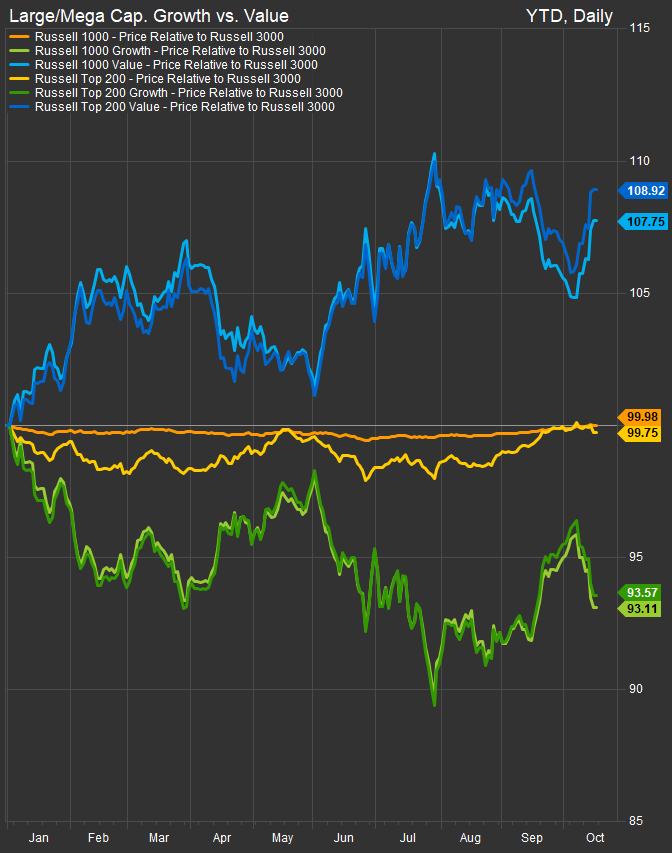
This is not a straightforward Value rotation. Technology remains a leader even as broad Growth indexes struggle, reflecting the importance of selectivity within the sector. Investors are increasingly distinguishing between businesses generating substantial cash flow today and those requiring inexpensive capital to deliver future profitability.
AI: Strong Earnings, Increasingly Difficult Financing
This week’s semiconductor results reinforce the exceptional strength of underlying AI demand. TSMC reported third-quarter revenue of $46.72 billion, up 50.9% in local currency, while net income increased 68.7%. ASML reported €11.7 billion in quarterly revenue and raised its annual guidance, noting that planned manufacturing capacity through 2028 may be insufficient to satisfy customer demand. Yet the market’s response has been restrained. Reports of rapidly widening CoreWeave credit spreads, revised financing terms for AI infrastructure developer Volta, and lower prospective IPO valuations for Anthropic demonstrate increasing investor skepticism toward heavily financed growth models.
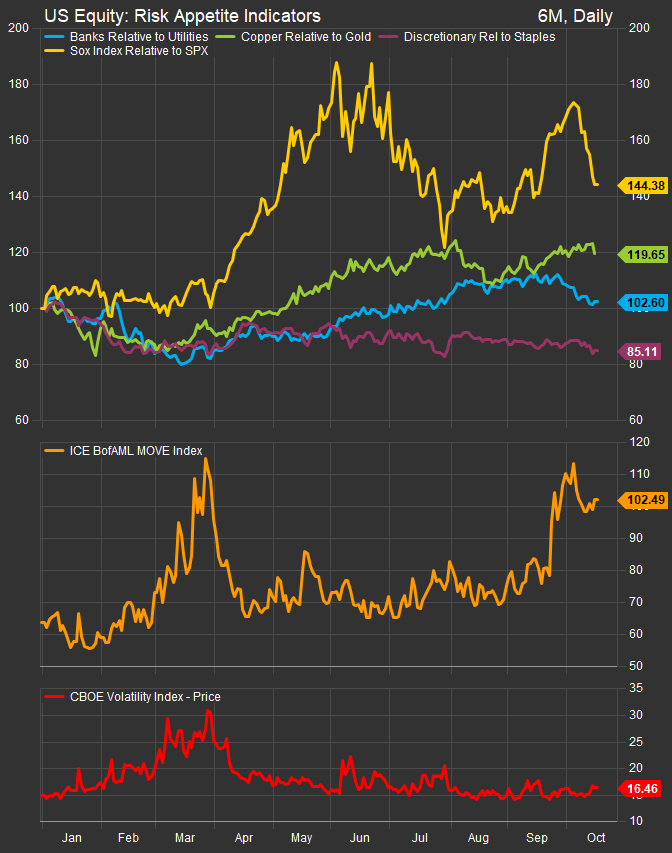
The distinction matters. Established semiconductor suppliers can convert exceptional demand into substantial operating profits. Data-center developers financed through expensive debt and lease obligations face the additional challenge of achieving sufficient utilization and margins to cover rapidly increasing capital costs. The semiconductor index has still outperformed the S&P 500 by 44.38% over six months, but its sharp decline from recent relative highs suggests investors are reducing their willingness to capitalize distant earnings at aggressive valuations.
Technology (VGT) remains attractive selectively, but the preference is shifting toward established cash-generative suppliers and away from highly leveraged AI infrastructure operators. This is a potential rotation within Technology rather than necessarily away from it.
Inflation Is Supporting Energy While Constraining Everyone Else
September’s inflation reports explain why that distinction has become increasingly consequential. Headline CPI rose 3.7% year over year, while core CPI increased 0.3% during the month. Producer prices accelerated 1.3% in September and 6.3% annually, demonstrating substantial pressure on corporate operating costs. The Middle East conflict, disruptions to energy transportation, and constrained refined-product supply continue supporting elevated crude and diesel prices. FactSet now expects Energy-sector third-quarter earnings growth of approximately 121%, with refining and marketing companies positioned to benefit disproportionately.
Energy (VDE) remains our preferred sector hedge against inflation and geopolitical disruption. But its strength is creating difficulties elsewhere. Higher fuel, freight, and electricity costs reduce operating leverage for transportation, manufacturing, and consumer businesses.
J.B. Hunt’s latest results illustrate the problem: quarterly revenue increased 20%, but operating income improved only 2% as transportation, equipment, insurance, and labor costs absorbed much of the benefit. Alcoa’s earnings demonstrate that materials producers can benefit from firmer commodity prices while remaining exposed to uneven demand and production costs. This also explains why the Copper-to-Gold ratio has advanced 19.65% over six months while the diversified Materials sector (VAW) has underperformed the S&P 500 by 4.65% year to date. Strong commodity prices do not automatically translate into broad sector outperformance when margins and end-market demand are under pressure.
Factor Performance: Follow Cash Flow, Not the Quality Label
The quality-factor exhibits contain an important message about the current investment environment. Over the trailing year, VictoryShares Free Cash Flow ETF (VFLO) has outperformed the S&P 500 by 25.27%, while Pacer US Cash Cows 100 ETF (COWZ) has generated 6.74% excess performance.
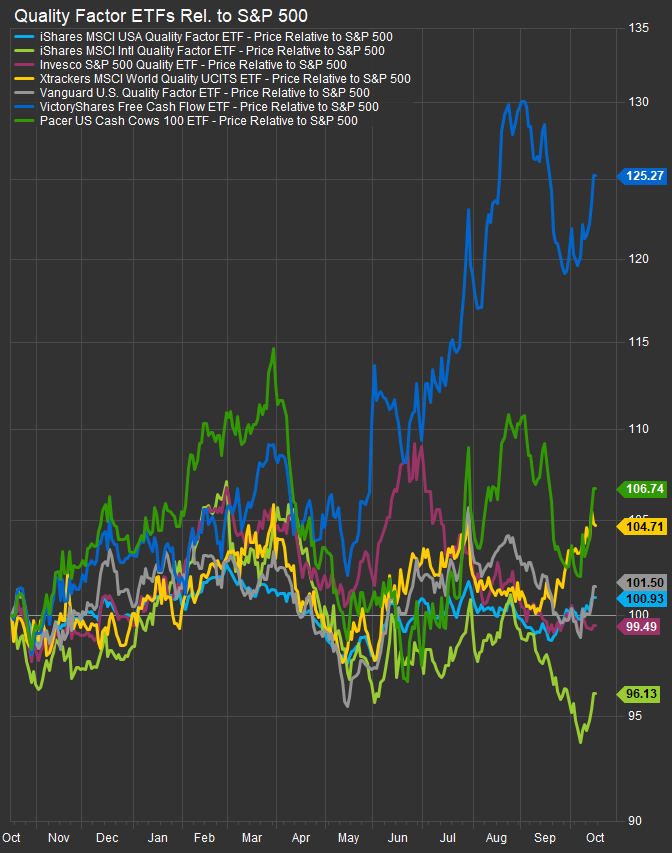
Traditional quality strategies have been less impressive. The iShares MSCI USA Quality Factor ETF (QUAL) has outperformed by only 0.93%, while Invesco S&P 500 Quality ETF (SPHQ) has underperformed by 0.51%. These funds use different selection criteria and sector allocations, so their performance is not a controlled comparison of quality definitions. Nevertheless, the divergence suggests that free-cash-flow generation and valuation discipline have provided more useful protection than broad profitability screens alone.
Risk appetite is also moderating. High Beta and Momentum retain 9.10% and 6.49% of year-to-date excess performance, respectively, but both have surrendered substantial relative gains since their peaks. Low Volatility remains 8.77% behind the S&P 500, although its recent relative recovery suggests defensive positioning is beginning to attract interest. The cross-asset indicators reinforce that message. The MOVE Index remains elevated at 102.49 while the VIX is comparatively subdued at 16.46. Bond investors remain concerned about inflation and financing conditions even as equity volatility implies a more manageable risk environment. Historically, that divergence can become problematic when equity valuations depend heavily on continued access to inexpensive financing.
Sector Positioning: Where the Tailwinds and Headwinds Are Shifting
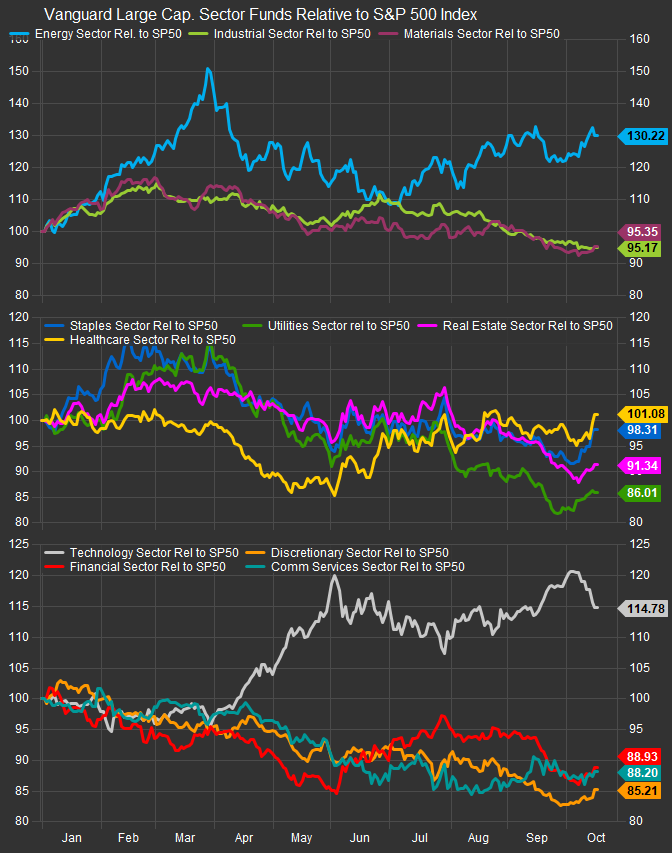
Energy (VDE) and selective Technology (VGT) retain the strongest earnings tailwinds, but for very different reasons. Energy benefits directly from inflation and supply disruptions; profitable semiconductor and infrastructure suppliers benefit from persistent AI investment. Both sectors warrant exposure, although rising credit stress argues for greater discrimination within Technology.
Health Care (VHT) and Consumer Staples (VDC) are becoming more interesting defensive opportunities. Health Care has recovered to modest year-to-date relative outperformance of 1.08%, while Staples has rebounded sharply toward benchmark parity. Both provide alternatives to concentrated AI exposure, although elevated operating costs and uneven earnings revisions argue against indiscriminate buying.
Industrials (VIS), Materials (VAW), and Financials (VFH) offer selective cyclical opportunities but lack broad relative-price confirmation. Industrials can benefit from automation, defense, and infrastructure spending; Materials from metals and electrification demand; Financials from capital markets activity and nominal growth. Higher input costs, weaker credit conditions, and expensive financing remain obstacles.
Consumer Discretionary (VCR) and Communication Services (VOX) face the clearest pressure from weaker household purchasing power, disruption, and competition. Discretionary has underperformed the S&P 500 by 14.79% year to date, while its relative performance against Staples has deteriorated sharply. Communications remains vulnerable to both competitive disruption and high expectations for digital advertising and AI monetization.
Utilities (VPU) and Real Estate (VNQ) remain constrained by higher interest rates and substantial capital requirements. Data-center electricity demand offers a powerful structural opportunity for selected power producers, but the broader sectors require greater confidence in stabilizing Treasury yields before a durable relative recovery becomes likely.
Investment Outlook: The Next Rotation Requires Lower Inflation or Better Breadth
Our preferred positioning remains overweight Energy, selective Technology, and high-free-cash-flow businesses, while gradually increasing attention to quality opportunities in Health Care, Staples, and economically resilient Industrials. The most constructive catalyst would be declining crude prices and bond volatility, allowing earnings growth to broaden beyond Energy and AI. That would favor Industrials, Financials, Utilities, and selected Consumer Discretionary businesses. The principal downside risk is more immediate: AI financing stress could undermine Technology leadership before other sectors have established positive earnings and relative-price momentum.
The market is increasingly rewarding businesses that can finance their own growth. Until inflation moderates and credit conditions stabilize, free cash flow and earnings durability should matter more than revenue growth alone.
Sources
Pricing and Performance data sourced from FactSet Research Systems, inc., October 16, 2026; BLS September CPI and PPI; TSMC Q3 results; ASML Q3 results; FactSet Energy Earnings Outlook; J.B. Hunt Q3 results. Additional market context from Reuters reporting October 15–16 on AI infrastructure financing and credit conditions.
Disclaimer: This publication is for informational and research purposes only and does not constitute investment advice or a recommendation to buy or sell securities. ETF relative-performance figures reflect indexed price ratios versus the stated benchmarks, not total returns. The exhibits cover different measurement periods: sector and style charts are year to date, risk-appetite indicators cover six months, and quality factors cover approximately one year. Historical performance does not predict future results.
