

Value and High Beta have captured 2026’s market broadening, while Low Volatility has been left behind. This week’s AI selloff, however, is testing whether investors still want more risk.
The factor market is sending a more complicated message than the major indexes suggest. Investors have generally preferred economically sensitive stocks, higher-beta exposures and recent winners, but they have not consistently favored the traditional Growth trade.
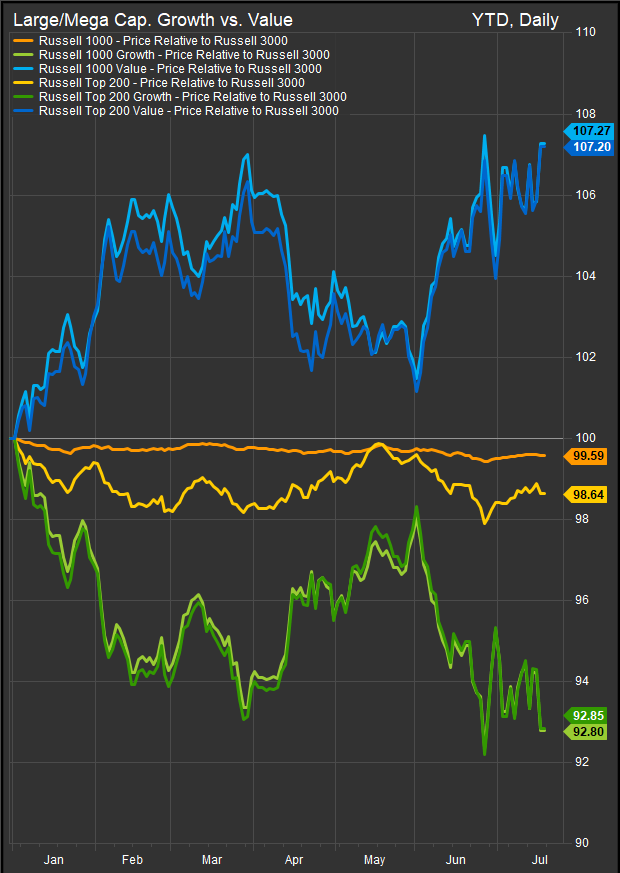
The attached performance charts make that distinction clear. Large-cap Value is outperforming the broad Russell 3000 by roughly 7% year to date, while large-cap Growth is trailing by approximately the same amount. At the factor level, the Invesco S&P 500 High Beta ETF (SPHB) and iShares MSCI USA Momentum Factor ETF (MTUM) are each ahead of the S&P 500 by roughly 10% to 11%. The Invesco S&P 500 Low Volatility ETF (SPLV), meanwhile, is about 2% behind.
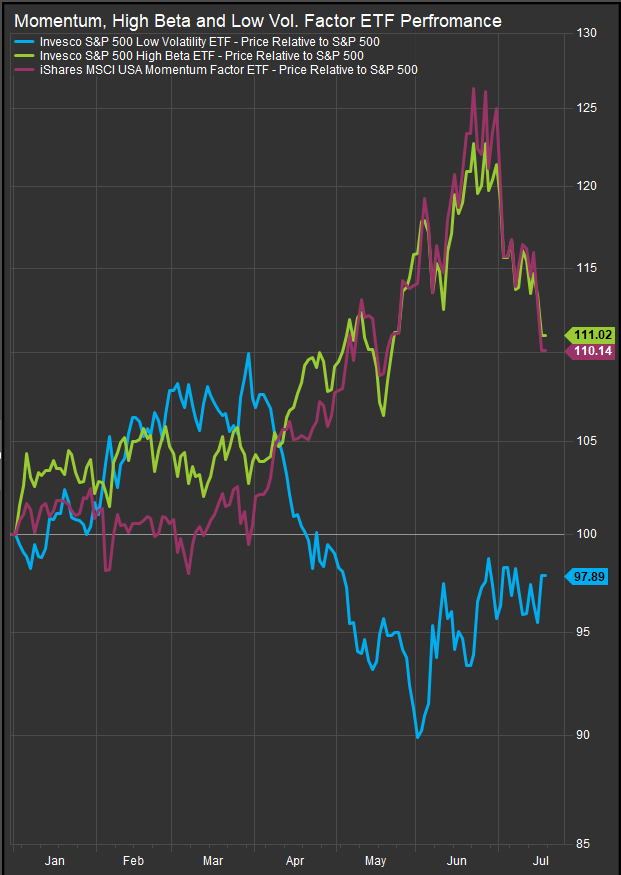
This is not a classic defensive Value rotation. It is a pro-cyclical broadening trade in which investors have moved away from expensive mega-cap Growth while continuing to favor companies with strong economic sensitivity, operating leverage and price momentum.
Cooler Inflation Meets a Stronger Economy
This week’s economic data initially reinforced that combination.
June headline CPI declined 0.4% month over month, while core prices were unchanged. Core inflation slowed to 2.6% year over year, and the monthly shelter increase was the smallest since January 2021. June producer prices also declined 0.3%, reducing immediate concerns that higher energy and input costs were rapidly moving through the inflation pipeline.
At the same time, economic activity remained firm. Retail sales increased 0.2% in June, initial jobless claims fell to 208,000 and the Philadelphia Fed manufacturing index jumped to 41.4, its highest reading since November 2021.
That mix—less inflation without an obvious growth downturn—is normally favorable for risk assets. It helps explain the relative strength of High Beta and the continued weakness of Low Volatility. It also supports economically sensitive Value exposures such as Financials (VFH), Industrials (VIS) and selected Materials (VAW), where earnings can benefit from nominal growth, capital spending and manufacturing activity.
But it does not automatically restore leadership to Growth.
Cooling inflation reduces the discount-rate pressure on long-duration equities, but resilient employment, consumption and manufacturing data keep Treasury yields elevated and give the Federal Reserve little urgency to ease. Markets were still pricing approximately 26 basis points of rate increases through December after the CPI and PPI releases.
Growth therefore receives some inflation relief without the full valuation benefit that would come from a decisive decline in real yields.
AI Is Becoming a Quality Test
Friday’s global technology selloff introduces another problem for Growth: investors are beginning to distinguish between AI adoption and AI spending discipline.
Global semiconductor and AI-linked stocks fell sharply after investors reassessed the durability of the capital-spending boom. Nasdaq futures declined more than 2%, Taiwan’s market fell over 6%, and leveraged-position unwinds amplified the move even though TSMC and ASML had recently reported strong operating results.
The week’s headline package similarly highlighted concern that cheaper Chinese AI models could challenge the assumption that ever-higher infrastructure spending will produce equally attractive returns. It also noted unease over hyperscaler spending, crowded semiconductor positioning and signs that investors were beginning to prepare for a slower AI capital-expenditure cycle.
That does not necessarily end the AI trade. It changes what investors should demand from it.
Growth exposures such as Vanguard Growth ETF (VUG), Vanguard Information Technology ETF (VGT) and Vanguard Communication Services ETF (VOX) may need stronger evidence that AI spending is producing revenue growth, margin expansion and defensible returns on invested capital. Simply announcing a larger data-center budget may no longer support higher valuations.
At the same time, AI spending continues to benefit parts of the Value and cyclical universe, including electrical equipment, construction, power infrastructure, machinery and financing. The next phase of the AI trade may therefore be less about owning the most expensive model developers and more about identifying companies earning durable cash flows from the buildout.
Investor Flows Confirm the Split
ETF flows show investors oscillating between enthusiasm for Growth and a desire to broaden beyond it.
Value style ETFs attracted approximately $12.5 billion in June, compared with $1.9 billion for Growth, putting Value slightly ahead for the year. Momentum factor ETFs received $3.1 billion during the month and $8.5 billion year to date. Low Volatility ETFs lost $367 million in June and approximately $2.5 billion during the first half.
There is an important distinction inside those figures. Broad Value style funds attracted money, but narrower Value factor strategies recorded outflows. Investors appear more comfortable buying diversified Value benchmarks and dividend-oriented portfolios than relying on concentrated quantitative screens.
Low Volatility faces a different structural challenge. Investors seeking downside protection are increasingly using defined-outcome and derivative-income ETFs rather than traditional minimum-volatility portfolios. Defined-outcome ETF assets were already nearly twice those of Low Volatility factor ETFs at the end of June.
Meanwhile, broader sentiment remains aggressive. Bank of America’s July fund-manager survey showed cash holdings falling to 3.6% and allocations to U.S. equities reaching their highest level since late 2024. That supports High Beta while also making it more vulnerable to sudden deleveraging when crowded trades reverse.
The Factor Outlook
Growth: Selective rather than broadly bullish. Cooler inflation is constructive, but Growth leadership probably requires stable or falling real yields and proof that AI spending is generating attractive returns. Favor profitable, cash-generative Growth over speculative or capital-intensive exposures.
Value: Still favored. The combination of resilient activity, elevated yields and broader capital spending supports Financials, Industrials and selected commodity-linked companies. Value’s advantage will weaken if the economy deteriorates sharply, but the current rotation appears more fundamental than purely defensive.
High Beta: Positive but increasingly tactical. SPHB’s relative strength reflects confidence in continued economic expansion. Yet crowded positioning, geopolitical risk and leveraged unwinds mean the factor offers less margin for error than it did earlier in the year.
Low Volatility: Lagging, but gaining optionality. SPLV and USMV remain unlikely leaders while growth stays resilient and breadth improves. Their relative appeal rises if the technology correction spreads, oil-driven inflation worsens or economic data begin to roll over.
The main conclusion is that investors are not abandoning risk. They are becoming less willing to pay any price for it. Value and High Beta remain the leading expressions of the broadening trade, while Growth must now defend its capital intensity.
Sources
FactSet Research Systems Inc. factor and style performance charts; U.S. Bureau of Labor Statistics CPI and PPI releases; U.S. Census Bureau retail-sales report; Department of Labor unemployment claims; Philadelphia Federal Reserve manufacturing survey; State Street Investment Management ETF flow research; BlackRock ETF market review; Reuters and The Wall Street Journal.
Disclaimer: This material is for informational and educational purposes only and does not constitute investment advice, an offer to sell or a solicitation to buy any security. ETF performance, factor leadership and market relationships can change rapidly. Past performance does not guarantee future results.
