


The late-July attempt by Growth stocks to regain leadership has stalled. The reason is increasingly clear: the earnings case for Growth remains strong, but the discount-rate backdrop has not cooperated.
The August 21 ETF data show Vanguard Value (VTV) gaining 3.80% over one month versus 2.16% for Vanguard Growth (VUG). Over the latest week, the gap widened sharply, with VTV up 0.39% while VUG fell 2.49%. Equal-weight equities also held up better than capitalization-weighted indexes, another sign that leadership remains broader than the mega-cap Growth complex.
But flows suggest investors are not abandoning Growth. QQQ attracted $3.42 billion over the latest week and $15.14 billion over one month, while the Vanguard Information Technology ETF (VGT) received approximately $229 million this week and $611 million over one month despite falling more than 3% for the week.
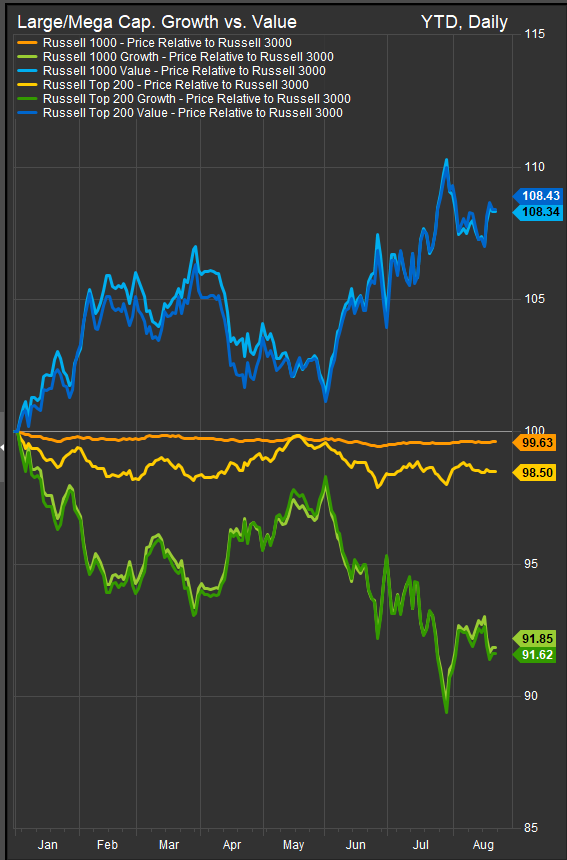
Chart: Value stocks have been clear leadership in 2026
The market is therefore separating price leadership from investor appetite. Value has the near-term performance advantage, while investors continue buying Growth weakness.
The Factor Tape
| Exposure | 1-Week Return | 1-Month Return | 1-Week Flow | 1-Month Flow |
| VUG – Growth | −2.49% | +2.16% | +$51M | −$934M |
| VTV – Value | +0.39% | +3.80% | −$309M | −$24M |
| VFLO – Free Cash Flow | +2.53% | +15.26% | +$150M | +$779M |
| SCHD – Dividend | +0.90% | +6.35% | +$875M | +$4.07B |
| SPMO – Momentum | −3.26% | +2.62% | +$271M | +$581M |
| MTUM – Momentum | −3.81% | +0.82% | −$179M | −$1.18B |
Source: ETFSector.com August 21 thematic ETF return and flow data.
The strongest message is not simply “Value.” It is current cash flow. VFLO has gained more than 15% over one month, while dividend-oriented SCHD has attracted more than $4 billion.
That is exactly what should work when the cost of capital remains high: investors place a greater premium on earnings and cash flows available today rather than profits expected many years into the future.
The Long End Is Still Blocking Growth
Treasury Secretary Scott Bessent’s attempt to calm the long end initially worked. Treasury doubled planned buybacks in the 10- to 30-year sector, briefly pulling yields lower. The effect faded quickly.
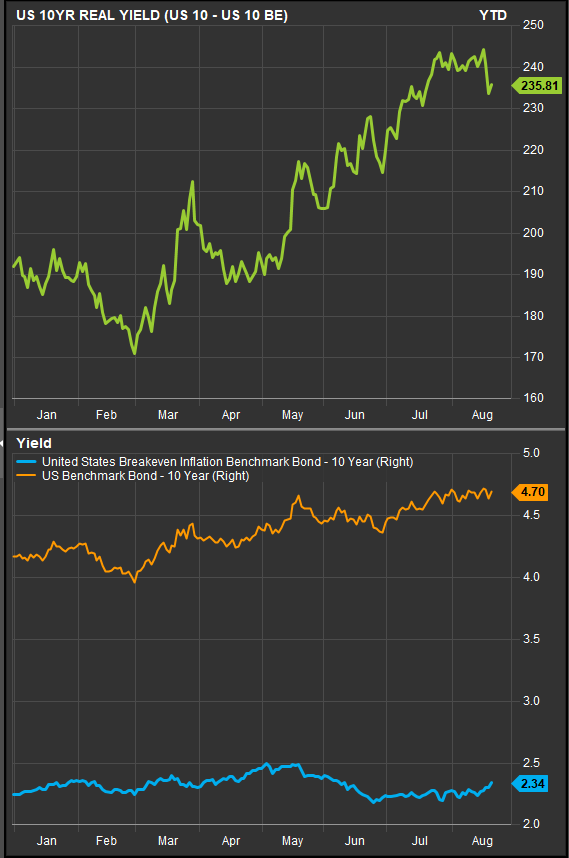
Chart: Rising real yields have been a tailwind to Value. Rates are dictating leadership.
The 10-year Treasury ended August 20 at 4.69% and the 30-year at 5.23%. Reuters reports the 30-year pushing back toward 5.25% Friday as investors questioned whether relatively small buybacks can offset persistent fiscal deficits, government borrowing and enormous corporate financing requirements.
Real yields have improved somewhat. The 10-year real yield fell from 2.44% on August 17 to 2.35% on August 20, while the 30-year real yield declined from 3.06% to 2.95%. But those remain restrictive levels for long-duration equities.
That is why Growth has not been able to convert its late-July rebound into sustained leadership.
The macro catalyst Growth needs is not another Treasury intervention. It is a fundamental decline in long-term real yields, driven by lower inflation, lower geopolitical risk and greater confidence in the fiscal and monetary-policy outlook.
AI Is Creating Its Own Interest-Rate Problem
Artificial intelligence remains one of the strongest earnings and capital-spending stories in the market. It is also becoming part of the reason long-term rates remain elevated.
Broadcom is reportedly exploring more than $60 billion of new debt financing for AI-chip infrastructure supporting customers including Anthropic and OpenAI. That follows a much broader surge in technology-sector borrowing to finance data centers, chips and electrical infrastructure.
The feedback loop matters.
AI investment boosts semiconductor, industrial, power and cloud revenues. But financing hundreds of billions of dollars of AI infrastructure puts additional supply into global bond markets, competing with already enormous Treasury borrowing. That can keep real yields high—and high real yields compress the valuations of the same Growth companies benefiting from the AI boom.
The political backdrop is becoming another constraint. Data-center development is facing growing local resistance over electricity prices, water use and infrastructure requirements. Axios cites estimates of roughly $600 billion of U.S. AI investment this year, while more restrictive permitting could increasingly distinguish well-capitalized projects from speculative development.
AT&T’s reported ability to cut some Anthropic-related costs by shifting workloads toward open-source models raises a second issue: AI demand may remain enormous even as the price of intelligence declines. That is good for enterprise adopters but potentially less favorable for the extreme revenue and margin assumptions embedded in frontier-model valuations.
Nvidia’s August 26 earnings therefore matter well beyond one stock. Investors need confirmation that AI demand remains strong enough to justify the industry’s increasingly large financing commitments. Reuters notes that the semiconductor index has fallen roughly 5% this week as rising yields again pressure the trade.
Where the Money Is Working Now
The sector tape reflects this higher-rate environment.
Energy’s VDE gained 2.89% this week and 9.93% over one month, while Health Care’s VHT rose 2.86% and 8.08%, respectively. Materials has gained approximately 6% over one month.
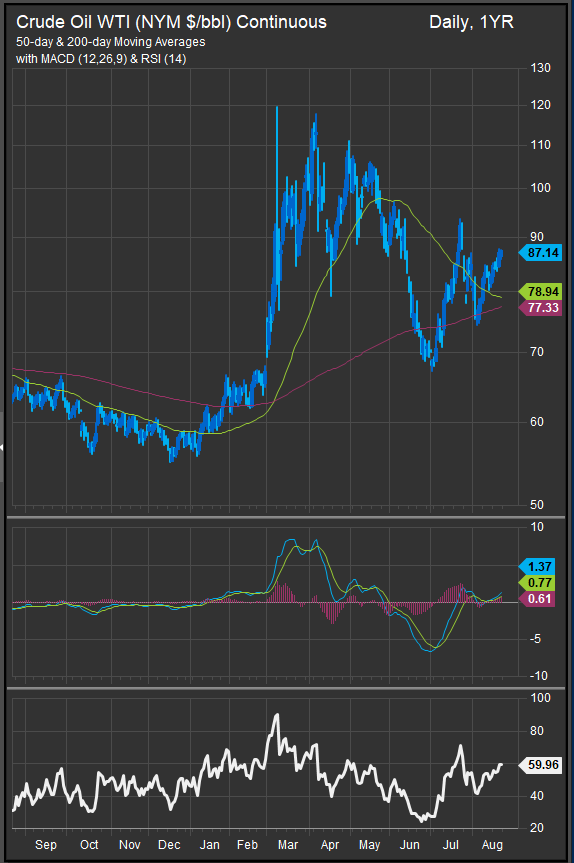
Chart: Crude prices are rising in the near-term, but remain in consolidation since April highs
By contrast, Information Technology fell 3.43% this week, Communication Services declined 2.48% and Industrials lost nearly 4%.
The thematic data are even more revealing.
Gold miners (GDX) gained 10.98% this week and 41.15% over one month. GLD attracted $2.23 billion this week and $4.91 billion over one month. Silver, copper miners and other natural-resource exposures have also been among the strongest recent performers.
That is the market’s “debasement” trade: investors responding to fiscal concerns, Treasury intervention, a weaker dollar and geopolitical uncertainty by buying scarce real assets. Reuters reports that long-term bond-market stress has persisted even as the dollar weakens and alternative stores of value strengthen.
Biotechnology is another notable winner. XBI gained 3.79% for the week and attracted approximately $361 million, while IBB rose 6.34%. Unlike mega-cap Technology, biotech offers Growth exposure without the same AI-capex crowding.
Iran Keeps the Value Tailwind Alive
The Middle East is also preventing a clean Growth rotation.
Washington is shifting toward economic pressure on Iran rather than immediate military escalation, but that does not necessarily mean lower energy prices. Iran has threatened retaliation while shipping through the Strait of Hormuz remains disrupted, and Brent crude moved above $93 Thursday.
If sanctions further restrict Iranian exports—or trigger retaliation affecting Gulf shipping—the inflationary consequences would reinforce Energy and commodity exposure while keeping pressure on long-term yields.
A genuine diplomatic settlement would do the opposite. Lower oil and refined-product prices could reduce inflation expectations, allow nominal and real yields to decline and create the macro opening Growth needs.
Can Growth Regain Leadership?
Yes—but the hurdle is higher than it appeared in late July.
The positive case is still intact. AI demand remains strong, Growth positioning has been cleaned up, investors continue buying Technology and QQQ during weakness, and real yields have begun edging down.
But Value and cash-flow factors retain the tactical advantage while the 30-year Treasury remains above 5% and geopolitical energy risk persists.
The most likely bridge back to Growth requires three things to occur together: continued evidence of tame core inflation, a meaningful decline in long-term real yields, and Nvidia plus the broader AI complex demonstrating that revenue and cash-flow returns justify the extraordinary capital being deployed.
Until then, the strongest factor message is less “Value versus Growth” than cash flow versus duration.
Free-cash-flow strategies, dividend stocks, Health Care, Energy and real assets are being rewarded for delivering earnings or scarcity value today. Growth still offers substantial upside, but the bond market is demanding a higher price for waiting.
If real yields finally break lower, the enormous flows continuing into QQQ and Technology suggest investors are already positioned to respond.
For now, Value has the lead. Growth needs cooler heads to prevail on Iran and some proof that inflation is now as bad as investors fear.
Sources
ETFSector.com August 21, 2026 thematic ETF return and flow data; ETFSector.com August 21 sector ETF return and flow data; U.S. Treasury daily nominal and real yield curves; Reuters reporting on global bond markets, Iran, oil and Nvidia; Financial Times and Axios reporting on Treasury buybacks and fiscal concerns; Reuters/Bloomberg reporting on Broadcom AI financing; Axios reporting on U.S. data-center investment and permitting pressures.
Disclaimer: This commentary is for informational and educational purposes only and does not constitute investment advice, an offer to sell or a solicitation to purchase any security. ETF prices, flows, factor exposures and economic conditions can change materially. Investors should consider their objectives, risks, charges and expenses before investing.
