


The Fed has begun tightening into an economy that is still growing and an inflation backdrop that remains uncomfortable. Value retains a commanding YTD lead, but the post-FOMC flattening of the Treasury curve is creating a more complicated factor setup than “higher rates equal Value.”
The Federal Reserve’s September rate hike did not settle the Growth-versus-Value debate. It made the debate more interesting. The Fed raised its target range by 25 basis points to 3.75%-4.00%, and its new projections point toward further tightening. The median year-end fed-funds projection rose to 4.1%, while the Fed simultaneously lifted its 2026 growth forecast, lowered its unemployment forecast and nudged inflation expectations higher. In other words, policymakers are tightening not because growth has collapsed, but because economic activity remains resilient enough that they believe inflation still requires restraint.
That distinction matters for equity factors. A tightening cycle driven by strong nominal growth and stubborn inflation is very different from a tightening cycle occurring immediately before recession. The former can continue to support Value, cyclicals and cash-generative companies even as higher discount rates pressure expensive equities. The latter eventually becomes hostile to almost everything except quality and defensives. For now, the factor charts still show a market firmly in the first camp.
Value Has Built a Large Lead
The attached Large/Mega Cap Growth versus Value chart leaves little ambiguity about the year-to-date leadership. Both Russell 1000 Value and Russell Top 200 Value are trading roughly 8% above the Russell 3000 on a relative basis, while their Growth counterparts are approximately 7% below it. The broad Russell 1000 and Top 200 themselves sit close to 100, which makes the divergence particularly useful: this has primarily been a style rotation within large-cap equities rather than simply a large-cap versus small-cap phenomenon. Value leadership accelerated materially through June and July as inflation pressures, commodity prices and Treasury yields moved higher. Growth has recovered somewhat from its summer relative lows, but the gap remains substantial. The first question for Factor Friday, therefore, is not whether Value has been winning. It clearly has. The question is whether the Fed’s new tightening cycle reinforces that leadership or begins to create the conditions for Growth to close the gap. The yield curve provides an important clue.
The 10-Year–2-Year Spread Is Becoming the Key Factor Signal
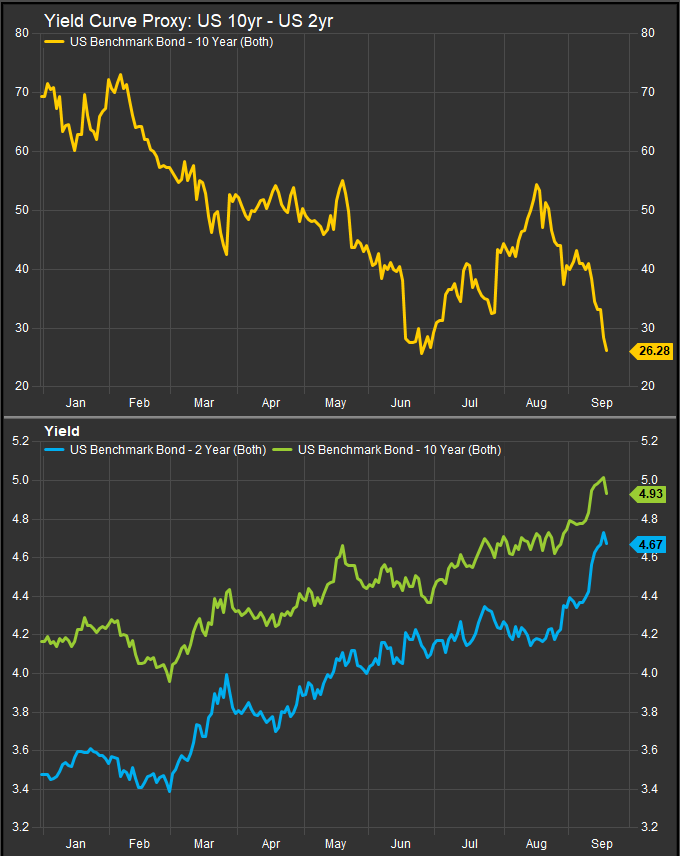
The attached Treasury chart shows the 10-year minus 2-year spread narrowing from roughly 70 basis points around the beginning of the year to about 26 basis points today. Both yields have risen sharply, but the front end has been catching up faster. The 2-year is now approximately 4.67%, versus roughly 4.93% for the 10-year. That is exactly what we would expect when markets price an active Fed tightening cycle. The central bank directly controls overnight rates and strongly influences the front end, so the 2-year responds quickly to expectations for additional hikes. The 10-year incorporates those expectations too, but it also reflects longer-run inflation, economic growth, fiscal risk and term premium.
The immediate post-FOMC reaction was a pronounced flattening of the curve as short yields rose more aggressively than long yields. Reuters characterized the move similarly, with the Fed’s hike and signal of additional tightening pushing the dollar and shorter yields higher while materially flattening the Treasury curve. For factor investors, that is important because “rates up” is not enough information. The source of the rate move and the shape of the curve matter.
If the Fed raises short rates but convinces investors that doing so will contain inflation, long-term yields can stabilize or decline. That removes one of the biggest valuation pressures on Growth. Conversely, if long yields continue climbing because investors remain worried about inflation, oil, deficits and term premium, the discount-rate headwind to Growth persists and Value retains an important relative advantage.
What Growth Needs: Fed Credibility Plus Earnings Delivery
The best scenario for Growth from here is not necessarily an immediate Fed reversal. It is a tightening cycle that successfully caps the long end. Growth equities are particularly sensitive to long-duration discount rates because a larger share of their valuation is attached to profits expected farther in the future. A 10-year yield moving sustainably lower would therefore matter more for Growth multiples than whether the Fed delivers one additional 25-basis-point hike at the next meeting. The ideal Growth setup would combine a stable or falling 10-year yield, a continuing flattening of the curve, resilient economic activity and continued earnings delivery from Technology and Communication Services. In that environment, markets could conclude that the Fed is doing enough to contain inflation without destroying demand. Long-duration valuations could receive some relief even while the policy rate remains elevated.
Friday’s AI headlines offer plenty of fundamental support for that possibility. Nvidia CEO Jensen Huang said chip shipments could double over the coming year as AI adoption spreads across industries, while Micron continues to describe tight memory supply and SK Hynix is considering additional U.S. production. Anthropic says AI is already performing more than a quarter of its internal research work, while Crusoe has raised another $3.9 billion to expand AI infrastructure. Those headlines matter because they strengthen the argument that earnings—not merely multiple expansion—can support parts of the Growth complex. If AI-related revenue, semiconductor demand and productivity gains continue expanding rapidly, Technology can tolerate a higher discount rate than it could if the investment case depended primarily on distant expectations.
Higher rates make the distinction between self-funded Growth and capital-dependent Growth increasingly important. Mega-cap Technology companies with large cash balances, semiconductor firms with strong order books and profitable software companies can finance investment internally. Startups, speculative clean-tech firms and heavily financed AI-infrastructure projects face a much more difficult calculation. SoftBank’s decision to increase an Arm-backed margin loan by another $5 billion and the financial pressure surrounding OpenAI-related investments illustrate just how capital-intensive parts of the AI ecosystem have become. Growth therefore has a credible path back—but it probably runs through earnings quality rather than another indiscriminate duration trade.
What Keeps Value in Control: Higher Long Yields and Strong Nominal Growth
The Value case remains formidable because many of the forces that produced its 2026 leadership are still present. Inflation has not been defeated. Oil and refined-product markets remain vulnerable to Middle East disruption, diesel prices are feeding into agricultural and food costs, and German producer-price data are showing renewed commodity pressure. The broader morning tape increasingly resembles a global tightening cycle rather than an isolated Fed move: the Bank of Japan has now raised rates as well, while officials at the ECB and RBA continue to discuss upside inflation risks. Reuters likewise notes that major central banks are confronting a renewed inflation problem tied in part to the energy shock, with monetary policy globally shifting toward tighter settings.
If that backdrop persists, Value retains several advantages. Higher nominal GDP tends to support revenues for cyclically exposed companies. Elevated commodity prices favor Energy and portions of Materials. Industrial companies benefit from infrastructure spending, reshoring, defense and manufacturing investment. Companies with substantial current free cash flow become more attractive when distant earnings are discounted at higher rates. The strongest continuation signal for Value would be a renewed rise in the 10-year yield accompanied by curve steepening. If the 10-year pushes higher because inflation, Treasury supply or term premium concerns overwhelm the Fed’s tightening efforts, investors would again have to increase the discount rate applied to long-duration Growth. That environment has historically been much more accommodating to Energy, Industrials, Materials and other economically sensitive Value exposures.
There is also a commodity component that cannot be ignored. Middle East diplomatic headlines have improved somewhat, but Saudi-Houthi strikes continue and tanker traffic through Hormuz remains vulnerable. At the same time, oil and food-related inflation remain prominent risks for global bonds. A renewed commodity surge would simultaneously improve the earnings outlook for parts of Value and increase the discount-rate pressure on Growth—a particularly powerful combination for relative Value performance.
Financials Are the Important Exception
There is one major problem with treating Value as a single trade: Financials do not necessarily want the same yield-curve configuration that benefits Energy or commodity-linked Value stocks. Banks typically prefer higher long rates accompanied by a healthy or steepening curve because their business models depend partly on earning a spread between funding costs and longer-term lending yields. A Fed-driven move that sends the 2-year sharply higher while the 10-year remains near 5% compresses that spread. That means further bear flattening—short rates rising faster than long rates—could weaken Financials even while other parts of Value remain resilient. A re-steepening caused by strong nominal growth would be much more constructive for the banks.
This distinction is critical because the factor trade may now begin to fragment. “Value” worked exceptionally well as a unified factor while oil, yields and cyclicals were rising together. As monetary policy tightens, investors may increasingly distinguish between Energy and Industrials, which can thrive on strong nominal activity, and Financials, which need the right shape of the yield curve in addition to higher rates.
The Curve Can Tell Us When the Factor Regime Is Changing
The two charts together provide a useful framework for the next phase of the market. Value’s YTD leadership is established. The question is what happens to the 26-basis-point 10-year/2-year spread from here. If the spread continues narrowing because the Fed pushes the 2-year higher while the 10-year stabilizes or declines, that would increasingly suggest that monetary-policy credibility is containing the long-run inflation premium. Such a move could become an important relative tailwind for Growth—particularly profitable Technology, semiconductors and Communication Services—while simultaneously limiting the benefit of tighter policy for banks.
If instead the curve re-steepens because the 10-year rises, the signal would be very different. That would suggest inflation, nominal growth, fiscal supply or term premium remain too powerful for the Fed to suppress long-term yields. Such a regime would likely continue to favor the parts of Value most exposed to commodities, industrial activity and current cash flow while keeping pressure on expensive Growth multiples.
There is also a third scenario: the curve steepens because the 2-year collapses as markets begin anticipating recession and future Fed cuts. That would initially help Growth valuations through falling yields, but it would carry a very different earnings implication. Cyclicals and lower-quality Value could suffer as investors start pricing economic weakness. The direction of the spread therefore matters less than why it is moving.
Factor Friday: What We Are Watching
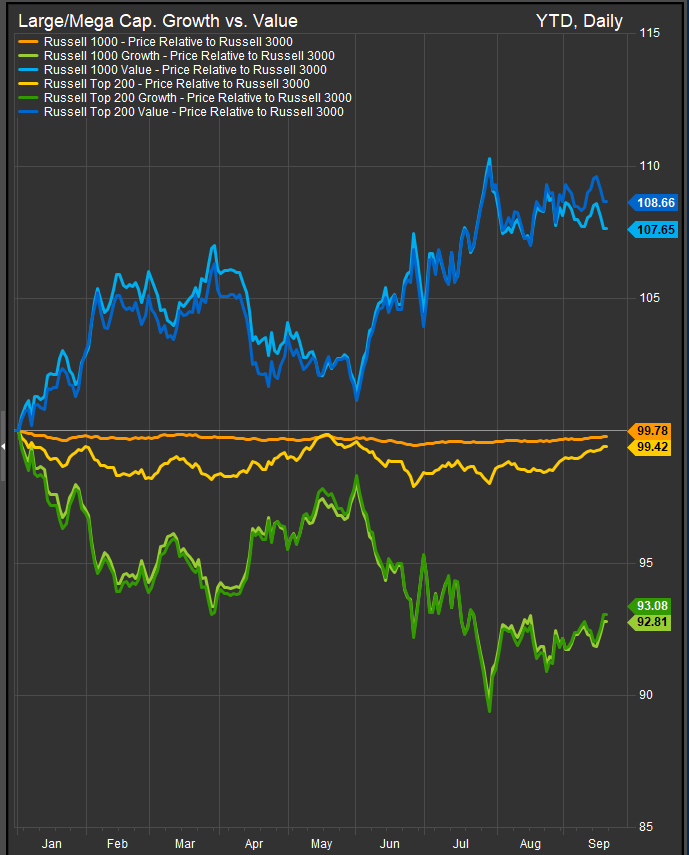
The current market is still a Value-led market, and the relative-performance chart shows just how significant that leadership has become. But the Fed’s first hike may have introduced the first credible mechanism for changing that regime. Growth does not need the Fed to cut rates immediately. It needs the Fed to establish enough credibility that long-term yields stop rising, while AI, semiconductor and software earnings remain strong enough to justify premium valuations. Continued curve flattening accompanied by stable economic growth would increasingly favor that outcome.
Value, by contrast, wants inflation and nominal activity to remain firm enough to sustain earnings without triggering a recession. The strongest environment would feature elevated commodity prices, resilient manufacturing and capital spending, and long-term yields remaining high or moving higher. A re-steepening curve driven by the 10-year—not collapsing short rates—would reinforce the Value case most clearly.
For sector investors, the tightening cycle therefore should not be reduced to a simple “Growth bad, Value good” rule. The more useful question is whether Fed tightening is raising the long-term discount rate or containing it. Right now, the Value trend remains dominant. But the rapidly flattening 10-year/2-year curve is beginning to create a path by which Growth could challenge that leadership. The next decisive move in long-term Treasury yields may tell us which factor gets the next leg of the trade.
Sources
Factor and Treasury-curve analysis is based on the supplied Large/Mega Cap Growth vs. Value and U.S. 10-Year minus 2-Year Treasury charts through September 2026 sourced from FactSet Research Systems Inc. Federal Reserve policy details and projections are from the September 16 FOMC statement and Summary of Economic Projections.
Reuters reporting was used for additional context on the post-FOMC yield-curve reaction and the developing global rate-hike cycle.
Disclaimer: This material is provided for informational and educational purposes only and does not constitute investment advice, a recommendation, or an offer to buy or sell any security. Factor leadership, interest rates and sector relationships can change rapidly, and historical relationships may not persist in future market environments.
