The YTD factor picture remains unusually clear: Value is still dominating Growth across both large- and mega-cap stocks. The Russell 1000 Value relative-performance series has outperformed by > 900 bps versus the Russell 3000, while Russell 1000 Growth has underperformed by >750 bps. The same pattern is visible in the Russell Top 200, where Value (+800 bps) and Growth near (-750bps). Meanwhile, the broad Russell 1000 and Top 200 relative series remain close to 100. In other words, this is not primarily a large-cap-versus-small-cap story. It is a pronounced style rotation occurring inside large-cap equities.
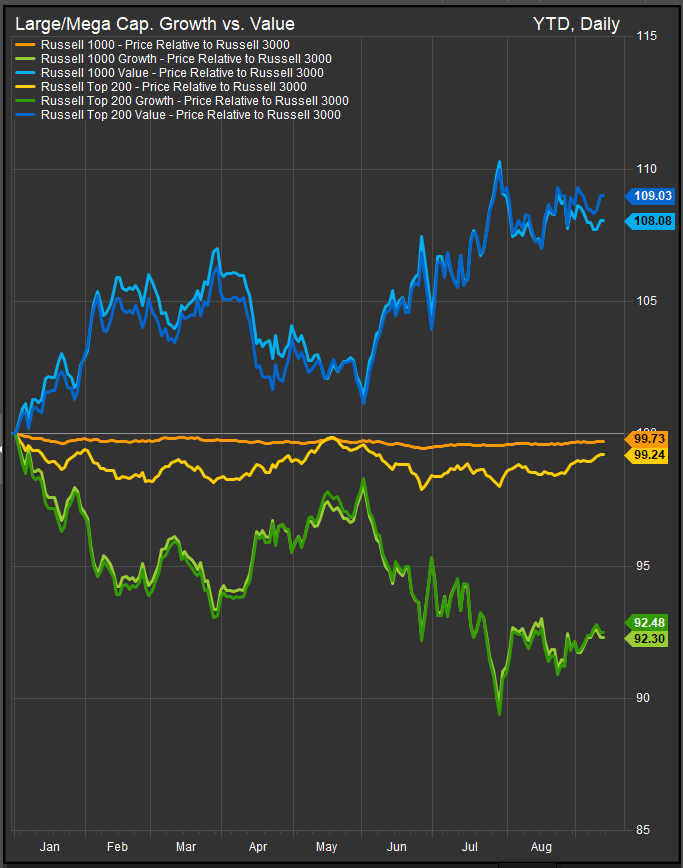
Chart: High crude prices, above target CPI readings and continued economic expansion have historically favored cheaper earnings streams and cash flows.
The macro backdrop continues to favor that rotation. The 10-year Treasury yield is approaching 5%, diesel has moved above $6 per gallon, and investors remain concerned that war-driven energy inflation could bleed into transportation, food and broader goods prices. At the same time, today’s CPI release has become the immediate test for whether the Fed can remain on hold or whether markets need to price a still-more-restrictive policy path.
Those conditions are inherently difficult for traditional long-duration Growth. But the news flow is also showing why the rotation is more nuanced than simply “sell Technology, buy Value.”
Higher Rates Are Still the Primary Factor Catalyst
The move toward Value began as higher real and nominal yields reduced the present value of distant earnings streams. That basic framework remains intact. A 10-year Treasury yield approaching 5% raises the hurdle rate for equities and particularly for businesses whose valuation depends on profits expected many years from now. It also gives investors an increasingly attractive alternative to equities.
This is visible in the chart. Large-cap Growth has not merely lagged for a few weeks; its relative-performance trend has been persistently negative for most of the year. Value, by contrast, broke decisively higher during the summer and remains near YTD relative highs even after its recent consolidation.
The important development now is that inflation risk, rather than economic weakness, is driving much of the rate backup. Diesel prices above $6, continued shipping disruption through Hormuz and ongoing refinery constraints all raise the probability that higher energy costs work their way through corporate margins and consumer prices.
That backdrop continues to favor companies with current earnings, pricing power, tangible assets and shorter-duration cash flows—the traditional building blocks of the Value factor.
But AI Is Splitting Growth Into Winners and Losers
The strongest counterweight to the Value rotation is the persistence of the AI capital-spending cycle. Oracle’s latest results are an important example. Oracle reported roughly 120% growth in cloud infrastructure, $664 billion of remaining performance obligations and approximately $30 billion of new AI contracts. Management also highlighted 850 MW of new capacity brought online. The caution is that this growth is extraordinarily capital intensive, with negative free cash flow and enormous financing requirements.
Microsoft provides another powerful fundamental signal. The company reportedly intends to add 26 GW of compute capacity, taking planned capacity to roughly 38 GW by 2032, while OpenAI has temporarily restricted subscriptions because infrastructure cannot keep pace with demand. Nvidia, meanwhile, continues to forecast extraordinary revenue growth.
That creates an important factor distinction. The market is becoming less willing to pay for Growth simply because it is Growth, but it remains willing to pay for companies where capital spending is already producing orders and revenue.
Oracle’s cloud business, Nvidia’s chips and the physical data-center infrastructure buildout fit that test. Adobe’s weaker outlook illustrates the other side: software franchises vulnerable to AI disruption are not automatically participating in the same fundamental boom.
The emerging rotation is therefore increasingly cash-flow Growth versus duration Growth, not simply Value versus Growth.
Energy Is Still the Macro Hedge—but Don’t Chase the Oil Spike
Energy remains one of the strongest sector expressions of the Value trade. The fundamental setup continues to benefit from restricted shipping, refinery bottlenecks and unusually strong product margins. Refiners in particular remain attractive because diesel scarcity and high crack spreads can improve downstream economics even when crude itself becomes volatile.
But today’s attempt to reopen negotiations over the Strait of Hormuz is an important reminder that geopolitical premiums can reverse quickly. Oil is pulling back after an eight-session advance of nearly 23% as Gulf officials prepare to discuss a possible temporary arrangement with Iran.
For sector investors, that argues for maintaining Energy exposure without chasing the highest-beta commodity producers after a vertical move. Refiners, energy infrastructure and companies with visible free cash flow offer a better factor fit than purely directional oil exposure.
Financials Remain a Natural Value Beneficiary
Higher yields also continue to support the relative case for Financials, particularly when the economy remains resilient enough to avoid a material deterioration in credit.
The sector offers current earnings, generally lower valuation multiples than Growth, and in many cases direct exposure to higher nominal rates and elevated market volatility. Capital-markets firms, exchanges, insurers and selected banks can all benefit from an environment in which nominal growth remains firm but asset-market volatility increases.
There is a limit to that bullish argument. A disorderly move in Treasury yields toward 5.5% would eventually become a broader financial-conditions shock. Today’s headlines already show investors increasingly concerned that rates in the 5%–5.5% area could precipitate an equity correction.
The factor takeaway is therefore to favor profitable, well-capitalized Financials rather than simply buying high-beta lenders.
Industrials Are Becoming a Hybrid Value/Growth Sector
Industrials may be the most interesting sector in the current factor environment because the AI power and infrastructure buildout is giving traditional cyclical businesses a secular-growth tailwind.
Electrical equipment, grid construction, power generation equipment, cooling and data-center infrastructure increasingly sit at the intersection of Value, Quality and Growth. These companies frequently have real earnings, large order books and industrial balance sheets while simultaneously participating in one of the strongest capital-spending cycles in the economy.
That makes the group different from speculative Growth. Investors do not have to wait for a distant AI application to generate profits; the physical infrastructure is being ordered today.
For sector allocators, this argues for emphasizing high-quality Industrials tied to power, grid and data-center capital spending, rather than treating the entire sector as a simple economic-cycle bet.
Health Care Offers a Different Kind of Factor Diversification
Health Care also remains attractive in the current factor mix. Unlike traditional defensive sectors such as Utilities or Real Estate, much of Health Care carries less direct long-duration bond sensitivity while still offering stable earnings and lower economic cyclicality.
That gives the sector a useful combination of Quality, defensive earnings and selective Growth. It also provides diversification from both the AI capital-spending complex and the oil/inflation trade.
In a market where Value leadership is strong but rates themselves are the source of risk, Health Care can function as a more attractive defensive allocation than simply reaching for bond proxies.
Traditional Defensives Are Not Necessarily the Answer
One of the traps in the current environment is assuming that rising volatility automatically means investors should overweight every low-volatility sector.
A 5% Treasury yield is a serious competitor for Utilities and Real Estate, while higher fuel and transportation costs can pressure consumer-oriented defensive businesses. Consumer Staples may offer earnings stability, but the sector also faces margin pressure if energy and logistics inflation persists.
That means the preferred defensive factor is increasingly Quality rather than low volatility alone.
Investors should focus on balance sheets, free cash flow and pricing power rather than simply historical beta.
What the Chart Is Really Saying
The YTD chart shows three distinct regimes.
Value has broken strongly higher relative to the broad market. Growth has broken strongly lower. But the broad large-cap and mega-cap series themselves remain almost exactly flat relative to the Russell 3000.
That tells us the dominant market question is not capitalization. It is what type of large-cap company investors want to own.
Right now, the answer is companies with current cash flow, tangible economic exposure and less duration risk. But within Growth, AI infrastructure companies are increasingly earning an exemption because their fundamental results are strong enough to overcome some of the rate pressure.
That combination can sustain Value leadership without requiring Technology to collapse.
Sector Positioning for the Week Ahead
For sector investors, the best positioning remains a Value and Quality bias with selective participation in AI infrastructure.
Energy and Financials remain the cleanest traditional beneficiaries of the Value regime, although the sharp oil move argues against chasing Energy indiscriminately. Health Care offers quality and defensive earnings without as much direct duration exposure as the traditional bond proxies.
Within Industrials, power generation, electrical equipment, grid infrastructure and data-center construction represent one of the strongest areas where secular Growth and current cash flow intersect. That deserves a higher allocation than more economically sensitive or transport-heavy industrial exposures, particularly while diesel costs remain elevated.
Technology should remain selective rather than broadly underweight. Semiconductors, cloud infrastructure and profitable AI-enablement businesses remain fundamentally supported. Application software and high-multiple Growth companies with less visible monetization face a much higher hurdle as Treasury yields approach 5%.
Consumer Discretionary, Real Estate and the most duration-sensitive Growth exposures remain the clearest areas of caution. High fuel costs pressure household purchasing power, while rising yields directly challenge housing affordability, REIT valuations and long-duration equity multiples.
The key factor message from this week’s tape is therefore not simply Value over Growth. It is cash flow over duration, infrastructure over concepts, and Quality over indiscriminate beta. The Russell style chart suggests that rotation is already well established; today’s macro and corporate news continues to reinforce it.
Factor Friday Bottom Line
The Value trade remains the dominant YTD factor trend, but the next phase is becoming more selective. Higher yields and energy inflation continue to favor Energy, Financials and cash-generative businesses, while AI infrastructure is creating pockets of durable Growth leadership inside Technology and Industrials.
For sector investors, that means staying biased toward Value and Quality while selectively owning the companies supplying the AI and power buildout—rather than making a blanket bet against Growth or a blanket bet on traditional defensive sectors.
Sources
- Price and Flow data sourced from FactSet Research Systems, Inc.
- Reuters / Bloomberg — global bond-market selloff, U.S. 10-year Treasury yield approaching 5%, equity-volatility concerns and Treasury-market developments.
- Bloomberg / Financial Times and other supplied corporate sources — Oracle cloud results, Adobe outlook, semiconductor developments and other corporate catalysts affecting Growth-factor leadership.
- Bloomberg / TechCrunch / other supplied AI-industry sources — Microsoft data-center expansion, OpenAI capacity constraints, Nvidia growth expectations and broader AI-infrastructure developments.
- StreetAccount CPI Preview — August core CPI expectations and competing interpretations for September Fed policy.
- Oracle earnings coverage / supplied market commentary — 120% OCI growth, $664 billion of RPO, AI bookings and the tension between strong AI monetization and large capital requirements.
- Reuters / Bloomberg / CNBC / New York Times — record U.S. diesel prices, refinery constraints and potential inflation spillovers into freight and food costs.
Disclaimer: The information provided is for informational and educational purposes only and should not be construed as an offer, recommendation or solicitation to buy or sell any security, ETF or investment strategy. All investments involve risk, including possible loss of principal, and past performance is not indicative of future results.
Sector, factor and style relationships can change rapidly as interest rates, inflation, economic conditions, earnings expectations and investor positioning evolve. References to Value, Growth, Quality, Momentum or other factors are analytical classifications and do not guarantee future performance. Opinions and market views reflect judgment as of the publication date and are subject to change without notice. Investors should conduct independent due diligence and consult an appropriate financial professional before making investment decisions.