
April 7, 2025
Macro Signals to Watch
Two market signals — 10-year Treasury yield below 4.2% and WTI crude below $100 — would indicate the market is pricing in a bullish Iran de-escalation scenario: reduced geopolitical risk premium in energy, easing inflation expectations, and a more constructive rate outlook. The corollary is that persistently elevated energy prices signal an inflation resurgence that threatens late-cycle business dynamics.
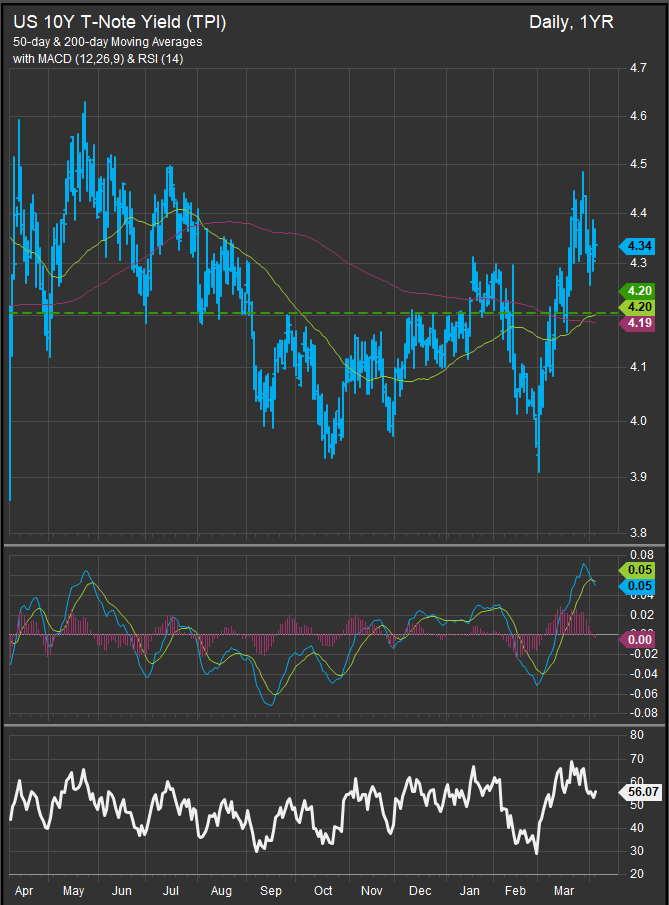
The 4.2% level is technically significant as it has been both support and resistance over the past 12-months and both the 50 and 200-day moving averages are very near that level as well.
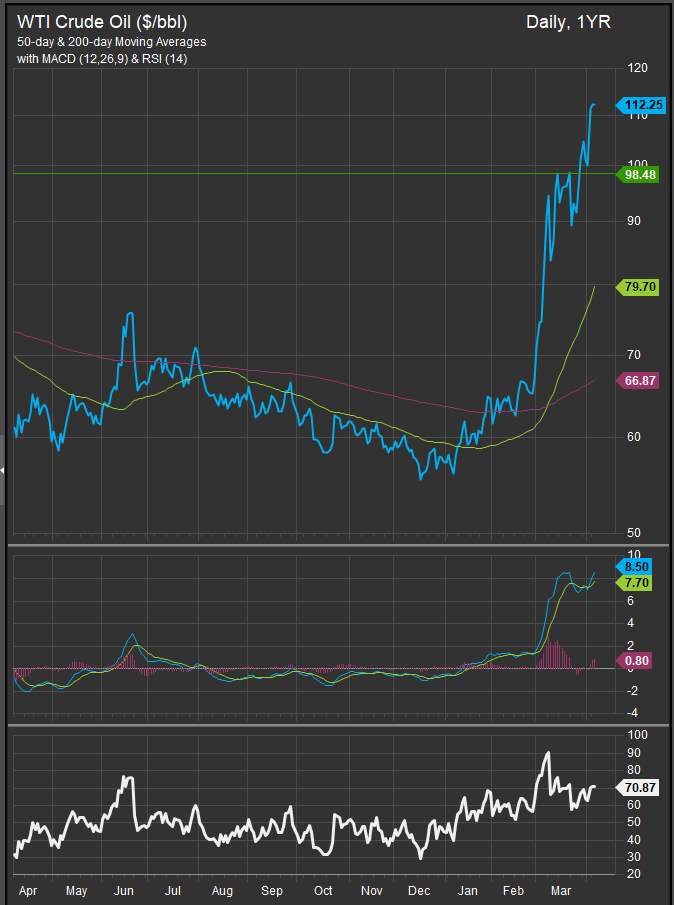
At WTI crude currently trading at $112.25/bbl, the market is not pricing de-escalation. It is pricing conflict persistence — and the inflation threat scenario this thesis warns against is now the base case.
What $112 Oil Means for the Thesis
The $100 threshold in this framework exists precisely because triple-digit crude is historically associated with demand destruction, margin compression, and late-cycle inflation pressure that the Fed cannot easily accommodate. At $112, the market is embedding a meaningful geopolitical risk premium — consistent with active Hormuz disruption fears, Iranian escalation rhetoric, and the kind of supply anxiety that does not resolve quickly.
This is not a market pricing a deal. This is a market pricing a protracted standoff.
Three supply-side dynamics are keeping crude elevated and could push it higher:
- Iranian export disruption risk. Iran produces ~3.4 million bpd and exports ~1.7 million bpd, primarily to China. Any further escalation threatening Hormuz transit — through which ~20% of global oil supply flows — would represent a supply shock with no short-term offset.
- OPEC+ has limited spare capacity buffer. The cartel’s ability to credibly replace Iranian barrels or absorb a Hormuz disruption is constrained, meaning supply shocks at this stage propagate more directly into price.
- U.S. shale response lag. Even with domestic producers incentivized at $112, meaningful new production takes 6–12 months to reach market — offering no near-term price relief.
The Inflation Threat Is Now the Base Case
Sustained crude above $100 feeds inflation through multiple transmission channels simultaneously:
- Gasoline and diesel pass through directly to CPI within 4–6 weeks
- Transportation and logistics costs reprice freight, elevating goods inflation broadly
- Petrochemical and industrial inputs raise producer prices across manufacturing
- Airline fuel surcharges compress consumer discretionary spending on travel and leisure
The Fed’s problem is acute: it cannot cut rates into an oil-driven inflation spike without risking a credibility-destroying policy error, yet tightening further into a growth slowdown risks accelerating the very recession that elevated yields and demand destruction would signal. This is the classic stagflation trap, and $112 oil is its primary accelerant.
Sector Implications — Stagflation / Conflict Persistence Positioning
Overweight
- Energy (Upstream E&P): The most direct beneficiary. Integrated majors and pure-play producers carry elevated margins at $112. Free cash flow generation is strong; shareholder return programs are well-funded. Names with Permian or offshore exposure are insulated from geopolitical supply disruption.
- Energy (Midstream/Infrastructure): Pipeline and storage operators benefit from elevated throughput economics and are relatively insulated from commodity price volatility while capturing the volume upside.
- Defense: Sustained Middle East tension is a multi-year procurement cycle catalyst. Budget pressure on NATO allies and U.S. readiness spending supports sector revenue visibility.
- Commodities/Materials: Broad commodity inflation lifts miners, fertilizer producers, and agricultural input companies. Pricing power is elevated across the complex.
- Healthcare: Defensive positioning with low energy input sensitivity. Outperforms in stagflationary environments where growth assets de-rate.
Underweight
- Consumer Discretionary: The most exposed sector to an oil-driven consumer squeeze. Real disposable income contracts as gasoline and food prices rise. Discretionary spending on travel, apparel, restaurants, and durables faces demand compression. Margins also pressured by freight and input costs.
- Airlines / Transport: Jet fuel is the single largest operating cost for carriers. At $112 WTI, fuel surcharges lag the cost curve, and demand elasticity kicks in at high ticket prices. Avoid.
- Homebuilders / REITs: Rate sensitivity combined with a Fed constrained from cutting makes this the wrong end of the duration trade in a stagflationary environment.
- Highly Leveraged Industrials: Input cost inflation combined with slowing end demand is a margin compression double-hit. Companies without pricing power are most vulnerable.
Neutral / Situational
- Financials: A steepening yield curve (if long rates rise on inflation) benefits net interest margin, but credit quality deterioration in consumer and small business books is a growing tail risk. Bank-specific rather than sector-wide call.
- Utilities: Classic defensive, but elevated energy input costs for non-renewable generators compress margins. Renewables-heavy utilities are relatively better positioned.
- Technology: Large-cap tech has become a quasi-defensive trade in volatile markets given balance sheet strength, but is not immune to a sustained risk-off regime or a Fed that cannot pivot.
Key Watchpoints for a Thesis Reversal
The de-escalation trade is not dead — it is simply not yet priced. The following catalysts would signal a shift back toward the bullish normalization scenario and warrant repositioning:
| Catalyst | Price Target Signal | Sector Rotation |
| Confirmed Iran nuclear framework | WTI breaks below $90 | Rotate out of E&P, into Discretionary/Airlines |
| Hormuz reopening / ceasefire | WTI breaks below $85 | Add Financials, Industrials |
| Fed signals rate flexibility | 10-yr yield drops below 4.0% sustainably | Add duration, growth |
| OPEC+ emergency supply release | WTI $95–100 range | Neutral energy, watch consumer data |
A WTI move below $100 sustained over 5+ trading sessions would be the first meaningful signal that the risk premium is unwinding. A single-day dip on a headline is not sufficient — the 2024–2025 oil tape has been characterized by violent intraday swings on geopolitical rumors that fully retraced within 48 hours.
Bottom Line
The thesis parameters were designed as a forward-looking signal framework. Right now, both threshold conditions are unmet — WTI is $12+ above the $100 warning level, and until the 10-year yield is confirmed, the full picture remains incomplete. But $112 crude alone is sufficient to conclude that the market is not discounting de-escalation; it is discounting a prolonged energy shock.
The inflation threat scenario is live. Sector investors should be positioned accordingly — long energy, long defense, short consumer cyclicals, and cautious on any rate-sensitive asset until crude shows a sustained and fundamental (not headline-driven) reversal below $100.
The de-escalation trade will be one of the more compelling rotations of the cycle when it triggers. It has not triggered yet.
