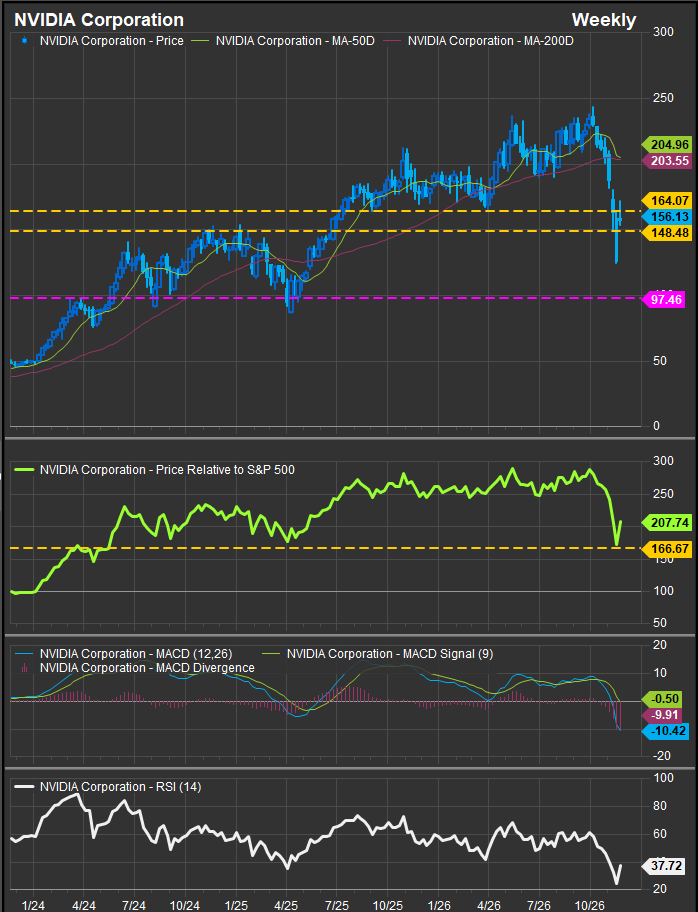
NVIDIA closed Monday at $165.05, putting the stock in recovery above $164. For advisors looking to build a position, $148–$164 is the potential accumulation zone. Existing holders can participate in the recovery; an underweight book can use a pullback into that range to add in stages. Below $148, abandon the thesis for a quicker bullish pivot.
Jensen Huang’s return as CEO helped lift the VanEck Semiconductor ETF (SMH) 15.03% on Monday. Even after that gain, SMH was up just 0.02% for the week. NVIDIA’s momentum indicators tell a similar story: weekly RSI has rebounded to 40.65, while MACD remains negative. If the recovery extends, the 200-day and 50-day moving averages mark overhead resistance at $203.60 and $205.14, respectively.
NVIDIA has generated 117.64% excess return versus the S&P 500 over the period shown. It surrendered part of that lead during the selloff and has begun to earn it back. For a sector investor deciding whether to increase an active weight in Technology, a widening excess return would strengthen the case: NVIDIA would be recovering faster than the alternative already available in the benchmark.
The fundamental question is who finances the next order. NVIDIA generated $48.3 billion of operating cash flow in its fiscal third quarter. It expects roughly $130 billion in fourth-quarter revenue without assuming any China data center compute sales. Yet management expects gross margin to fall from 74.8% to 71%–72%, and days sales outstanding rose from 60 to 64. NVIDIA cited shipment timing and longer payment terms for some investment-grade customers. The next earnings report has two useful tests: whether margins hold within guidance and whether collections catch up with sales.
Credit exposure extends beyond invoices. Of NVIDIA’s $118 billion in maximum gross guarantees, $105 billion relates to one SB Energy campus that will house OpenAI infrastructure. That guarantee takes effect building by building, with the first expected in fiscal 2029. No payments had been made under the guarantees as of the quarterly disclosure. The distinction matters: if a developer cannot finance construction, chip deliveries can slip before a guarantee ever takes effect. With inflation around 3.5%, according to New York Fed President John Williams, cheaper funding is a poor assumption on which to base a purchase. The board’s investigation also remains open, and Huang’s December 3 Senate hearing keeps export controls in focus.
| ETF / exposure | 1-week return | 1-week net flow | 1-month return | 1-month net flow |
| SMH · Semiconductors | +0.02% | −$834m | −12.71% | +$2,225m |
| SOXX · Semiconductors | −0.88% | +$1,046m | −12.03% | −$1,055m |
| AIQ · AI and technology | −1.74% | +$144m | −11.90% | +$59m |
| CIBR · Cybersecurity | +3.43% | +$399m | −10.59% | +$545m |
| IGV · Software | −0.50% | −$636m | −13.86% | −$858m |
| GRID · Grid infrastructure | −0.52% | −$137m | −5.13% | −$336m |
Source: FactSet Research Systems Inc., November 24 data. ETF returns are absolute; net flows are in U.S. dollars, rounded to the nearest million.
The $1.05 billion weekly inflow into SOXX looks less decisive alongside $834 million of redemptions from SMH. Together, the two chip funds took in $212 million, and both still carried monthly losses of about 12%. The flows alone cannot tell us whether investors switched funds. Cybersecurity offers a clearer weekly signal: CIBR gained 3.43% and attracted $399 million, while the broader software fund IGV lost 0.50% and shed $636 million. For an advisor looking beyond chips, that makes security spending a better candidate for research than a blanket increase in software exposure.
For an advisor already overweight AI, the recovery offers a chance to trim where conviction is lowest. Start with the NVIDIA shares held indirectly through technology and semiconductor ETFs. Then look for different holdings that depend on the same customer: a chip supplier, an electrical equipment maker and a power developer may all be counting on one data center getting built. If the book needs less AI exposure, a position that depends on the developer’s next financing round is a better candidate for sale than a supplier already collecting cash on delivered work.
40-word excerpt: NVIDIA is in recovery above $164. A pullback into the $148–$164 range offers a potential accumulation opportunity. For advisors sizing AI exposure, the sharper distinction is between suppliers collecting cash on deliveries and developers still seeking financing for their projects.
Sources: Morning headlines, NVIDIA chart and thematic ETF data supplied for November 24, 2026. CSV data sourced from FactSet Research Systems Inc. Additional research:
- NVIDIA fiscal third-quarter 2027 results, November 17, 2026.
- NVIDIA CFO commentary on fiscal third-quarter 2027 results.
- NVIDIA supplemental financial information for the quarter ended October 25, 2026.
- NVIDIA board reinstatement announcement, November 23, 2026.
- Senate Banking Committee hearing scheduled for December 3, 2026.
- John Williams, “The Economic Mixdown,” November 23, 2026.
Disclaimer: This commentary is for informational and educational purposes only and does not constitute investment advice or a recommendation to buy or sell any security. Opinions may change without notice. Sources are believed reliable, but accuracy and completeness are not guaranteed. Past performance does not guarantee future results. Investing involves risk, including loss of principal.