

December 9, 2025
Every market cycle has its rhythms, but few relationships are as reliable—and as frequently misunderstood—as the link between rising commodity prices and outperformance in the Energy and Materials sectors. Investors tend to treat commodities as macro noise or inflation signals, yet for the companies that extract, process, or transport those raw inputs, commodity pricing is the single most powerful driver of earnings, cash flow, and equity performance. When commodity prices rise, these sectors don’t just benefit—they often outperform dramatically. The reasons are structural, not cyclical, and understanding them is essential for sector allocators navigating today’s reawakening commodities environment.
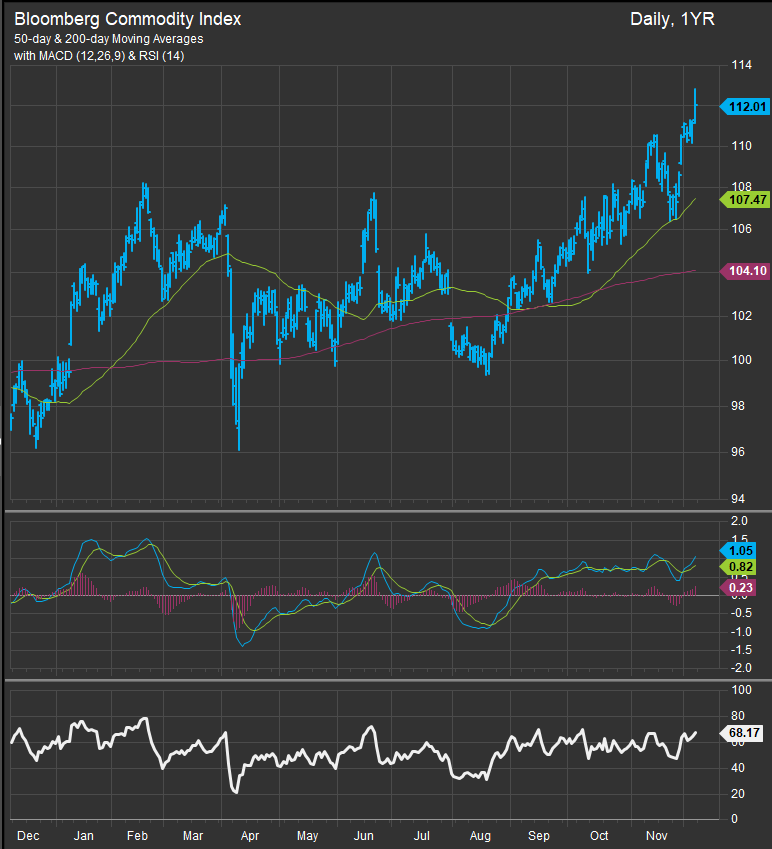
At the core of the relationship is operating leverage. Commodity-producing companies have relatively fixed production costs—labor, equipment, transportation, maintenance—while the price of what they sell can move sharply with shifts in global supply and demand. When oil, copper, natural gas, or industrial metals rise meaningfully, that incremental price increase flows through to margins with extraordinary force. The result is a surge in free cash flow and profitability that is disproportionate to the move in the underlying commodity. This is why an oil or copper price up 15% can translate into 40–70% upside in certain Energy or Materials equities. The stocks are not responding linearly to the commodities—they are responding to the expanding wedge between fixed costs and rising selling prices.
But the historical outperformance of these sectors goes beyond simple margin expansion. Rising commodity prices also reshape investor psychology and capital flows. In periods of commodity strength, inflation expectations tend to firm, bond yields often move higher, and the market rotates toward real assets and value sectors. This is precisely the environment in which Energy and Materials outperform relative to the broader market. Investors discount future earnings at higher rates when yields rise, which pressures long-duration growth stocks but benefits cash-generating, asset-intensive sectors whose profitability improves in nominal terms. In other words, rising commodities can weaken the multiple drivers of growth stocks while simultaneously amplifying the earnings drivers of Energy and Materials.
There’s also a supply-side dynamic that reinforces the pattern. Most commodity cycles are shaped not only by demand strength but by years of underinvestment. Both Energy and Metals producers tend to go through extended capital discipline phases after commodity downturns—cutting capex, reducing exploration budgets, and avoiding large projects. When demand rebounds, supply cannot respond quickly. Oil projects take years to come online; new mines can take a decade to permit and develop. This structural supply lag makes commodity upswings more persistent, allowing Energy and Materials companies to enjoy extended periods of elevated pricing power. Investors, recognizing the durability of these cycles, rotate into the sectors not just tactically but strategically, driving further outperformance.
Inflation also plays a reinforcing role. When commodity prices rise as part of a broader inflation environment—like the 1970s, early 2000s, 2021–2022—Energy and Materials stocks tend to act as hedges. Their revenues rise with inflation, their margins expand, and their asset bases appreciate in real terms. Few other sectors have this natural inflation pass-through ability. In periods when inflation is top-of-mind, portfolio managers increase exposure to the sectors that benefit directly from nominal price growth rather than those hurt by it. This inflation-hedging characteristic has historically allowed Energy and Materials to outperform even when broader equity markets struggle.
And then there is the geopolitical factor. Commodity prices often spike around geopolitical tension—war in Eastern Europe, supply disruptions in the Middle East, labor strikes at mines, sanctions on major producers. Unlike most sectors, Energy and Materials benefit from geopolitical volatility rather than suffer from it. Supply disruptions raise realized selling prices, while diversified global operators can shift distribution or production to mitigate local risk. The equity market, in turn, treats these companies as beneficiaries of global imbalance rather than victims of it.
The result of all these forces—operating leverage, supply constraints, inflation dynamics, investor rotations, and geopolitical asymmetry—is a pattern that has repeated for decades: when commodities rise, Energy and Materials outperform. It happened in the inflationary 1970s, during the China-led commodity boom of the early 2000s, in the post-COVID supply shock of 2021–2022, and again in the early stages of the Russia–Ukraine war. And we’re seeing the early signs of the cycle reasserting itself today, as geopolitical tensions rise, natural gas prices firm, oil supply disruptions proliferate, and the long-term power demands of AI begin to reshape global energy and metals consumption.
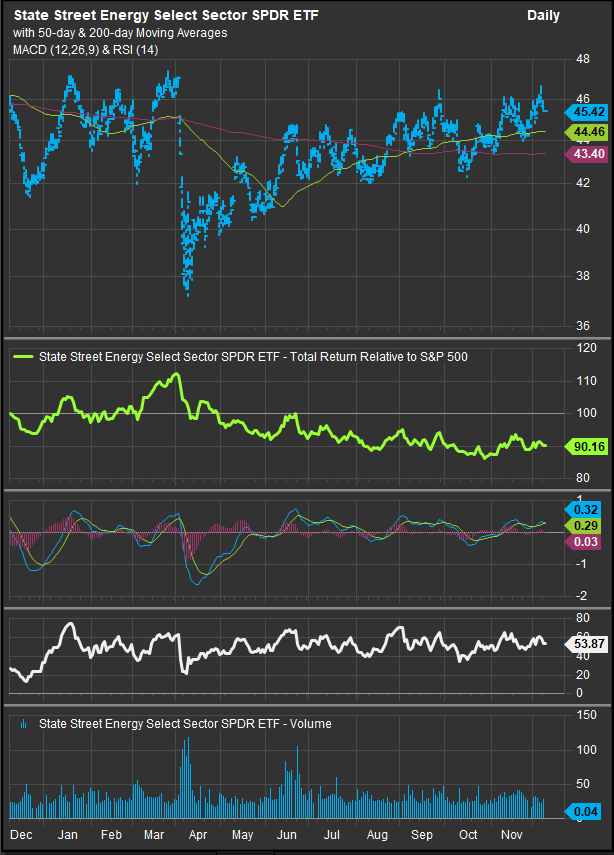
XLE
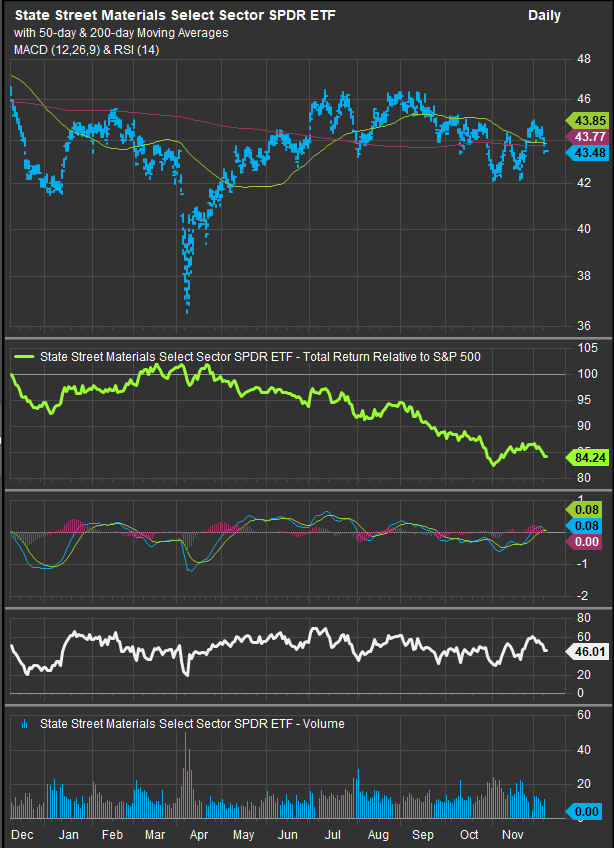
XLB
For investors, the lesson is not simply that rising commodities help Energy and Materials—it is that these sectors offer some of the purest, most leveraged exposure to global real-asset cycles. When commodity prices rise, they generate windfall cash flows, attract capital rotation, and often trade at valuations that still underestimate the persistence of the underlying cycle. And unlike speculative pockets of the market, their strength is grounded in fundamental scarcity, physical demand, and global supply limits.
In a market where inflation is not fully tamed, geopolitical stability is uncertain, and energy and metals demand is once again being repriced upward, the historical playbook is clear: rising commodity prices are a signal, and Energy and Materials remain two of the most reliable beneficiaries when that signal turns positive. With the XLB and XLE being sold to start December, we think the setup for accumulating these exposures is favorable and we are long both in our Elev8 Sector Rotation Model for December.
Sources:
Bloomberg, Global Commodities and Sector Performance Coverage, Bloomberg L.P., various reports.
Reuters, Energy and Metals Market Dispatches; OPEC+ Developments, Thomson Reuters Corp., multiple releases.
Financial Times, “Energy Markets, Metals Supply Chains, and Inflation Impacts,” FT Group, assorted articles.
CNBC, “Commodity Pricing Trends and Sector Rotation Commentary,” CNBC Digital, periodic coverage.
The Wall Street Journal, “U.S. Energy Producers, Mining Sector Dynamics, and Inflation Trends,” Dow Jones & Co.
International Energy Agency (IEA), Oil Market Report and World Energy Outlook, Paris: IEA Publications (annual and monthly).
U.S. Energy Information Administration (EIA), Short-Term Energy Outlook and Annual Energy Review, U.S. Department of Energy.
OPEC Secretariat, Monthly Oil Market Report and OPEC+ Ministerial Communications, Vienna.
World Bank, Commodity Markets Outlook, Washington, D.C.: World Bank Group (semiannual).
S&P Global Market Intelligence, Sector Research and Commodity Cycle Analysis, various reports.
MSCI Inc., Global Industry Classification Standard (GICS) Methodology and Sector Behavior Studies.
Goldman Sachs Global Investment Research, Commodities Research: Supercycles, Supply Constraints, and sector earnings sensitivity.
J.P. Morgan Research, Commodities Strategy and Macro Sensitivity of Energy & Materials.
Bank of America Global Research, Equity Sector Rotation and Real-Asset Cycles.
National Bureau of Economic Research (NBER), Studies on Inflation Cycles and Commodity Shocks, Cambridge, MA.
Federal Reserve Bank of St. Louis (FRED), Commodity Index Data, CPI/PPI Inflation Series, Industrial Production Time Series.
International Monetary Fund (IMF), World Economic Outlook: Commodity Demand and Global Supply Constraints, Washington, D.C
Other data sourced from Factset Research Systems Inc.
