



Meta has become one of the cleanest case studies for the AI pricing dilemma now facing equity investors. The company is not an AI pretender. Its core advertising business is already using AI to improve ranking, recommendations, ad targeting, creative automation, and conversion. Revenue growth is strong, the Family of Apps business remains highly profitable, and management is positioning AI agents, business messaging, and personal assistants as future revenue opportunities.
That is the bullish case. The bearish case is not that AI is failing. The bearish case is that the cost of remaining a front-line AI platform is rising faster than the market can comfortably underwrite.
Meta’s recent fundamentals show both sides of the debate. Revenue rose 22% in 2025 to roughly $201 billion, and operating income increased 20% to about $83 billion. In Q1 2026, revenue grew 33% year over year, ad impressions increased 19%, and average price per ad rose 12%. Those are not the numbers of a company losing relevance. They suggest that AI is strengthening the existing advertising engine by improving engagement, pricing, and advertiser performance.
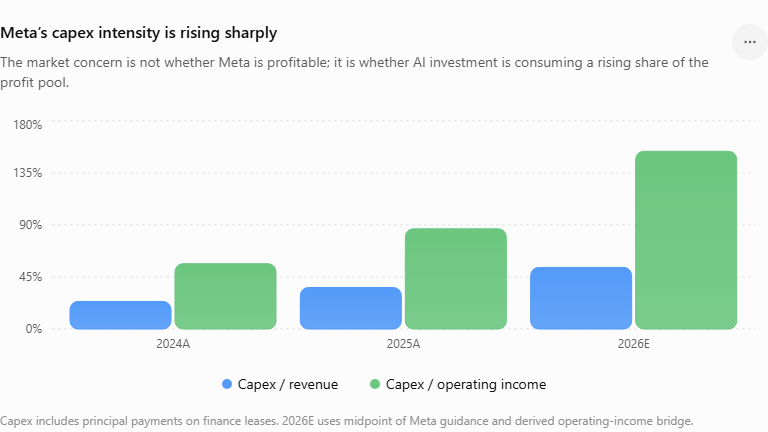
Chart: Despite a strong track record of earnings growth, META’s AI spend has grown faster.
But the investment debate has shifted from revenue growth to return on invested capital. Meta’s capex, including principal payments on finance leases, increased from about $39 billion in 2024 to $72 billion in 2025. For 2026, management now expects $125–145 billion of capex, with the midpoint nearly doubling again from 2025 levels. That means investors are being asked to value a company whose operating model is still producing exceptional profits, but whose cash-flow profile is becoming far more capital intensive.
That is the AI pricing dilemma in one chart. Meta’s operating income rose from about $69 billion in 2024 to $83 billion in 2025, and management expects 2026 operating income to exceed the 2025 level. But the capex line is rising much faster. Using consensus 2026 revenue and the midpoint of management’s expense guidance, operating income could bridge to roughly $88 billion. That is positive growth, but against approximately $135 billion of guided capex at the midpoint. On that basis, capex would be more than 150% of estimated operating income in 2026, up from roughly 57% in 2024.
This does not mean Meta is structurally impaired. It means the market is no longer willing to treat AI spending as self-evidently accretive. Investors want proof that AI infrastructure spending can generate revenue growth, pricing power, margin expansion, and free cash flow at a pace that justifies the investment. The burden of proof has moved from “does Meta have AI?” to “does Meta earn an acceptable return on the next $100 billion-plus of AI capacity?”
The spending increase is being driven by several factors. Meta is building compute capacity for its core recommendation systems, advertising products, personal AI assistants, and Meta Superintelligence Labs. Management has also pointed to higher component pricing and additional data center costs needed to support future capacity. In other words, some of the capex increase reflects more ambition, but some also reflects inflation in the cost of AI infrastructure. That distinction matters. If spending is rising because future demand is exploding, investors may tolerate it. If spending is rising because GPUs, memory, power, and data-center components are more expensive, then the return hurdle rises.
The profitability side of the case is also nuanced. Meta’s core Family of Apps business remains one of the strongest profit pools in the global equity market. It produced more than $26 billion of operating income in Q1 2026 alone. But that profit pool is being used to fund a much broader AI strategy. Investors are effectively paying for an advertising business they can understand today and an AI platform strategy whose payoff may not be visible until 2027 or later.
That is why Meta is such a useful proxy for the broader AI trade. It sits between the obvious AI infrastructure winners and the less-proven application-layer adopters. Unlike many software companies, Meta can point to real AI-driven improvement in an existing revenue model. But unlike the semiconductor suppliers, it must spend heavily before monetization is fully observable. The company is both a beneficiary of AI and a major customer of AI infrastructure. That makes its stock sensitive to both sides of the cycle.
For Growth investors, the lesson is that AI evidence alone is no longer enough. Meta can deliver strong ad growth, rising pricing, and accelerating engagement, yet still face multiple pressure if investors believe capex is moving ahead of monetization. For Value investors, the lesson is that the physical AI build-out can support Industrials, Utilities, Energy, Materials, and infrastructure-linked companies even when the largest technology platforms are under pressure. The market is increasingly distinguishing between companies selling into AI capex and companies funding AI capex.
Meta’s stock can recover if investors gain confidence in three things. First, the capex cycle needs a clearer peak or at least better visibility into how much capacity is enough. Second, AI must keep improving ad pricing, conversion, engagement, and business-messaging monetization. Third, free cash flow needs to stabilize after the current infrastructure surge. A convincing path from AI spending to free cash flow would change the market’s interpretation of Meta from “capital-intensive AI spender” back to “dominant platform compounder.”
The risk is that the company keeps beating revenue estimates while investors keep raising the required proof of return. If capex guidance continues to move higher, if component inflation persists, or if new AI products take longer to monetize, the market may continue to compress the multiple even while the income statement looks healthy.
That is the central point. Meta is not a case study in AI failure. It is a case study in AI pricing discipline. The business is strong, the AI use case is real, and the revenue engine is working. But the market is asking whether the next stage of AI investment will create enough incremental profit and free cash flow to justify the scale of spending.
That question is bigger than Meta. It is the question now hanging over the entire Growth trade.
Sources
- Meta Platforms — Q4 and FY 2025 results. Used for 2024 and 2025 actuals, including revenue, operating income, capex including finance-lease principal payments, and free cash flow. Meta reported 2025 revenue of $200.97B, operating income of $83.28B, and capex of $72.22B.
- Meta Platforms — Q1 2026 results. Used for current operating momentum and 2026 guidance. Meta reported Q1 revenue of $56.31B, up 33% YoY, ad impressions up 19%, average price per ad up 12%, and capex of $19.84B.
- Meta Q1 2026 earnings-call transcript. Used for the forward spending/profitability bridge. Management guided to $162–169B of 2026 expenses, said 2026 operating income should exceed 2025, and raised capex expectations to support AI/data-Fac
- FactSet Research Systems Inc.
Disclaimer: This commentary is for informational and educational purposes only and should not be considered investment advice, a recommendation to buy or sell securities, or a complete analysis of Meta Platforms or any related security. Forward estimates are subject to revision, and actual results may differ materially from projections. Investors should consider valuation, business risk, regulatory risk, liquidity, tax considerations, and their own objectives before making investment decisions.
