
The latest earnings season did not validate the Magnificent Seven as a single investment. It exposed seven increasingly different combinations of growth, valuation, capital intensity and execution risk—with direct implications for Information Technology, Communication Services and Consumer Discretionary investors.
The Magnificent Seven label has always been more convenient than precise. Apple, Microsoft, Alphabet, Amazon, Nvidia, Meta Platforms and Tesla share size, index influence and some exposure to artificial intelligence, but their businesses have never been especially similar.
The latest earnings reports have stretched those differences to the breaking point.
Nvidia is selling scarce computing infrastructure at extraordinary margins. Microsoft is converting artificial-intelligence investment into cloud and software revenue. Alphabet and Amazon are reporting accelerating cloud demand while consuming enormous amounts of cash. Meta is financing an uncertain infrastructure buildout with a highly profitable advertising platform. Apple is defending a premium valuation through product quality and its installed base rather than leadership in AI infrastructure. Tesla is valued primarily on autonomy, robotics and energy businesses that remain much smaller than its automotive operation.
This is the sundering of the Mag7.
The question is no longer whether the seven companies are collectively cheap or expensive. Investors must decide which form of growth they want to own, which capital-spending risks they are prepared to accept and which sector fund gives them the intended exposure.
The Group Is Not Cheap—or Expensive—as a Unit
The S&P 500’s forward price-to-earnings multiple has fallen to just below 20 times as earnings estimates have risen and the index has moved sideways. That is the most useful starting point for evaluating the Mag7: the broader market itself is no longer trading at its peak valuation.
Against that benchmark, the seven companies occupy very different positions.
Microsoft and Meta recently traded below 20 times estimated forward earnings, according to Reuters Breakingviews, despite Microsoft’s accelerating cloud growth and Meta’s 28% revenue increase. Nvidia’s earnings have expanded so rapidly that its valuation is increasingly being determined by the durability of AI infrastructure demand rather than by its current growth rate. Apple continues to require a substantial quality premium, while Tesla’s valuation depends far more on future autonomy and robotics businesses than on current automotive earnings.
Alphabet and Amazon sit between those extremes. Their core businesses are growing, but investors must determine whether current data-center spending will produce adequate future returns. Their headline earnings also require scrutiny because investment revaluations have contributed substantially to reported profits while free cash flow has deteriorated.
The result is not a uniformly expensive cohort. It is a collection of different valuation debates.
| Company | Vanguard sector proxy | Fundamental bet | Valuation question |
| Nvidia | VGT | AI compute demand and semiconductor scarcity | How long can exceptional growth and margins persist? |
| Microsoft | VGT | Enterprise AI, Azure and recurring software revenue | Is improving monetization sufficient to offset capital intensity? |
| Apple | VGT | Installed base, hardware quality and services | Does moderate forward growth justify a premium valuation? |
| Meta Platforms | VOX | Advertising growth financing an AI platform buildout | Is the valuation discount adequate compensation for cash-flow risk? |
| Alphabet | VOX | Search resilience, cloud acceleration and proprietary AI infrastructure | Will cloud and AI returns exceed the cost of the buildout? |
| Amazon | VCR | AWS, advertising, logistics and AI infrastructure | Can future cloud earnings justify current cash consumption? |
| Tesla | VCR | Autonomy, robotics, energy storage and electric vehicles | How much unproven future business is already reflected in the price? |
Nvidia: The AI Supplier Being Paid Today
Nvidia continues to present the cleanest current earnings case.
First-quarter fiscal 2027 revenue increased 85% from a year earlier to $81.6 billion. Data-center revenue rose 92% to $75.2 billion, while non-GAAP operating income increased 147%. Nvidia guided to approximately $91 billion of revenue for the following quarter while assuming no data-center compute revenue from China.
Those results distinguish Nvidia from the companies purchasing its equipment. Hyperscalers are spending heavily today in anticipation of future AI revenue. Nvidia is recognizing the revenue and cash flow now.
The risk is cyclicality disguised as permanence. Nvidia’s customers are concentrated, semiconductor competition is increasing and large cloud providers are developing proprietary chips. The company’s current growth rate cannot remain near 85% indefinitely.
Nevertheless, the latest report supports owning Nvidia on fundamentals rather than simply on AI enthusiasm. Its valuation debate is about the duration of exceptional earnings, not the absence of earnings.
Microsoft: The Strongest Evidence of Monetization
Microsoft delivered the most convincing evidence that hyperscaler capital spending is producing measurable revenue.
Azure revenue increased 43% in its fiscal fourth quarter, contracted cloud backlog reached $678 billion and paid Microsoft 365 Copilot users surpassed 30 million. Microsoft projected approximately 45% constant-currency Azure growth for the following quarter.
Capital spending remains substantial. Microsoft expects approximately $50 billion of capital expenditure in the September quarter and roughly $175 billion during calendar 2026. Free cash flow declined from the prior year, but remained strongly positive at $19.6 billion during the quarter.
That is an important distinction. Microsoft is spending heavily, but it is also demonstrating cloud backlog, paid AI adoption and continuing cash generation.
Microsoft’s valuation is therefore an execution bet: can Azure, Copilot and enterprise AI revenue continue growing fast enough to absorb the increase in depreciation, infrastructure and lease obligations?
The latest quarter moved the answer in a positive direction.
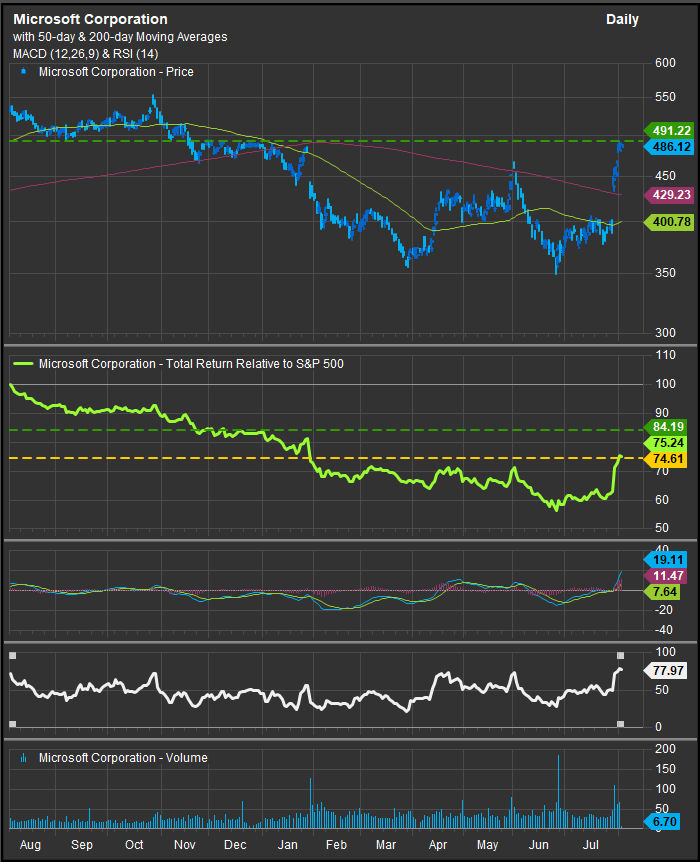
Chart: A move above technical resistance at the $490 level would confirm the near-term bullish reversal.
Apple: A Premium Franchise Without an AI-Led Earnings Story
Apple reported a strong June quarter. Revenue increased 16.4% to $109.42 billion, iPhone revenue rose 21.7% and Mac sales increased 28.7%. The problem was the outlook.
Management projected September-quarter revenue growth of 9% to 11%, below Wall Street’s approximately 12% expectation. Services revenue increased 12.1% but missed estimates, while component shortages constrained production and reduced management’s flexibility.
Apple’s fundamentals are not weak. Demand appears resilient, margins remain high and the company continues to benefit from one of the world’s most valuable installed consumer bases.
The difficulty is the relationship between quality and price.
Unlike Nvidia, Microsoft, Alphabet or Amazon, Apple is not yet demonstrating that AI is creating a major new earnings stream. Its premium valuation therefore depends on continued hardware demand, pricing power, services growth and confidence in eventual AI monetization.
Apple remains a high-quality company. The latest report made it harder to argue that it is a low-priced growth stock.
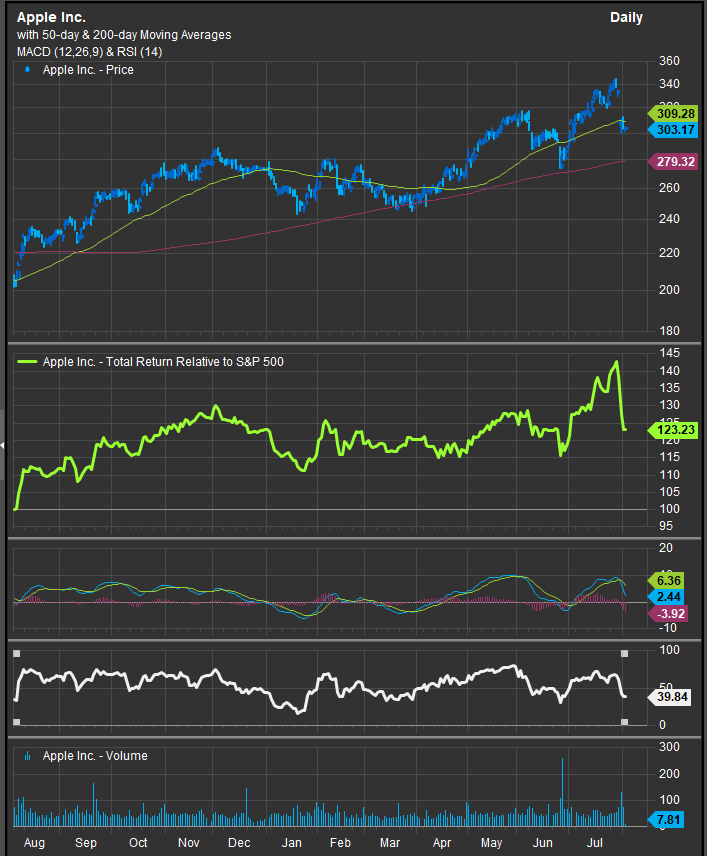
Chart: The buyer has a chance to show strength by picking up AAPL at near-term oversold levels this week.
Meta: Attractive Earnings Valuation, Expensive Strategic Ambition
Meta’s core advertising business remains exceptionally strong.
Second-quarter revenue increased 28% to $60.8 billion, while daily active people across its applications rose to 3.6 billion. Those results show that Meta’s existing platforms continue to generate engagement and advertising demand.
The concern is what Meta is doing with the cash.
Quarterly free cash flow declined 91% to $784 million as the company expanded data centers, servers, chips and energy infrastructure. Meta increased the lower end of its 2026 capital-spending forecast and now expects expenditures of $130 billion to $145 billion.
Meta’s relatively low earnings multiple reflects this uncertainty. Investors are being offered a profitable advertising platform at a discounted valuation, but part of that discount is compensation for an AI investment program whose ultimate business model remains less visible than Microsoft Azure or Amazon Web Services.
Meta may eventually use its computing capacity to improve advertisements, power consumer agents or sell services to outside customers. Until those returns become visible, the stock remains a value-priced operating business attached to a venture-style capital program.
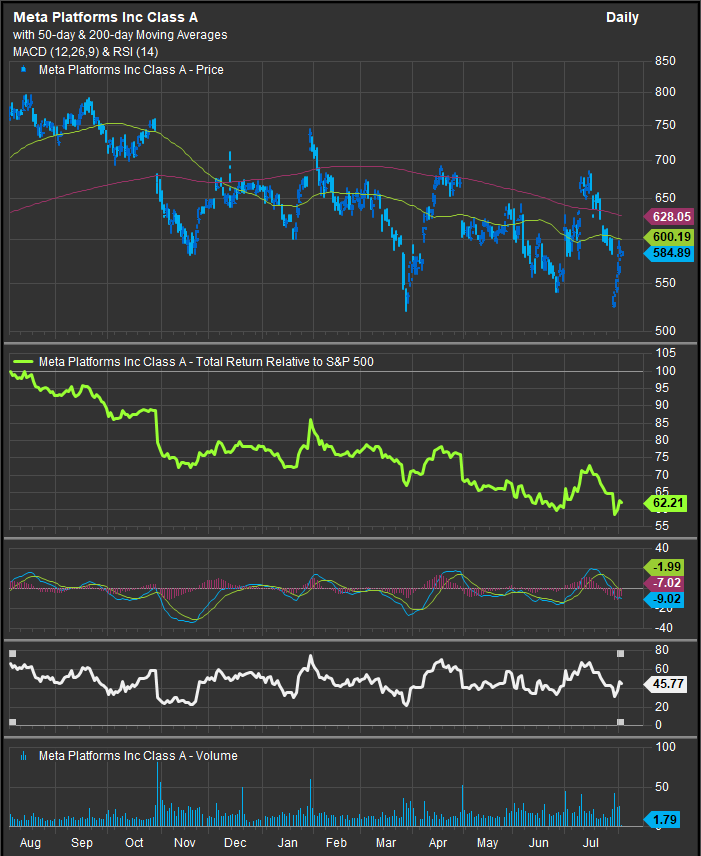
Chart: META remains in a long-term underperformance trend.
Alphabet: Accelerating Cloud Growth Meets Negative Cash Flow
Alphabet produced one of the strongest revenue reports in the group.
Second-quarter revenue increased 24% to $119.8 billion. Google Cloud revenue surged 82% to $24.8 billion, while advertising revenue reached $81.6 billion. The results demonstrated continued Search resilience and rapidly increasing demand for cloud and AI infrastructure.
Alphabet also raised its 2026 capital-expenditure forecast to between $195 billion and $205 billion. The company recorded negative free cash flow of $5.9 billion—its first cash-flow-negative quarter—as infrastructure investment accelerated.
Alphabet’s valuation case depends on whether investors view the cash burn as temporary construction spending or evidence that the economics of AI infrastructure are deteriorating.
The operating evidence is constructive. Cloud growth is accelerating, Search remains profitable and Alphabet possesses proprietary chips, models, consumer distribution and data-center infrastructure. The financial evidence is more complicated because current spending is rising faster than current cash generation.
Alphabet is not merely a digital-advertising stock anymore. It is becoming a capital-intensive cloud and AI infrastructure company financed by Search.
Amazon: Strongest Cloud Acceleration, Highest Reinvestment Burden
Amazon Web Services delivered its fastest growth in more than four years. AWS revenue increased 37% to $42.2 billion, while contracted backlog rose from $364 billion to $496 billion. Amazon also reported that its AI and semiconductor businesses had each exceeded $25 billion annualized revenue run rates.
Management responded by increasing its 2026 capital-spending forecast to approximately $220 billion. Trailing 12-month free cash flow fell to negative $7.6 billion from positive $18.2 billion one year earlier.
Amazon argues that data centers require spending well before they begin generating revenue and that much of its future capacity has already been reserved. The latest AWS growth supports that argument.
The stock is nevertheless a reinvestment bet. Investors must believe that the present cash outflow will create long-lived, high-return cloud assets rather than excess industry capacity.
Amazon’s operating momentum is stronger than its current cash-flow statement. That makes the stock fundamentally attractive for investors willing to accept a long investment cycle, but less suitable for those prioritizing immediate free-cash-flow yield.
Tesla: A Publicly Traded Option on Future Businesses
Tesla’s current valuation remains disconnected from conventional automotive earnings.
The company delivered a record 480,126 vehicles during the second quarter, but reported negative free cash flow of $1.1 billion as spending increased on artificial intelligence, robotaxis, battery capacity and next-generation manufacturing. Management warned that further cash burn could follow.
Tesla’s automotive business provides revenue, manufacturing scale and a large installed fleet. Its valuation, however, is primarily supported by expectations surrounding autonomous driving, robotaxis, robotics and energy storage.
That does not necessarily make the stock uninvestable. It makes it fundamentally different from the other six.
Nvidia is valued on current AI infrastructure earnings. Microsoft is valued on enterprise software and cloud monetization. Meta and Alphabet are valued on advertising platforms financing AI investment. Tesla is valued on the probability that future businesses become dramatically larger than its current earnings base.
It is the least useful company to include in an earnings-based Mag7 valuation average.
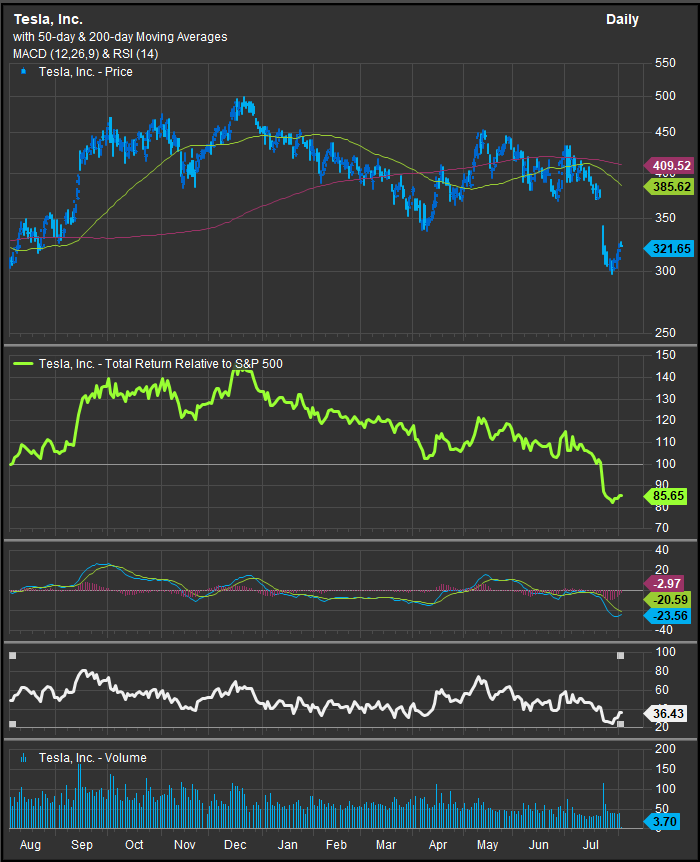
Chart: At its best, TSLA is priced as a cutting-edge technology conglomerate. However, it struggles with many of the same headwinds as legacy auto companies (not a good thing).
Sector Implications: Three Funds, Three Different Concentration Bets
The sundering of the Mag7 matters because the companies are divided across three major sectors.
Using Vanguard sector ETFs as proxies, investors are not choosing between “technology” and “the rest of the market.” They are choosing among three different clusters of Mag7 risk.
Information Technology: Vanguard Information Technology ETF (VGT)
VGT’s largest holdings were Nvidia at 16.78%, Apple at 15.26% and Microsoft at 9.87% as of May 31. Together, the three represented approximately 42% of the fund.
That concentration combines three very different investments:
- Nvidia offers the strongest current AI earnings growth.
- Microsoft offers the clearest evidence of enterprise AI monetization.
- Apple offers franchise quality but the least visible AI-related earnings acceleration.
The earnings conclusion for VGT is constructive, but not because all three companies are inexpensive.
Microsoft and Nvidia provide a fundamental basis for maintaining an overweight allocation to Information Technology. Apple reduces the sector’s growth-adjusted valuation appeal, while the fund’s semiconductor concentration introduces cyclicality and sensitivity to the AI capital-spending cycle.
VGT remains the strongest direct sector proxy for AI infrastructure, software and semiconductor earnings. Investors should recognize that its result will increasingly depend on whether Nvidia and Microsoft can offset Apple’s slower forward trajectory.
Communication Services: Vanguard Communication Services ETF (VOX)
Meta represented 22.19% of VOX as of May 31. Alphabet’s two publicly traded share classes represented another 21.69%, placing approximately 44% of the fund in two companies.
VOX therefore provides the most concentrated exposure to the advertising-financed AI investment model.
Meta and Alphabet have profitable core platforms, strong revenue growth and more moderate earnings valuations than the market commonly associates with megacap technology. They are also committing extraordinary amounts of capital to infrastructure while free cash flow deteriorates.
The sector implication is cautiously positive.
VOX may offer the most attractive valuation-to-growth balance among the three Vanguard proxies, but its investment thesis has changed. It is no longer primarily a diversified mix of telecom, media and internet companies. Its performance is heavily dependent on whether Meta and Alphabet can convert AI spending into higher advertising efficiency, cloud revenue and new platform earnings.
Investors seeking relatively lower Mag7 valuation risk may prefer VOX to VGT, but they are accepting greater uncertainty around capital allocation and free-cash-flow conversion.
Consumer Discretionary: Vanguard Consumer Discretionary ETF (VCR)
Amazon represented 22.17% of VCR and Tesla accounted for 17.69% as of May 31. Together, the two stocks made up almost 40% of the fund.
That creates the most internally divided sector exposure.
Amazon has an identifiable and rapidly growing cloud business, a large contract backlog, a profitable advertising operation and improving evidence that AI investment is generating demand. Tesla is priced primarily on future autonomy, robotics and energy opportunities that are not yet producing comparable earnings.
The earnings conclusion for VCR is neutral rather than outright bullish.
Amazon provides substantial fundamental support, but Tesla makes the fund less useful as a straightforward play on consumer spending or economic growth. Investors purchasing VCR are effectively combining a cloud-infrastructure compounder with a high-duration technology option and then adding traditional retailers, restaurants, automakers and home-improvement companies around them.
VCR can outperform when Amazon and Tesla rise together. It is the least coherent of the three Vanguard sector proxies when the two companies’ fundamentals and valuations diverge.
The Sector Verdict
The latest earnings reports validate continued exposure to the companies driving the AI investment cycle. They do not validate a uniform Mag7 overweight.
For sector investors, the hierarchy is clearer:
VGT offers the strongest operating momentum, led by Nvidia and Microsoft, but contains meaningful Apple valuation risk and a high degree of semiconductor-cycle exposure.
VOX offers the strongest relative-value argument, led by Meta and Alphabet, but requires confidence that record infrastructure spending will eventually restore free-cash-flow growth.
VCR contains the widest fundamental dispersion, with Amazon providing a credible cloud and AI earnings story while Tesla remains an expensive option on future technologies.
The broader Vanguard S&P 500 ETF (VOO) already provides substantial exposure to all seven companies. Adding VGT, VOX or VCR is therefore not primarily a diversification decision. It is a decision about which form of Mag7 concentration an investor wants to increase.
The sundering of the Mag7 does not mean megacap leadership is over. It means sector selection, security selection and valuation discipline matter again.
Investors should buy the earnings stream they understand—not the nickname that used to contain it.
Sources
- Nvidia Investor Relations: Fiscal first-quarter 2027 results, including revenue, Data Center growth, margins and management’s outlook.
- Microsoft earnings coverage: Fiscal fourth-quarter revenue, adjusted earnings, Microsoft Cloud growth, Azure growth and Copilot adoption.
- Apple Investor Relations and earnings coverage: Fiscal third-quarter results, iPhone and Mac performance, earnings and revenue growth.
- Meta Platforms: Second-quarter revenue, free-cash-flow decline and updated 2026 capital-expenditure guidance.
- Alphabet: Second-quarter revenue, Google Cloud growth, negative free cash flow and increased capital-spending outlook.
- Amazon: Second-quarter AWS growth, cloud backlog, capital-spending guidance and free-cash-flow trends.
- Tesla Investor Relations and Reuters: Second-quarter financial results, vehicle deliveries, capital spending, negative free cash flow and the strategic emphasis on AI, autonomy and robotics.
- Reuters Breakingviews: The effect of private-investment revaluations and AI infrastructure spending on Alphabet’s and Amazon’s reported earnings and cash flow.
- Vanguard Information Technology ETF: VGT portfolio composition and its concentrations in Nvidia, Apple and Microsoft.
- Vanguard Communication Services ETF: VOX holdings, including its combined concentration in Meta and Alphabet.
- Vanguard Consumer Discretionary ETF: VCR holdings, including its substantial Amazon and Tesla weights.
Disclaimer: This material is provided for informational and educational purposes only and does not constitute investment advice, an offer or a recommendation to buy or sell any security. Valuation multiples, earnings estimates and ETF holdings are subject to change. Investors should review fund prospectuses and consider their objectives, risk tolerance and existing portfolio concentration before investing.
