
The thematic ETF market is sending a more nuanced message than the major indexes. Investors have not abandoned artificial intelligence, infrastructure or economic growth, but the August 13 flow data shows that they are becoming considerably more selective about which sectors and industries they use to express those views.
That distinction matters for sector investors because the largest thematic trades of 2026 have become embedded in several different parts of the S&P 500. Semiconductors and software feed directly into Information Technology. Data-center construction, defense and electrical equipment reinforce Industrials. Rising electricity demand has implications for Utilities. Persistent disruption around the Strait of Hormuz affects Energy, while biotechnology is beginning to respond to a less threatening rate environment. At the same time, housing, electric vehicles and several internet-oriented themes remain weak enough to temper the case for broad Consumer Discretionary and Communication Services exposure.
The result is not a simple growth-to-value rotation. It is a rotation within growth and within cyclicals, away from the most crowded expressions of secular themes and toward businesses with visible demand, scarce physical capacity and current cash flow.
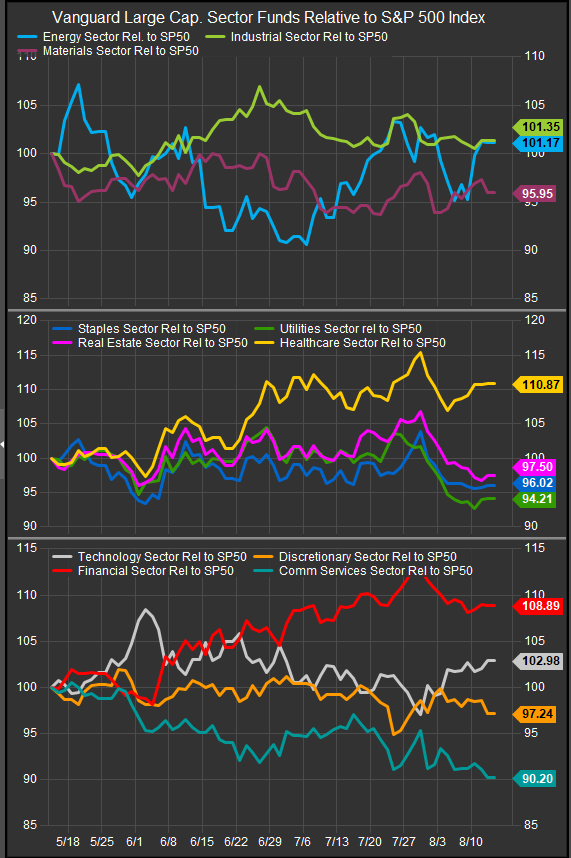
The Sector Flow Map
| Sector Proxy | Key Thematic Signal | 1-Week vs. YTD Message | Sector Read |
| VGT – Information Technology | Semiconductors, software, AI | Strong YTD inflows; sharp recent redemptions | Constructive, but narrowing |
| VIS – Industrials | Defense, infrastructure, electrification | Defense confirms; broad infrastructure diverges | Strongest thematic confirmation |
| VPU – Utilities | Power demand, grid buildout | Electrification remains positive | Improving structural backdrop |
| VDE – Energy | Oil, midstream, energy security | Midstream confirms; oil services lag | Positive, but favor cash flow |
| VHT – Health Care | Biotechnology | Weekly inflows accelerating from weak YTD base | Early improvement |
| VCR – Consumer Discretionary | Housing, autos, EVs, travel | Mostly weak or inconsistent | Mixed |
| VOX – Communication Services | Internet/platform economy | Persistent thematic outflows | Stock-specific rather than sector-wide |
Information Technology: The AI Thesis Survives, but VGT Is Losing Its Easy Flow Tailwind
Information Technology remains the center of the 2026 thematic market, but this week produced the clearest evidence that investors are no longer willing to treat every AI-related decline as a buying opportunity.
Semiconductor ETFs have attracted approximately $20.0 billion year to date, making them the largest thematic asset-gathering category in the August 13 database. That long-term conviction remains substantial: the iShares Semiconductor ETF (SOXX) has collected about $9.3 billion YTD, VanEck Semiconductor ETF (SMH) roughly $8.5 billion and Invesco PHLX Semiconductor ETF (SOXQ) another $1.3 billion. Yet the latest week produced approximately $4.4 billion of semiconductor outflows, including $3.7 billion from SOXX and $775 million from SMH, even as both funds posted positive weekly returns.
Software is beginning to display the same pattern. The category retains more than $5.4 billion of YTD inflows, but experienced roughly $670 million of weekly redemptions and $779 million over the latest month. Broad AI and robotics funds have also stalled, with approximately $4.5 billion of YTD inflows contrasting with modest net outflows over both the latest week and month.
That makes the sector message for Vanguard Information Technology ETF (VGT) constructive but less straightforward than it was earlier in the year. The fundamental AI investment cycle is still expanding; Nvidia is reportedly working with major Wall Street firms on financing structures capable of channeling up to $500 billion into AI infrastructure. That supports the demand outlook for compute, networking and data-center hardware, but it also emphasizes how capital-intensive the next stage of the cycle is becoming.
Investors appear to be shifting from asking whether AI spending will continue to asking whether the companies funding that spending will earn an adequate return. That is an important evolution for VGT. Nvidia, Microsoft and the semiconductor complex still provide exceptional operating momentum, but the ETF flow market is no longer providing the same indiscriminate technical support. Information Technology remains attractive, but increasingly as a security- and industry-selection trade rather than a broad thematic chase.
There is also evidence of narrowing beneath software. Cybersecurity and cloud funds are holding up better than broad software exposure, suggesting that investors favor areas where AI creates an identifiable new spending requirement rather than merely a productivity narrative. The distinction supports cybersecurity and enterprise infrastructure while making the broader VGT outlook somewhat more dependent on earnings execution.
Industrials: VIS Has the Cleanest Thematic Tailwinds
If Technology represents a strong long-term theme undergoing a short-term reset, Industrials increasingly represents the opposite: several underlying themes are producing both fundamental demand and persistent capital flows.
Aerospace and defense is the clearest example. Defense ETFs have attracted approximately $1.68 billion YTD, with another $215 million arriving during the latest week and $126 million over one month. Unlike semiconductors, the short-term flow is reinforcing rather than contradicting the longer-term trend. The fundamental case is also unusually visible. The U.S. and its allies are attempting to replenish depleted weapons inventories, and Rheinmetall recently warned that rebuilding supplies of long-range precision missiles could take years even as manufacturers increase production capacity.
The second Industrial tailwind comes from the physical infrastructure required to support the digital economy. Broad infrastructure funds have attracted approximately $4.0 billion YTD, although they have experienced $169 million of one-month redemptions. That divergence shows investors are becoming more selective within infrastructure just as they are within Technology.
Electrical infrastructure is holding up better. Electrification ETFs retain approximately $1.12 billion of YTD inflows and another $81 million over the latest month. That preference has a fundamental basis: the Energy Information Administration now projects U.S. electricity consumption to rise from a record 4,195 billion kilowatt-hours in 2025 to 4,268 billion in 2026 and 4,391 billion in 2027, with data centers among the important sources of incremental demand.
For Vanguard Industrials ETF (VIS), that creates one of the better sector setups in the current thematic flow map. Defense spending, electrical equipment, engineering and data-center construction provide several independent sources of demand. Investors are no longer buying generic “infrastructure” exposure as aggressively, but that selectivity actually strengthens the sector argument: capital is moving toward the Industrial businesses closest to the bottlenecks rather than toward every company loosely associated with construction spending.
Among the Vanguard sector proxies, VIS currently has one of the cleanest combinations of secular growth exposure and less direct dependence on megacap technology valuations.
Utilities: AI Is Turning Electricity Demand Into a Growth Story
Utilities occupy an unusual position in the current market. The sector has historically been treated as a defensive, income-oriented allocation, yet one of the largest secular growth themes in the economy is increasingly dependent on its ability to deliver more electricity.
The thematic flows show investors distinguishing between electricity infrastructure and traditional clean energy. Electrification funds retain positive YTD and one-month flows, while broad clean-energy ETFs have experienced approximately $269 million of one-month outflows and remain slightly negative for the year. The market is not making a blanket decarbonization bet. It is making a capacity bet.
That distinction is increasingly important for Vanguard Utilities ETF (VPU). EIA forecasts imply sustained increases in commercial electricity demand as AI and data-center capacity expand, while natural gas is expected to maintain roughly 40% of U.S. generation and nuclear power about 18% through 2027. The underlying demand story therefore cuts across generation sources: regulated utilities need transmission capacity, reliable generation and grid investment whether the incremental electron comes from natural gas, nuclear, renewables or storage.
VPU is not a pure data-center infrastructure fund, and higher capital requirements can pressure utility balance sheets if regulators do not allow adequate returns. Still, the thematic backdrop is becoming more supportive. Utilities are gradually shifting from a simple bond-proxy narrative toward a sector where electricity scarcity and load growth can become earnings drivers.
Energy: The Money Prefers Infrastructure to Maximum Oil Beta
Energy is another sector where the underlying thematic signals are stronger than the headline commodity trade suggests.
Oil and gas producers have performed well as the Strait of Hormuz remains disrupted, but fund flows show investors preferring energy infrastructure over the highest-beta expressions of an oil rally. MLP and midstream ETFs have attracted approximately $1.62 billion YTD, including $432 million during the latest month. Alerian MLP ETF (AMLP) alone has collected approximately $930 million YTD.
Oil services tell a different story. VanEck Oil Services ETF (OIH) has risen almost 9% over one month, yet investors have withdrawn approximately $192 million over the same period. The market is therefore willing to own cash-generating pipelines and existing energy infrastructure while remaining reluctant to extrapolate current oil prices into a major new drilling cycle.
The macro backdrop explains the caution. The Strait of Hormuz remains severely disrupted, with the United States and Iran continuing to make competing claims over control of the waterway. At the same time, U.S. crude inventories recently increased by 17.4 million barrels and both OPEC and the IEA lowered their demand outlooks, leaving crude caught between genuine supply risk and a weaker consumption picture.
For Vanguard Energy ETF (VDE), the signal is positive but not unequivocal. Elevated geopolitical risk supports producer cash flows and the strategic value of domestic energy supply, but the strongest thematic flows are occurring in midstream vehicles that VDE does not directly replicate. The sector can still benefit from higher realized energy prices, yet investors appear to prefer cash flow and infrastructure scarcity over simply maximizing oil-price sensitivity.
That is a healthier signal than indiscriminate commodity chasing, but it also argues for selectivity inside Energy.
Health Care: Biotechnology Is Showing the First Signs of a Flow Turn
Health Care has been largely absent from the dominant thematic narrative this year, which makes the recent biotechnology flows more interesting.
Biotech ETFs have attracted only about $216 million YTD, a relatively small amount compared with semiconductors, software or infrastructure. Yet roughly $268 million flowed into the category during the latest week alone. The iShares Biotechnology ETF (IBB) gained about 4% while attracting approximately $117 million, and several smaller biotechnology strategies also recorded improving returns.
The timing coincides with a somewhat less hostile rate backdrop. July core CPI increased 2.5% from a year earlier, down from 2.6% in June, while markets reduced the probability of a September Federal Reserve hike following the report. Treasury yields also moved lower as investors reassessed the policy path.
That matters disproportionately for biotechnology because early-stage companies derive much of their value from cash flows expected well into the future. A lower discount-rate hurdle can improve valuations even before clinical or commercial fundamentals materially change.
For Vanguard Health Care ETF (VHT), the signal is best characterized as early improvement rather than established leadership. One strong week of biotech inflows does not reverse a year of limited investor enthusiasm, and VHT contains a much broader mix of pharmaceuticals, managed care, medical devices and life-sciences companies. Still, Health Care is beginning to show the kind of flow acceleration that often precedes broader sector rotation, particularly if inflation continues to moderate and rate volatility subsides.
Consumer Discretionary: The Thematic Undercurrents Remain Weak
Consumer Discretionary provides the clearest counterpoint to the improving cyclical narrative elsewhere.
Housing and automotive thematic funds have lost approximately $679 million over one month and $479 million YTD. Electric-vehicle exposure remains particularly unconvincing, while home-construction funds have struggled to attract sustained assets despite periods of improving price performance. Travel is somewhat better—leisure and entertainment funds have attracted capital—but the category is not generating a broad consumer-risk signal.
That leaves Vanguard Consumer Discretionary ETF (VCR) in a complicated position. The fund’s largest companies, particularly Amazon and Tesla, can overwhelm the performance contribution from traditional consumer industries, so the thematic data should not be interpreted as a direct forecast for VCR. It does, however, indicate that investors remain reluctant to add aggressively to the more economically sensitive housing, automobile and EV narratives.
The recent inflation report offers some support through lower rate pressure, but real wage growth remains constrained and the current thematic flows do not yet indicate a decisive return of consumer-cycle conviction. VCR can still work through its megacap exposure, but the grassroots thematic evidence beneath the sector remains mixed.
Communication Services: Strong Companies, Weak Thematic Confirmation
Communication Services is another sector where the thematic flow data does not necessarily mirror the fundamentals of its largest constituents.
Internet and metaverse-oriented funds remain weak from a positioning standpoint, with the group down roughly $1.49 billion YTD in flows and another $62 million over the latest month. That suggests investors are not making a broad return to internet-platform themes despite improving AI monetization narratives among some of the sector’s dominant companies.
For Vanguard Communication Services ETF (VOX), that reinforces the importance of stock selection. Alphabet and Meta have much stronger earnings and cash-flow profiles than many smaller internet or speculative digital-platform companies, which means broad thematic outflows should not automatically be interpreted as bearish for VOX. Instead, they show that investors are distinguishing between established platforms that can monetize AI through advertising, cloud services and engagement and businesses whose growth still depends primarily on future expectations.
VOX therefore remains fundamentally interesting, but it lacks the broad flow confirmation currently visible in Industrials or defense-related themes. The sector is increasingly a concentrated mega-cap fundamental bet rather than a broad thematic allocation.
Thematic Thursday: What the Sector Map Is Saying
The August 13 flows suggest the market is moving beyond the first phase of the AI trade. The early phase rewarded almost anything connected to chips, software, data centers, electricity or disruption. The next phase is becoming much more discriminating.
For Information Technology (VGT), the structural AI story remains intact, but massive YTD semiconductor and software inflows are now being harvested. The sector still offers some of the market’s strongest earnings growth, but ETF flows argue that investors should expect more differentiation between winners and merely expensive participants.
Industrials (VIS) currently offer the strongest thematic confirmation. Defense demand, electrical infrastructure and data-center construction provide identifiable spending streams, while the sector avoids some of the valuation concentration embedded in Technology. Broad infrastructure flows have softened, but that appears to reflect narrowing toward the most capacity-constrained areas rather than a deterioration in the investment cycle.
Utilities (VPU) are becoming a more credible second-order AI beneficiary as electricity demand accelerates. Energy (VDE) retains geopolitical and supply-security support, although the strongest flow message favors midstream cash flow over oil-service beta. Health Care (VHT) is beginning to improve as biotech flows accelerate from a low base, while Consumer Discretionary (VCR) still lacks consistent confirmation from housing, autos and EVs. Communication Services (VOX) remains more dependent on the fundamentals of its largest platforms than on broad thematic enthusiasm.
The larger message is that the market has not turned defensive. Capital is still flowing toward growth, infrastructure and strategic scarcity, but investors increasingly want to see where the earnings will appear, who controls the bottleneck and how much capital must be committed before returns arrive.
That is a more mature phase of the thematic cycle. It also makes sector selection more important.
The strongest themes are no longer necessarily the ones attracting the most money. Increasingly, the opportunity lies in identifying which sectors contain the next-order beneficiaries of themes that investors have already crowded into elsewhere.
Sources
- FactSet Research Systems Inc. — August 13, 2026 thematic ETF return and fund-flow database supplied for the report; source for the 1-week, 1-month and YTD flow comparisons.
- Reuters — Aug. 11: Nvidia and major Wall Street firms are working on financing structures aimed at mobilizing as much as $500 billion for AI infrastructure, reinforcing both the scale and growing capital intensity of the AI buildout.
- Reuters / EIA — Aug. 11: U.S. electricity consumption is projected to reach new records in 2026 and 2027, driven partly by AI data centers and electrification. The outlook supports the structural case for electrical equipment, grid investment, Utilities and selected Industrials.
- Reuters — Aug. 7: Rheinmetall said rebuilding depleted U.S. long-range missile inventories will take time as manufacturers expand production, supporting the article’s favorable assessment of aerospace-and-defense demand within Industrials.
- Reuters — Aug. 13: Iran and the U.S. continue to make competing claims over control of the Strait of Hormuz, keeping energy security, shipping risk and defense spending relevant to the Energy and Industrials outlooks.
- Reuters — Aug. 13: Oil prices faced competing forces from Hormuz supply risks, a 17.4-million-barrel increase in U.S. crude inventories and weaker OPEC and IEA demand forecasts, supporting a preference for energy cash flow over maximum commodity beta.
- Reuters — Aug. 12: July CPI increased 3.4% year over year while core inflation eased to 2.5%, reducing pressure for an immediate September Fed hike and improving the rate backdrop for longer-duration areas such as biotechnology.
- Reuters — Aug. 13: Global equities remained supported by AI-related earnings strength and expectations for a September Fed hold, reinforcing the argument that current thematic rotation reflects changing sector leadership rather than a broad retreat from risk.
