


COMMENTARY:
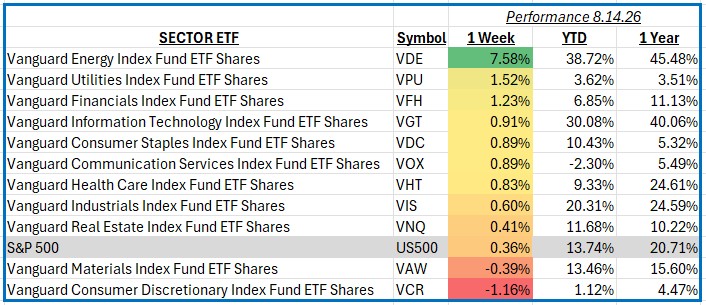
The S&P 500 Index gained 0.36% for the week ended August 14, 2026, as investors balanced generally resilient economic conditions against shifting expectations for interest rates and global growth. Energy prices moved sharply higher, supporting inflation-sensitive assets and energy equities. Meanwhile, corporate earnings and company-specific developments continued to drive meaningful dispersion across sectors, while bond-market movements kept rate-sensitive groups such as utilities and financials in focus.
Energy was the market’s clear leader, advancing 7.58%, significantly outpacing the S&P 500. Integrated oil companies, large exploration-and-production businesses, refiners, and oil-field service providers were important contributors as crude prices rose amid continued attention to global supply risks, producer discipline, and geopolitical uncertainty. Major industry participants also benefited from expectations for durable free cash flow and continued shareholder distributions through dividends and repurchases.
Utilities gained 1.52%, outperforming the S&P 500 by 1.16%. Regulated electric and gas utilities, including several large transmission and distribution operators, helped lead the advance. Investor demand for comparatively defensive earnings, dividend income, and long-term power-demand growth linked to data centers and electrification supported the group. Interest-rate movements remained a key consideration, as lower or stabilizing yields can improve the relative appeal of utility dividends.
Financials increased 1.23%. Large banks, diversified financial-services companies, insurers, and payment networks contributed to returns. The sector benefited from a generally constructive economic backdrop, ongoing credit-quality resilience, and optimism around capital-markets activity. Bank investors continued to monitor the path of short- and long-term rates, deposit costs, commercial real-estate conditions, and the potential implications for net interest income.
Materials declined 0.39%, trailing the S&P 500 by 0.75%.Weakness among chemical, metals and mining, packaging, and industrial-gas companies weighed on results as investors assessed uneven manufacturing demand and uncertain global growth conditions. Commodity-price volatility, including pressure in certain industrial metals, also contributed to the sector’s softer performance.
Consumer discretionary fell 1.16%, and ranked as the weakest sector among those highlighted. Retailers, automobile-related companies, home-improvement businesses, restaurants, and select internet retailers faced pressure as investors became more selective about consumer spending trends, valuation levels, and the effect of still-elevated borrowing costs. Company earnings and forward guidance remained particularly influential across the group.
This week’s market reflected a preference for energy-linked earnings, income-oriented utilities, and economically sensitive financials, while materials and consumer-oriented businesses lagged. Looking ahead, investors will remain focused on inflation data, interest-rate expectations, consumer-demand indicators, and commodity-market developments.
