

COMMENTARY:
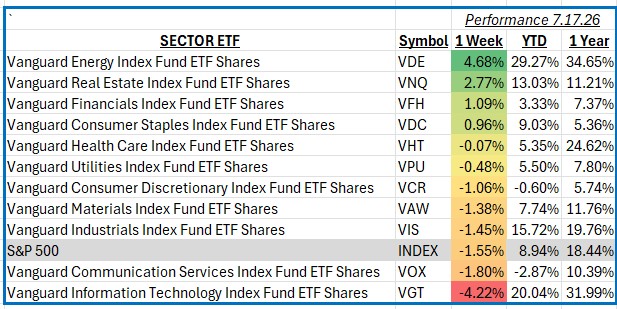
For the week ending July 17, 2026, the S&P 500 declined 1.55% as investors took a more cautious approach following several weeks of strong gains. Markets weighed a combination of mixed corporate earnings, evolving expectations for Federal Reserve policy, and renewed concerns about inflation after economic data suggested price pressures remain more persistent than anticipated. At the same time, geopolitical developments and higher commodity prices influenced sector leadership, leading to a noticeable rotation away from many of this year’s market leaders and into more cyclical areas of the market.
Energy was the week’s standout performer, gaining 4.7% as crude oil prices climbed on tightening global supply expectations and ongoing geopolitical tensions that supported higher energy prices. Integrated oil producers and exploration & production companies led the advance, with Exxon Mobil, Chevron, ConocoPhillips, and EOG Resources making the largest positive contributions. Oilfield service providers also benefited from expectations for stronger capital spending by producers. Higher commodity prices improved earnings expectations across the industry, attracting investors seeking exposure to companies with strong cash flows, disciplined capital allocation, and attractive shareholder return programs.
Financials also delivered a solid week, advancing 1.1% as investors responded positively to another round of generally healthy bank earnings. Several large financial institutions reported resilient loan growth, stable credit quality, and stronger-than-expected investment banking and trading activity. JPMorgan Chase, Goldman Sachs, Wells Fargo, and Morgan Stanley were among the largest contributors to sector performance. While uncertainty surrounding future interest-rate policy remains, investors viewed the earnings results as evidence that many financial firms remain well positioned to navigate the current economic environment.
Communication Services and Information Technology were the weakest-performing sectors, declining 1.8% and 4.2%, respectively. Profit-taking weighed heavily on several large-cap technology and internet companies following their strong year-to-date gains, while investors rotated toward more value-oriented sectors. Within Communication Services, weakness in Alphabet and Meta Platforms accounted for much of the sector’s decline as investors reassessed growth expectations ahead of earnings season. Technology stocks were pressured by declines in NVIDIA, Microsoft, Apple, and Broadcom, as elevated valuations and higher interest-rate expectations reduced investor appetite for higher-growth companies despite continued optimism surrounding artificial intelligence and long-term technology spending.
Although the broader market experienced a modest pullback, sector performance highlighted the benefits of diversification as leadership rotated across industries. With earnings season gaining momentum and investors closely monitoring economic data and Federal Reserve expectations, market volatility may persist, but long-term fundamentals continue to provide opportunities for disciplined investors.
