

COMMENTARY:
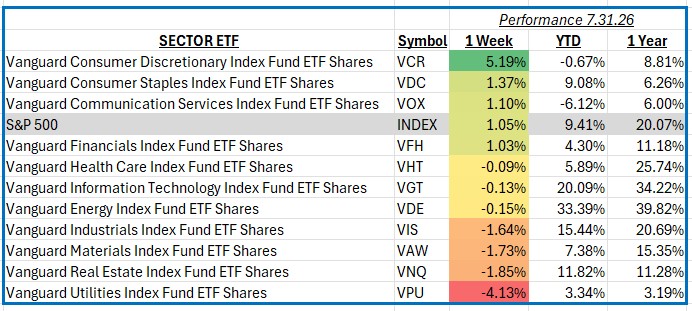
The S&P 500 advanced 1.05% for the week ending July 31, 2026, capping a busy week driven by a combination of corporate earnings, economic data, and Federal Reserve commentary. Investors welcomed another round of generally solid second-quarter earnings, particularly from several large technology companies, while stronger-than-expected economic growth reinforced confidence in the resilience of the U.S. economy. At the same time, the Federal Reserve maintained a cautious stance on interest rates as inflation remained above its long-term target, keeping Treasury yields elevated and markets focused on the outlook for monetary policy.
Consumer Discretionary was the week’s standout performer, gaining 5.19% and outperforming both the S&P 500 and every other sector by a wide margin. The sector was fueled by a sharp rally in Amazon following stronger-than-expected earnings, highlighted by accelerating cloud computing growth and continued progress in monetizing artificial intelligence investments. Strength in other consumer-focused companies, including Tesla, also contributed to the sector’s impressive advance as investors rewarded businesses with improving growth expectations.
Consumer Staples finished the week with a 1.37% gain, modestly outperforming the broader market while trailing Consumer Discretionary. Investors continued to favor defensive companies with stable earnings and dependable cash flows amid uncertainty surrounding interest rates. Strong quarterly results from several household product and food manufacturers helped support the sector, demonstrating that investors continue to value consistent earnings growth even as market leadership remains concentrated in technology-related industries.
Communication Services rose 1.10%, narrowly edging the S&P 500 but finishing behind both Consumer Discretionary and Consumer Staples. Performance was mixed across the sector as Alphabet continued to benefit from optimism surrounding artificial intelligence, while Meta Platforms faced selling pressure after investors questioned the pace of its capital spending despite another quarter of healthy revenue growth. Even so, the sector remained resilient thanks to continued demand for digital advertising and online media platforms.
On the downside, Real Estate declined 1.85% as higher Treasury yields weighed on property values and interest-rate-sensitive real estate investment trusts. Elevated borrowing costs continued to pressure commercial real estate fundamentals, leaving the sector well behind the S&P 500. Utilities posted the weakest performance of the week, falling 4.13% and significantly underperforming both Real Estate and the broader market. Rising bond yields reduced the relative appeal of the sector’s traditionally stable dividend income, prompting investors to rotate toward higher-growth areas of the market.
Overall, the week highlighted investors’ continued preference for companies delivering strong earnings growth and clear evidence that artificial intelligence investments are translating into business results. While higher interest rates remain a headwind for some sectors, resilient economic data and solid corporate fundamentals continue to provide support for U.S. equities as markets enter the final month of the summer.
