





COMMENTARY:
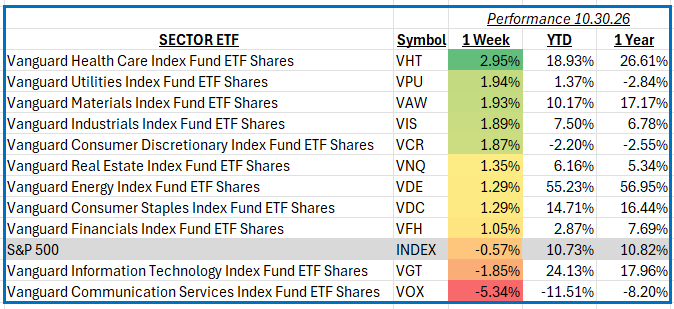
The S&P 500 declined 0.57% for the week ending October 30, as disappointing technology earnings and concerns about artificial intelligence (AI) spending weighed on investor sentiment. The Federal Reserve held interest rates steady, while its assessment of the economy and incoming inflation data remained important considerations for investors. Third-quarter economic growth and corporate earnings provided additional insight into the economy’s resilience. Despite weakness in several mega-cap technology stocks, market participation broadened, with healthcare, utilities, and materials advancing as investors rotated toward defensive investments and companies tied to essential services and industrial demand.
Healthcare, Utilities, and Materials Lead Performance
Healthcare was the strongest-performing sector, gaining 2.95% as pharmaceutical companies and biotechnology-related investments attracted buying interest. Eli Lilly advanced approximately 11% during the week, helping drive sector performance, while Gilead Sciences and Johnson & Johnson also contributed positively. Eli Lilly’s continued strength in its pharmaceutical business reinforced investor interest in the sector. Utilities gained 1.94%, supported by demand for defensive investments and the appeal of established electricity providers amid market uncertainty. Companies such as NextEra Energy, Southern Company, and Constellation Energy represent important exposures to electricity generation and infrastructure demand, including the growing power requirements associated with data centers. Materials advanced 1.93%, with industrial gas producers, chemical companies, and metals-related businesses benefiting from selective investor interest. Air Products, Linde, and Freeport-McMoRan illustrate the sector’s exposure to industrial activity, manufacturing, and commodity demand.
Information Technology and Communication Services Lag
Information Technology declined 1.85%, underperforming the S&P 500 by 1.28 percentage points. Investor concerns about the cost and profitability of AI investments contributed to weakness across semiconductor and software companies. Intel suffered a sharp decline following its earnings report, while Nvidia and Broadcom also faced selling pressure late in the week. Microsoft experienced pressure as investors evaluated the returns expected from substantial AI infrastructure spending. Although demand for advanced computing remains significant, investors increasingly scrutinized whether anticipated revenue growth can justify elevated capital expenditures and valuations. (Reuters)
Communication Services was the weakest sector, falling 5.34% and underperforming the S&P 500 by 4.77 percentage points, the largest negative difference among the sectors reviewed. Alphabet weighed heavily on performance after its quarterly results disappointed investors, despite strong growth in Google Cloud. Weaker-than-expected advertising revenue and concerns about AI-related spending and cash flow overshadowed its cloud business momentum. Meta Platforms also faced pressure amid investor concerns about the costs of developing AI capabilities. These developments reinforced market uncertainty about the balance between long-term AI opportunities and near-term profitability. (Reuters)
Market Outlook
Overall, the week’s results reflected a shift away from technology-heavy market leadership toward defensive and healthcare investments. Investors will continue monitoring corporate earnings, inflation, Federal Reserve policy, and the returns generated by AI spending as they assess the sustainability of market valuations.
