


COMMENTARY:
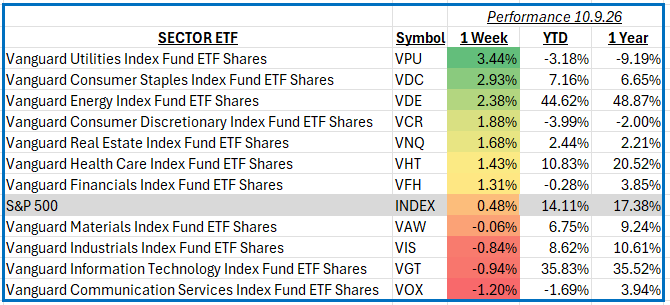
The S&P 500 gained 0.48% for the week ending October 9, as investors balanced optimism surrounding the upcoming third-quarter earnings season against concerns about inflation, rising interest rates, and geopolitical uncertainty. Utilities, consumer staples, and energy led sector performance, reflecting demand for defensive investments and renewed interest in energy producers. Meanwhile, technology and communication services struggled as investors reassessed artificial intelligence valuations and competitive pressures. The S&P 500 reached a record high during the week before retreating amid rising Treasury yields and concerns about the outlook for inflation.
Utilities led the market, gaining 3.44%, outperforming the S&P 500 by 2.96 percentage points. Investors favored the sector’s relatively stable earnings and dependable dividends amid uncertainty surrounding borrowing costs and economic conditions. Companies benefiting from electricity demand associated with data centers and artificial intelligence infrastructure remained important contributors to investor interest. Constellation Energy, NextEra Energy, and Southern Company were among the major utility holdings to watch as investors evaluated electricity demand, infrastructure investment, and the sector’s longer-term growth opportunities.
Consumer Staples advanced 2.93%, reflecting continued interest in companies providing essential household goods, food, and everyday products. Walmart and Costco remained important contributors to the sector’s investment profile, supported by their competitive positions in value-oriented retailing. Procter & Gamble and Coca-Cola also represented the defensive characteristics investors often seek when economic uncertainty increases. These businesses can benefit from relatively consistent consumer demand, although higher operating costs and price-sensitive shoppers remain important considerations for earnings growth.
Energy rose 2.38%, supported by elevated oil prices and continuing geopolitical concerns surrounding Middle Eastern supply routes. Exxon Mobil, Chevron, and ConocoPhillips were among the major holdings influencing sector performance. Crude oil prices remained sensitive to developments involving Iran and regional shipping, while uncertainty about future supply contributed to volatility. Energy companies attracted attention as investors assessed the potential benefits of stronger commodity prices against the risks of weaker demand and further geopolitical disruptions.
Information Technology declined 0.94%, while Communication Services fell 1.20%, making communication services the week’s weakest sector. Both underperformed the S&P 500, with communication services lagging the technology sector by 0.26 percentage points. In technology, Nvidia, Broadcom, and other semiconductor companies faced pressure as investors questioned the pace of artificial intelligence investment and the ability of anticipated revenue growth to justify elevated valuations. In communication services, Meta Platforms and Alphabet remained influential holdings, while AT&T, T-Mobile, and Verizon faced additional competitive concerns after SpaceX announced plans to expand into mobile services through a spectrum acquisition, subject to regulatory approval.
Overall, the week highlighted a rotation toward defensive sectors and energy as investors weighed corporate earnings prospects against inflation, interest rates, and geopolitical risks. Upcoming economic reports and company earnings will help determine whether the market’s recent resilience can continue.
