



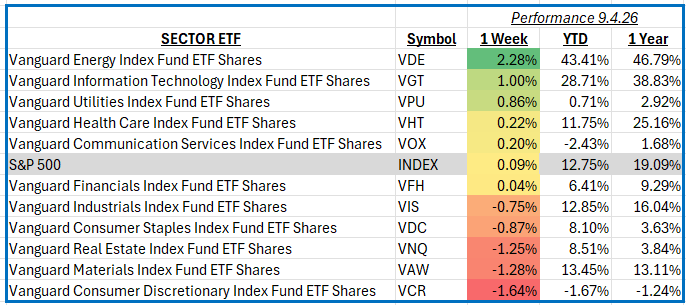
COMMENTARY:
The S&P 500 finished the holiday-shortened week with a modest 0.09% gain, as investors balanced a stronger-than-expected labor market against renewed concerns about inflation, interest rates and geopolitical risk. The August employment report showed 162,000 new jobs, well above expectations, while unemployment held at 4.1%. The report pushed Treasury yields higher and increased market expectations for a potential Federal Reserve rate hike at its September meeting. Meanwhile, escalating U.S.-Iran tensions drove oil prices sharply higher, with WTI rising more than 9% for the week.
Energy was the clear sector leader, gaining 2.28%, or 2.19 percentage points above the S&P 500. Rising crude prices and renewed concerns surrounding Middle East supply disruptions provided a strong backdrop for energy equities. Major integrated producers including Exxon Mobil and Chevron, along with exploration and production companies such as ConocoPhillips, benefited from the move higher in oil. ConocoPhillips gained approximately 3% for the week, while Exxon Mobil rose about 1.7%. Oil ended the week substantially higher as U.S.-Iran military exchanges intensified and shipping through the Strait of Hormuz remained constrained.
Information Technology gained 1.00%, supported by renewed enthusiasm for artificial intelligence and semiconductor stocks. Nvidia remained a key contributor, while Apple and Microsoft also helped drive Thursday’s technology-led rally. Semiconductor stocks were particularly strong late in the week, with memory and AI-related companies leading gains despite Friday’s broader market decline. Nvidia also received attention following its announced acquisition of AI platform Hugging Face, reinforcing investor interest in the longer-term AI investment theme.
Utilities advanced 0.86%, helped by strength in companies including Constellation Energy, NextEra Energy and Duke Energy. Constellation was particularly strong on Friday, rising nearly 5%, as investors continued to focus on growing electricity demand from data centers and other energy-intensive industries. Separately, shareholders approved the proposed $66.8 billion combination of Dominion Energy and NextEra Energy, highlighting the industry’s ongoing consolidation and the strategic importance of electricity infrastructure.
At the other end of the spectrum, Consumer Discretionary declined 1.64%, 1.73 percentage points below the S&P 500 and 0.36 percentage points weaker than Materials, which fell 1.28%. Consumer stocks were pressured by weakness in Tesla and Amazon, while Lululemon’s disappointing results and lower guidance added to concerns about selective consumer spending. Materials were also challenged by weakness in mining names, including Freeport-McMoRan and Newmont, as higher Treasury yields strengthened the dollar and weighed on precious metals.
Overall, the week highlighted continued sector rotation, with energy benefiting from geopolitical risk and technology from AI enthusiasm, while higher rates pressured more economically sensitive areas. Investors enter the coming week focused on inflation data and the Federal Reserve’s next policy decision.
