
South Korea has become one of the most important stress tests for the global AI trade. The market sits at the intersection of three powerful forces: the AI memory supercycle, extreme benchmark concentration in Samsung Electronics and SK Hynix, and a retail-driven boom in single-stock leveraged ETFs. That combination has produced one of the strongest equity rallies in the world, but also one of the most fragile.
The immediate question is whether Korea’s single-stock leverage issue is contained or contagious. The answer is: fundamentally contained, but technically contagious.
It looks fundamentally contained because the underlying AI memory story remains intact. Reuters reported that SK Hynix rallied sharply after softer U.S. inflation data and renewed optimism around AI memory demand, while Samsung Electronics and Hanmi Semiconductor also rebounded. Meritz Securities analyst Kim Sunwoo told Reuters that DRAM suppliers are meeting only about 75% to 80% of demand, with the fulfillment rate potentially falling further in 2027. “With supply shortages set to deepen, memory prices and earnings are likely to continue improving,” Kim said.
That is not the language of a broken semiconductor cycle. It is the language of a tight supply-demand backdrop where AI servers, cloud capex, memory pricing and long-term supply agreements still support earnings visibility.
The problem is market structure. Reuters reported that Samsung Electronics and SK Hynix together account for more than half of the KOSPI. The Business Times reported that the two chipmakers plus leveraged ETFs tied to them recently represented more than 70% of Korean market trading value, with the ratio reaching as high as 84% in late June. That is the core issue: a concentrated index has become even more concentrated through products that mechanically amplify daily moves.
That makes the issue technically contagious. Leveraged ETFs that target twice the daily move of Samsung or SK Hynix must rebalance daily. In rising markets, that can add fuel to upside momentum. In falling markets, it can force selling into weakness. Korea JoongAng Daily described the resulting feedback loop as especially dangerous because the KOSPI is unusually top-heavy. It also reported that Korea’s volatility index hit a record-high 90.8 and that sidecar trading halts have already exceeded the number seen during the 2008 financial crisis.
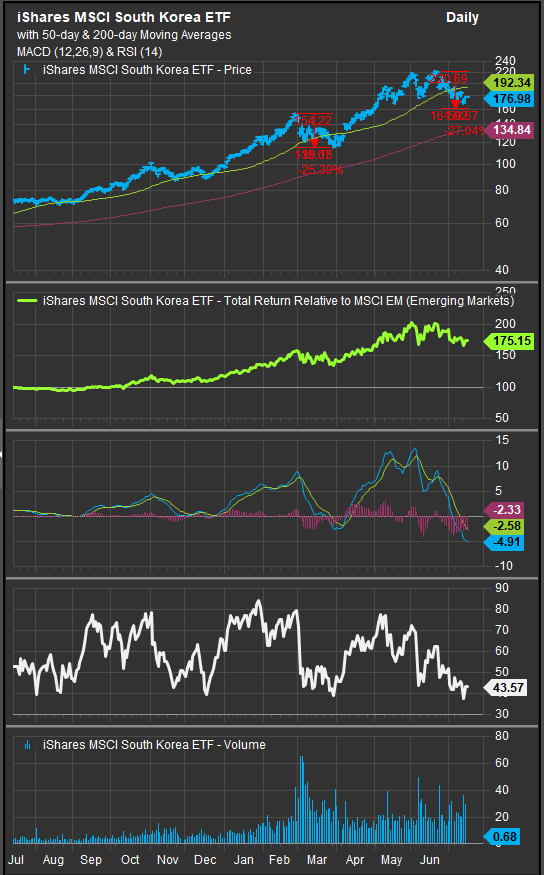
Chart: The iShares MSCI Korea ETF (EWY) has been through two “bear market” (>20% drawdown) corrections already in 2026. With Korean stocks currently at oversold levels, the next week will be a tell for the bull trend.
This is why the Korea story matters beyond Korea. A leveraged ETF unwind in Seoul can pressure Samsung, SK Hynix, Korea ETFs, emerging-market technology exposure and global semiconductor sentiment even when the AI demand story has not changed. Goldman Sachs, according to Reuters, said the recent Korean chip-stock selloff was amplified by ETF position unwinds while the underlying semiconductor cycle remained fundamentally robust. Business Insider similarly cited KB Securities’ Jeff Kim, who argued the recent share-price decline reflected “sentiment rather than fundamentals.”
Regulators now appear to understand the problem. KBS reported that President Lee Jae Myung instructed financial authorities to quickly prepare supplementary measures to address risks from single-stock leveraged ETFs. KBS also reported that Financial Supervisory Service Governor Lee Chan-jin accepted responsibility as a market regulator and had previously expressed regret for not blocking the products. Korea JoongAng Daily quoted Lee even more bluntly: “We should have stopped it.”
The remedies being discussed fall into four buckets.
First, Korea has already slowed the addition of new leverage tools. Yonhap reported that Korea Exchange delayed the planned launch of weekly options on Samsung Electronics, SK Hynix, Hyundai Motor and LG Energy Solution, citing “recent market conditions.” That is important because weekly single-stock options would have added another layer of short-dated leverage to an already volatile market.
Second, authorities are reviewing tighter investor safeguards. Korea JoongAng Daily reported that current investors must complete two hours of online training and maintain a 10 million won minimum deposit before trading single-stock leveraged ETFs. Sogang Business School finance professor Won Jai-hwan told the outlet that regulators could mitigate risks by extending the mandatory education requirement and raising the minimum deposit. Korea Herald has also reported that one proposal under review would raise the threshold from 10 million won to 50 million won.
Third, regulators are looking at product-level oversight and marketing. Reuters reported that Korea’s Financial Supervisory Service said it would monitor the products and investigate excessive marketing if needed. The Bank of Korea has also told lawmakers it is watching whether single-stock ETFs could distort markets and increase volatility. That suggests the regulatory focus is shifting from investor suitability alone to broader market-stability risk.
Fourth, political pressure is rising around whether some products should be restricted or even delisted. The Business Times reported that one opposition lawmaker called for delisting, while other Korean officials have urged regulators to assess whether the ETFs have created excessive concentration in a small number of stocks. Delisting is still a high bar, but the fact that it is being discussed shows how quickly the policy tone has changed.
For investors, the key is to separate AI fundamentals from AI leverage.
The bullish interpretation is that the selloff created opportunities in quality AI hardware and memory exposure where earnings visibility remains strong. SK Hynix, Samsung Electronics, Micron, Broadcom, Nvidia, Applied Materials, Lam Research, KLA and memory/storage names remain tied to the physical AI buildout. Korea-focused ETFs such as EWY, semiconductor funds such as SMH and SOXX, and broader technology exposure through Vanguard Information Technology (VGT) can still participate if memory supply remains tight and cloud capex holds up.
The bearish interpretation is that the AI trade has become more crowded and more fragile. If single-stock ETF flows keep dominating Korean turnover, volatility can feed on itself. A local drawdown can trigger global de-risking in semiconductors, especially if investors are already concerned about AI capex ROI, open-source competition, memory supply expansion or elevated valuations. In that scenario, Korea becomes less of a clean AI-growth exposure and more of a volatility amplifier.
The broader AI implication is not that the trade is over. It is that the market is entering a more mature phase. Investors are still willing to buy AI infrastructure, but they are less willing to ignore market structure, financing stress, valuation and positioning. The next leg of the AI trade will likely require clearer earnings confirmation, better evidence that capex is generating returns and less dependence on leverage-driven momentum.
For sector investors, Korea’s message is straightforward: stay constructive on AI hardware, but reduce exposure to crowded or leveraged expressions of the same theme. Favor semiconductors, memory, equipment, power infrastructure and high-quality platform companies with visible cash flows. Be more cautious with leveraged products, speculative AI software and themes that require constant liquidity to maintain momentum.
The issue in Korea is not yet a systemic AI demand problem. But it is a reminder that when a market becomes dominated by a few chip stocks and leveraged products tied to them, fundamentals can temporarily take a back seat to flows. Korea is now the most important near-term volatility gauge for the global AI trade.
Sources
- Reuters — “SK Hynix shares surge 13% on AI hopes as U.S. tech stocks resume their climb” — Used for SK Hynix/Samsung/Hanmi rebound, AI memory-demand commentary, DRAM supply tightness and analyst views that the semiconductor cycle remains fundamentally intact.
- Reuters — “Inside South Korea’s world-beating bear market” — Used for KOSPI volatility, benchmark concentration, single-stock leveraged ETF risks, FSS/Bank of Korea monitoring and the quote from Shinhan Securities’ Park Woo-yeol.
- Reuters — “South Korea to closely watch risks around stock market volatility” — Used for official concern that single-stock leveraged ETFs can amplify one-sided trading, increase concentration and exacerbate volatility.
- Korea JoongAng Daily — “Regulator set to rein in leveraged ETFs tied to Samsung, SK hynix amid wild volatility” — Used for regulatory proposals, investor-safeguard discussion, current education/deposit requirements and FSS Governor Lee Chan-jin’s “We should have stopped it” quote.
- Korea Herald — “Leveraged chip ETFs face fivefold deposit hike” — Used for the proposed increase in the base deposit requirement from 10 million won to 50 million won.
- The Business Times — “Samsung, SK Hynix and leveraged ETFs drive 70% of Korea trading, drawing criticism” — Used for trading concentration, benchmark concentration and the political debate over whether products should be delisted.
- Yonhap — “Korea Exchange delays planned listing of weekly options” — Used for the delayed launch of weekly options on Samsung Electronics, SK Hynix, Hyundai Motor and LG Energy Solution.
- KBS World — “Lee Orders Swift Measures on Single-Stock Leveraged ETFs” — Used for President Lee Jae Myung’s instruction to financial authorities to prepare supplementary measures addressing single-stock leveraged ETF risks.
- Business Insider — “Why SK Hynix’s wild swings aren’t only an AI story” — Used for SK Hynix ADR volatility, ADR premium, differing investor bases and the argument that the selloff reflected sentiment and market structure rather than a collapse in AI fundamentals.
- MarketWatch — “Why the huge premium on SK Hynix’s U.S. listing may prove short-lived” — Used for the SK Hynix ADR premium, expected mutual conversion mechanics and arbitrage implications.
