
Renewed Persian Gulf conflict, higher oil prices and another increase in U.S. tariff activity are forcing international ETF investors to become more selective.
The July 22 country-ETF data do not show a uniform retreat from overseas markets. Instead, capital is separating into three groups: markets still attracting meaningful inflows, countries where investors are largely waiting for greater clarity, and funds experiencing sustained redemption pressure.
The clearest near-term opportunities are concentrated in defensive developed markets, indirect energy beneficiaries and selected oversold Asian markets. The greatest vulnerabilities remain among energy importers, technology-heavy markets, direct conflict exposures and countries facing new U.S. trade pressure.
Attracting Flows
| ETF | Country | 1-Week Return | 1-Month Return | 1-Week Flow | 1-Month Flow | YTD Flow |
| EWY | South Korea | +0.73% | -21.12% | +$2.43B | +$2.73B | +$6.86B |
| EWU | United Kingdom | 0.00% | +2.88% | $0 | +$282.1M | +$965.1M |
| EWD | Sweden | -0.65% | -0.50% | +$7.5M | +$237.1M | +$215.0M |
| EWI | Italy | -0.48% | -0.13% | +$63.1M | +$176.2M | +$204.5M |
| EWL | Switzerland | -1.09% | +2.17% | +$15.8M | +$173.1M | +$514.3M |
| EWP | Spain | -0.23% | +0.76% | +$48.6M | +$133.7M | +$41.0M |
| EIDO | Indonesia | +5.75% | +2.17% | +$5.4M | +$100.1M | +$229.6M |
The inflow group contains two very different trades.
The United Kingdom (EWU) and Switzerland (EWL) offer relatively defensive earnings exposure. The U.K. also provides indirect participation in higher energy prices through its large oil and gas companies, while Switzerland’s healthcare and consumer businesses can provide resilience if geopolitical risk begins to weigh on global growth.
Southern and northern European funds—including Italy (EWI), Spain (EWP) and Sweden (EWD)—are also attracting capital, although their modest recent returns suggest flows are anticipating improvement rather than following established momentum.
South Korea (EWY) is the most important outlier. The fund has attracted approximately $2.73 billion over one month despite falling more than 21%. That is aggressive dip-buying, not defensive positioning. Korea could rebound sharply if semiconductor selling stabilizes, but it remains vulnerable to higher imported-energy costs and continued volatility in the AI trade.
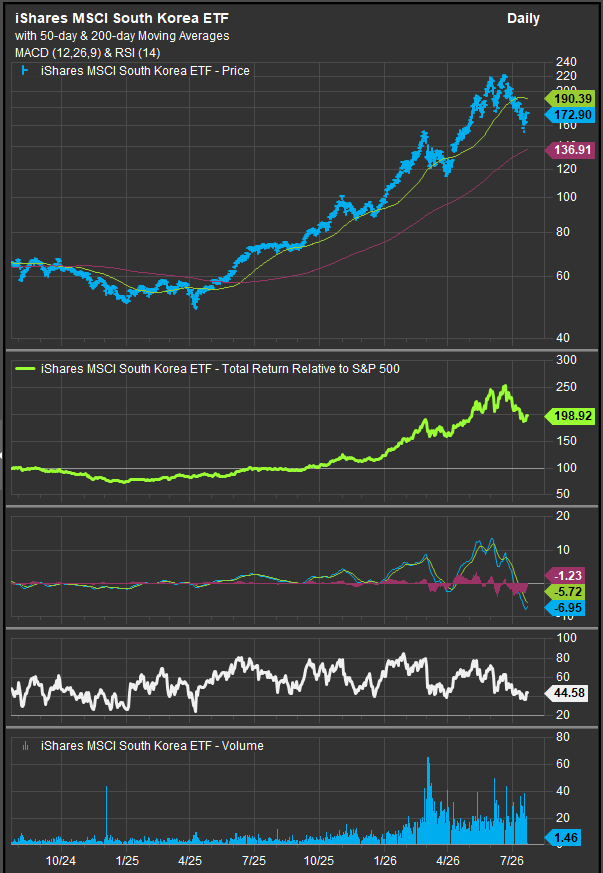
Chart: Investors are entering the EWY as oscillator studies show near-term oversold conditions.
Indonesia (EIDO) combines positive performance and strong flows, but its 5.75% weekly gain and elevated momentum reading argue against chasing the move without a pullback.
On the Sidelines
| ETF | Country | 1-Week Return | 1-Month Return | 1-Week Flow | 1-Month Flow | YTD Flow |
| ENOR | Norway | +0.60% | +2.99% | $0 | +$6.9M | +$48.3M |
| EIS | Israel | -1.80% | -1.85% | +$11.9M | -$18.1M | +$232.5M |
| EWH | Hong Kong | +1.00% | +4.79% | -$5.0M | -$6.6M | +$543.3M |
| EWW | Mexico | +0.60% | -1.93% | +$7.5M | -$7.3M | -$157.2M |
| EPU | Peru | +0.50% | -0.79% | $0 | $0 | +$209.8M |
| QAT | Qatar | -0.34% | -4.52% | $0 | +$0.9M | +$1.2M |
| UAE | United Arab Emirates | -1.61% | -7.17% | $0 | +$5.0M | +$155.6M |
The sidelines group contains several markets that appear fundamentally relevant to the current geopolitical environment but have not attracted enough capital to confirm investor conviction.
Norway (ENOR) is the clearest example. Its energy-export exposure should benefit from higher oil prices, and the fund has gained nearly 3% over one month. Yet monthly inflows of less than $7 million suggest investors have not made Norway a major geopolitical hedge.
Direct Gulf exposure looks less attractive. Qatar (QAT) and the United Arab Emirates (UAE) have received little new capital despite their energy-exporting status. Their negative monthly returns indicate that proximity to the conflict, shipping disruption and regional security risks are offsetting the benefit of higher crude prices.
Israel (EIS) is similarly caught between long-term strategic inflows and immediate conflict risk. Hong Kong (EWH), meanwhile, has rallied almost 5% over one month without attracting new capital, suggesting investors are hesitant to chase recent strength.
Mexico (EWW) and Peru (EPU) also show limited near-term conviction. Their flows are essentially flat, leaving performance more dependent on commodity prices, currencies and the direction of U.S. trade policy.
Under Pressure
| ETF | Country | 1-Week Return | 1-Month Return | 1-Week Flow | 1-Month Flow | YTD Flow |
| EWZ | Brazil | -0.72% | +5.60% | — | -$460.3M | +$1.81B |
| EWJ | Japan | -0.81% | -3.66% | -$122.0M | -$270.8M | +$4.01B |
| EWT | Taiwan | -1.86% | -8.56% | — | -$178.5M | -$490.2M |
| EWA | Australia | -0.42% | +0.42% | +$17.1M | -$101.6M | -$28.7M |
| MCHI | China | -0.28% | +2.33% | — | -$94.9M | -$871.1M |
| EZA | South Africa | -2.29% | -6.68% | — | -$69.7M | +$55.6M |
| INDA | India | +0.12% | -1.61% | -$58.5M | -$58.5M | -$1.85B |
| EWC | Canada | -0.74% | +2.04% | — | -$52.7M | +$1.74B |
| EWG | Germany | -0.41% | -0.46% | -$12.4M | -$48.9M | -$185.8M |
| KSA | Saudi Arabia | -0.30% | -4.51% | -$22.2M | -$22.2M | -$6.6M |
The most important signal is that positive performance is not preventing redemptions.
Brazil (EWZ) has gained 5.60% over one month but lost approximately $460 million. That combination suggests investors are using market strength to reduce exposure, particularly as Brazil faces additional U.S. tariff risk.
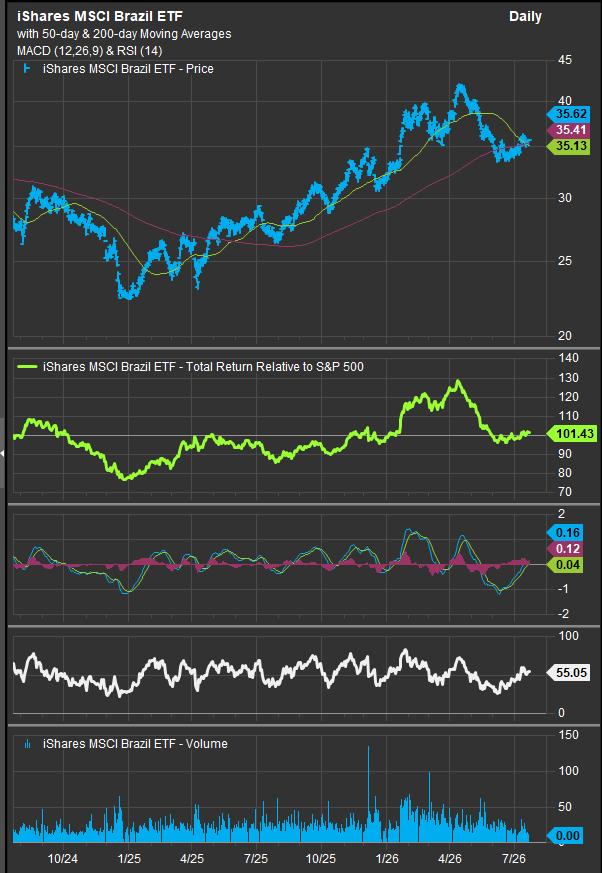
Chart: The near-term flow picture has been shakier for Brazilian equities despite their clear tilt towards commodities exposures.
Canada (EWC) presents a similar tension. Energy exposure provides support, but new U.S. tariffs create uncertainty for exporters, manufacturing supply chains and the broader trade relationship.
Japan (EWJ), India (INDA) and Taiwan (EWT) remain vulnerable to higher oil prices because each relies heavily on imported energy. Japan also faces currency-related inflation pressure, while Taiwan and India combine energy sensitivity with technology or growth-sector exposure.
Taiwan’s weak performance and negative flows make it particularly exposed if semiconductor volatility continues. China (MCHI) has managed a positive monthly return, but continued redemptions indicate that investors remain unconvinced by the rebound.
Saudi Arabia (KSA) illustrates why higher oil prices do not automatically make Gulf markets attractive. The direct risks to infrastructure, shipping and regional activity are currently outweighing the benefit of stronger crude revenues.
Near-Term Positioning
The country-flow data favor selective rotation rather than broad international de-risking.
Among developed markets, the United Kingdom and Switzerland offer the most balanced combination of positive flows, resilient sector exposure and relatively stable performance. Norway remains a logical indirect oil hedge, but the limited flow confirmation and strong recent momentum argue for patience rather than aggressive buying.
South Korea offers the strongest tactical rebound opportunity, but it should be treated as a high-volatility trade. Its large inflows are attempting to capture an oversold semiconductor market, not provide protection against geopolitical stress.
Investors should remain cautious toward direct Gulf exposure, oil-dependent Asian economies and countries facing additional U.S. tariff pressure. Brazil and Canada may benefit from commodity exposure, but their flow trends suggest trade-policy concerns are currently dominating.
The next confirmation will come from oil prices and shipping conditions. A sustained energy shock would favor exporters and defensive developed markets. A ceasefire or restoration of secure shipping routes would improve the outlook for Japan, Korea, Taiwan and India—but the flow data show that investors are not yet positioning for that outcome.
Sources
- FactSet Research Systems Inc.: July 22, 2026 country-ETF performance and fund-flow dataset supplied for the analysis.
- Reuters: Oil rose above $94 as escalating U.S.–Iran hostilities threatened traffic through both the Strait of Hormuz and Bab el-Mandeb.
- Reuters: Gulf equity markets weakened as direct security and shipping risks offset some of the potential benefits of higher oil prices.
- Reuters: Asian refiners and Saudi tankers began considering longer routes through the Suez Canal or around Africa, increasing transportation costs and delivery times.
- Reuters: South Korea and Taiwan led a $46.1 billion emerging-market equity outflow in June as investors reduced concentrated technology exposure.
- Reuters: Japan’s weak yen and higher oil prices increased concerns about imported inflation and potential currency intervention.
Disclaimer: This material is provided for informational and educational purposes only and does not constitute investment advice, an offer to sell, or a solicitation to purchase any security. ETF performance and fund-flow data are historical, may be revised and do not guarantee future results. Country ETFs involve risks including geopolitical events, currency fluctuations, market concentration, trade restrictions and differing regulatory environments. Investors should review each fund’s prospectus and consult an appropriate financial professional before making investment decisions. Myrtle Tree Investment Research LLC may hold positions in securities discussed.
