China has become one of the more frustrating markets for global investors in 2026. Valuations look inexpensive, Beijing continues to promise economic support, exports are booming and Chinese companies remain increasingly competitive in artificial intelligence, semiconductors, electric vehicles and advanced manufacturing. Yet the internationally accessible Chinese equity market remains firmly underwater.
The iShares MSCI China ETF (MCHI) was down 8.4% year to date through August 24, while the KraneShares CSI China Internet ETF (KWEB) had lost 17.7% through July. Hong Kong’s Hang Seng Tech Index was still down roughly 14% for 2026 as of August 21.
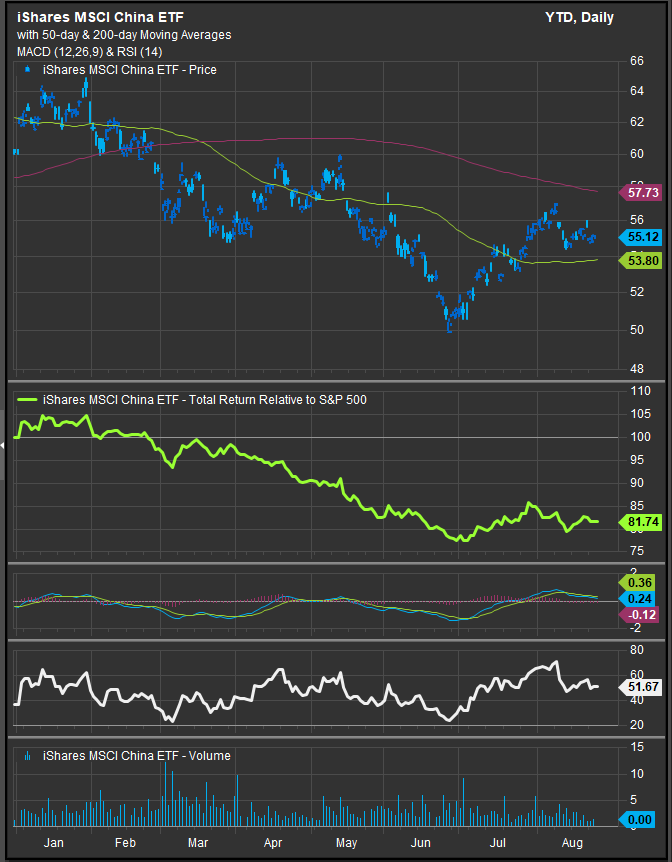
Those numbers, however, obscure perhaps the most important development in China today: there is no longer a single Chinese economic or equity cycle. Shanghai’s STAR 50 technology index has gained more than 20% this year while internationally owned consumer, internet and Hong Kong-listed shares have struggled. The divide reflects China’s increasingly two-speed economy—one driven by exports, technology investment and industrial policy, and another still weighed down by property losses, weak household confidence and subdued domestic consumption. For sector investors, that distinction matters more than the question of whether China itself is simply “cheap.”
The Property Bust Is Still Driving the Cycle
China’s fundamental problem remains the aftermath of its property boom. Real estate was not merely another industry in China’s economy. Housing represented a major store of household wealth, construction supported local-government finances, and land sales helped fund infrastructure and public spending. The collapse of that system has created a negative wealth effect that Beijing has still not fully offset. Property investment fell 19.2% year over year during the first seven months of 2026. New commercial-property sales measured by floor area declined 11.8%, while sales by value dropped 13.1%. New-home prices fell 3.2% from a year earlier in July, and only 17 of the 70 cities monitored by China’s statistics bureau recorded monthly price increases.
That housing weakness is feeding directly into household behavior. Chinese families remain reluctant to borrow and spend because the value of their largest asset is still falling. July delivered a particularly stark example. New yuan bank lending contracted by 340 billion yuan, the largest decline on record. Household loans shrank by 460.3 billion yuan, including mortgages, while outstanding loan growth fell to a record-low 5.1%. This is one reason simply cutting interest rates has failed to produce the sort of response investors might expect in a traditional economic cycle. China’s problem is increasingly demand for credit, not merely the price of credit.
The Consumer Hasn’t Taken Over From Housing
Beijing has spent several years talking about shifting the economy toward domestic consumption. The transition remains incomplete. July retail sales increased only 0.6% from a year earlier, after rising 1.0% in June. Retail sales during the first seven months were up just 1.2%. Department-store sales declined 2.4%, while brand-exclusive stores fell 9.3%. There are pockets of strength. Online sales increased 4.8%, online services rose 5.2%, convenience-store sales climbed 6.1% and food-related online spending remained strong. But these are not yet large enough to create a broad consumer-led expansion. That weakness explains much of the disconnect between inexpensive Chinese consumer equities and their inability to sustain rallies.
The Global X MSCI China Consumer Discretionary ETF (CHIQ), for example, traded at just 6.3 times earnings and below book value in late August. Those are striking valuations, but valuation alone cannot repair household confidence. Chinese consumer stocks need improving earnings expectations more than they need lower multiples.
Manufacturing Is Stronger—but It Has Its Own Problem
China’s industrial sector presents almost the opposite picture. Industrial production increased 4.5% year over year in July, including 5.5% growth in manufacturing. High-tech investment increased 5% during the first seven months even as total fixed-asset investment contracted 6.7%. Investment in information services jumped 19.2%, aerospace equipment increased 12.3%, and electronics and communications equipment rose 7.1%.
Exports have been even stronger. July exports rose 23.9% from a year earlier, with high-tech exports rising more than 40%. Semiconductor exports nearly doubled as global AI infrastructure spending continued to support demand for Chinese electronics and components. That is the bullish side of the Chinese story.
But there is a catch: China’s factories are producing much more successfully than Chinese households are consuming. The resulting surplus capacity has fueled fierce price competition in electric vehicles, solar equipment, lithium batteries, steel, cement and even food delivery. Beijing calls the phenomenon “involution-style competition”—companies cutting prices and sacrificing margins to preserve market share. Solar manufacturers provide a vivid example. Despite enormous production capacity and global leadership, many major Chinese solar companies remain loss-making because oversupply has overwhelmed industry economics. Chinese regulators held another industry meeting in July aimed at restraining destructive pricing behavior. For equity investors, this creates a crucial distinction: Fast revenue growth does not necessarily mean strong shareholder returns if competition destroys the industry’s margins.
Why Broad Chinese Equities Keep Disappointing
This helps explain why the equity market has struggled despite apparently attractive valuations. China currently has several different economic forces pulling in opposite directions. Property remains deeply recessionary. Consumption is weak. Private investment is contracting. Credit demand is soft. Manufacturers face overcapacity. Trade partners are increasingly resisting China’s export surpluses. At the same time, government-supported technology, AI infrastructure, advanced manufacturing and export-oriented industries continue to grow. The result is not an economy in conventional recession, but an economy undergoing a difficult capital reallocation away from property and toward strategic manufacturing and technology.
Investors exposed to the old growth model—property, consumer demand, traditional financial credit creation and Hong Kong internet platforms—have experienced something very different from investors exposed to semiconductor manufacturing, robotics or China’s STAR Market. As of mid-August, the broad CSI 300 was up less than 1% for the year, while the STAR 50 had gained roughly 29%. That divergence is the China investment story.
Beijing Is Stimulating—But There Is No Bazooka
The policy outlook also helps explain why markets have repeatedly been disappointed. China’s leadership is clearly concerned about the slowdown. Second-quarter GDP growth fell to 4.3%, down from 5.0% during the first quarter and the weakest pace in more than three years.
At its July Politburo meeting, Beijing promised stronger countercyclical support, faster fiscal spending, additional policies where needed, greater support for domestic demand and continued implementation of an “appropriately accommodative” monetary stance. Officials also specifically highlighted service consumption, AI, strategic infrastructure and efforts to stop destructive industrial competition. But Beijing is still resisting a giant property- or credit-driven stimulus package. The People’s Bank of China kept its benchmark lending rates unchanged again in August—the one-year Loan Prime Rate at 3.00% and five-year rate at 3.50%—for the 15th consecutive month. Bank profitability and already-thin net interest margins are limiting the central bank’s room to cut aggressively. Fiscal policy is therefore becoming the more important lever.
An 800 billion yuan, or roughly $119 billion, policy-financing facility has begun accepting projects. The program is intended to provide seed capital for infrastructure and strategic investment that can then attract additional bank and private financing. Goldman Sachs estimates it could eventually add roughly 0.5 percentage point to GDP, although much of the impact may not arrive until late 2026 or early 2027. China’s finance ministry has also promised additional measures aimed more directly at household spending, including consumer and small-business loan subsidies. That represents progress—but it remains targeted stabilization rather than shock therapy.
There Are Signs of a Turnaround—Just Not a Broad One Yet
There are legitimate reasons to become less bearish on China. Producer prices are now rising rather than falling. China’s July PPI increased 3.5% year over year, although it fell 0.7% from June, suggesting the reflation signal is still heavily influenced by commodities rather than purely stronger domestic demand. Consumer inflation remained just 0.5%. Exports are extremely strong. Technology investment remains positive. Industrial profits increased during the first half. Beijing is accelerating fiscal spending. The yuan has strengthened to its highest level against the dollar since 2023, supported by China’s enormous trade surplus. And the equity market itself is beginning to differentiate between businesses benefiting from China’s new economic model and those still trapped in the old one. That is typically what an early-stage market turn looks like: leadership develops before the macroeconomic data become uniformly good.
But we would not yet characterize China as entering a traditional cyclical recovery. The confirmation signals would be broader: sustained improvement in retail sales; positive household credit growth; stabilization in national home prices; an end to the decline in private fixed investment; manufacturing new orders moving consistently above 50; and evidence that government fiscal commitments are translating into completed projects rather than simply announced funding. Those conditions have not yet been met.
The Sector Investor’s China Playbook
| Sector | ETFSector View | What Matters Now |
| Semiconductors / AI / Technology Hardware | Most Constructive | Policy support, technological self-reliance, AI investment and exports remain powerful structural tailwinds. Valuation excess is becoming a risk after the STAR rally. |
| Industrials / Infrastructure | Improving | The 800 billion yuan financing facility and faster fiscal deployment should support selected machinery, electrical equipment, grid and infrastructure companies. |
| Materials / Solar / Batteries | Selective Turnaround | Anti-involution policy could improve margins if real capacity exits occur. Avoid assuming higher commodity prices automatically mean sustainable profitability. |
| Internet / Platforms | Watch for Confirmation | Valuations have compressed substantially and AI offers upside, but weak consumption and intense e-commerce competition continue to pressure near-term earnings. KWEB remains a high-beta recovery vehicle rather than a confirmed leadership trade. |
| Consumer Discretionary | Early-Cycle Watchlist | CHIQ and similar exposure could have considerable upside if household confidence turns. Retail sales and housing stabilization are the key triggers. |
| Financials | Neutral to Cautious | Weak loan demand and compressed banking margins limit the benefits of monetary easing. A genuine household and private-credit recovery would change the thesis. |
| Real Estate | Underweight | Falling prices, contracting investment, developer restructurings and excess lower-tier-city inventory remain fundamental obstacles. |
World Wide Wednesday View
China is becoming more interesting—but the investment case is selective, not yet broad-based. The old Chinese cycle was relatively simple: credit accelerated, property investment increased, commodity demand strengthened, consumers spent more and the broader equity market followed.
The new cycle is different. Beijing is deliberately directing capital toward AI, semiconductors, robotics, computing infrastructure, advanced manufacturing and national technological self-sufficiency while refusing to fully reinflate the property system that powered the previous two decades. That transition can ultimately create a healthier economy, but it also explains why inexpensive broad-China equity exposure has been such an unreliable trade.
For sector investors, we would therefore resist treating China as a binary risk-on/risk-off allocation. The emerging opportunity is inside the market. Technology hardware, semiconductors and selected strategic industrials already appear to be pricing in an economic future that looks better than the present. Consumer discretionary, internet platforms and financials offer potentially greater cyclical upside—but they require evidence that policy is finally reaching households rather than primarily producers.
The real China turnaround will arrive when those two economies begin moving in the same direction. For now, they aren’t.
Sources
- National Bureau of Statistics of China — July 2026 economic releases: Primary source for industrial production, retail sales, fixed-asset investment, real-estate investment, housing prices, CPI/PPI and PMI. Fixed-asset investment fell 6.7% year over year in January–July, underscoring the weakness in domestic capital spending.
National Bureau of Statistics — Latest Releases - Reuters — China’s July exports: Exports rose 23.9% year over year, supported by AI-related demand, semiconductor shipments and high-tech exports, illustrating the strength of China’s external/manufacturing economy relative to domestic demand.
- Reuters — China keeps lending rates unchanged: The PBOC left the one-year Loan Prime Rate at 3.00% and the five-year rate at 3.50% in August, reinforcing the view that Beijing currently favors targeted fiscal support over aggressive monetary easing.
- Reuters — $119 billion policy-financing facility: Beijing has begun accepting projects for an 800 billion yuan financing program designed to support infrastructure and strategic investment, although implementation delays could push much of the economic impact into late 2026 or 2027.
- Reuters — Fiscal-policy outlook: China’s Finance Ministry has pledged additional fiscal support, including faster infrastructure spending and subsidies for eligible consumer and small-business borrowing, as policymakers attempt to strengthen domestic demand.
- Xinhua — July Politburo economic-policy meeting: Chinese leadership called for a more proactive fiscal policy, appropriately accommodative monetary policy, stronger countercyclical measures and expanded domestic demand, while emphasizing AI, advanced technology and efforts to curb destructive “involution-style” competition.
Disclaimer: This material is provided for informational and educational purposes only and does not constitute investment advice, a recommendation, or an offer to buy or sell any security or ETF. Market conditions, economic data and policy expectations can change rapidly. Investors should consider their individual objectives, risk tolerance and circumstances and conduct their own research before making investment decisions.