
DM for the Core, EM for the Catalyst
International equities enter this week at an important inflection point. Emerging markets have been one of the strongest global trades of 2026, helped by the semiconductor cycle, strong Asian exports and a substantial rerating across several previously discounted markets. That relative strength is now being tested by a very different macro backdrop. The Federal Reserve is expected to raise rates, oil and refined-product prices remain elevated because of the Middle East conflict, and China’s latest economic data continue to show a widening gap between strong manufacturing and weak domestic demand. At the same time, fiscal spending, defense investment and trade diversification are creating increasingly visible earnings catalysts in parts of the developed world.
The ETF tape is beginning to reflect that shift. In the supplied international dataset, the iShares MSCI Emerging Markets ETF (EEM) has still returned 15.8% over six months, comfortably ahead of the 9.5% gain for the iShares MSCI EAFE ETF (EFA). Over the latest three months, however, EEM has fallen 5.7% while EFA has gained 1.3%, and the gap widened again over the latest week, with EEM down 4.3% versus a 2.7% decline for EFA.
That reversal is particularly important because broad emerging markets no longer offer the valuation discount investors normally expect as compensation for higher volatility. As of September 9-10, iShares reported EEM trading at roughly 20.0 times earnings, compared with about 19.2 times for EFA. EFA also carried a 12-month trailing yield of roughly 3.1%, compared with 1.7% for EEM, while its three-year beta and volatility were substantially lower. After EM’s strong first-half rerating, the choice is therefore no longer between expensive developed markets and obviously cheap emerging markets.
For the near-term international allocation framework, developed markets deserve the larger core exposure, while emerging markets increasingly look like a country-selection trade rather than a broad beta trade. Germany and Canada offer identifiable fiscal, industrial, energy and trade catalysts. China offers genuine valuation optionality, but the economic turn remains incomplete. South Korea still has perhaps the strongest earnings engine of the four markets, but its extraordinary run and subsequent flow reversal leave it better suited to selective risk-taking than indiscriminate EM exposure.
| Market | ETF | 1 Week | 1 Month | 3 Months | 6 Months | 1-Month Fund Flow |
| Germany | EWG | -1.18% | -3.69% | +1.65% | +8.87% | -$62M |
| Canada | EWC | -1.15% | -3.12% | +2.31% | +10.07% | +$495M |
| China | MCHI | -0.81% | -3.15% | -3.68% | -7.83% | +$110M |
| South Korea | EWY | -7.49% | -1.81% | -16.53% | +42.16% | -$1.23B |
Source: FactSet Research Systems Inc.
Germany: Fiscal Expansion Is Starting to Matter
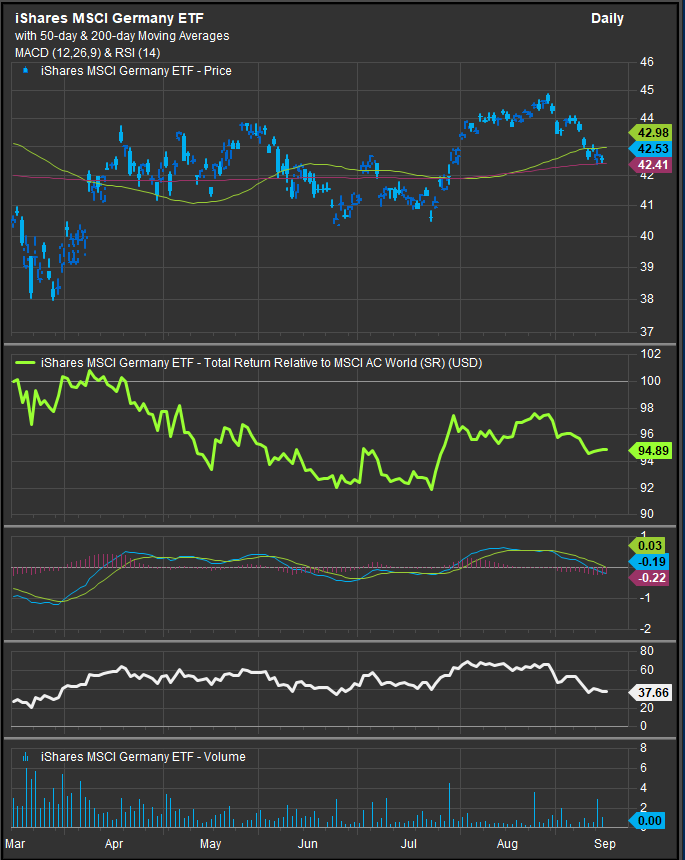
Germany remains one of the more interesting developed-market recovery trades because its equity market is positioned very differently from the domestic economy investors have spent the past several years worrying about. The iShares MSCI Germany ETF (EWG) is almost 29% Industrials, 23% Financials and 16% Information Technology. It is therefore substantially more exposed to capital spending, defense, automation, financial activity and external demand than to Germany’s sluggish household economy. EWG also trades at roughly 18.6 times earnings, modestly below broad EAFE.
The economic recovery itself remains uneven. German manufacturing orders increased 2.5% in July and were 13.1% above year-earlier levels, although orders excluding large-scale contracts declined 1.4%. Industrial production fell 1.1% during the month, demonstrating that the recovery has not yet broadened decisively. Exports also slipped 0.8% from June but remained 6.1% higher than a year earlier.
What is changing is the fiscal side of the equation. The European Commission expects Germany to grow only 0.6% in 2026 and 0.9% in 2027, but it also expects government deficits to widen materially as defense spending, infrastructure investment and tax relief begin filtering into activity. That is precisely the mix that matters for EWG’s industrial-heavy composition. Germany and the United States also signed an agreement this week to deepen defense-industry cooperation, while the UAE recently committed €40 billion of investment into Germany, including digital infrastructure, data centers, energy and industrial projects.
The ETF itself has pulled back 3.7% over the past month, with an RSI near 25 and roughly $77 million of weekly outflows. That weakness looks more consistent with an early-cycle industrial recovery experiencing a macro setback than with deterioration in the underlying fiscal thesis. Germany still faces expensive energy, uneven manufacturing demand and trade sensitivity, but its equity market increasingly provides exposure to the parts of the economy receiving the greatest incremental investment.
Canada: Investors Are Already Buying the Pullback
Canada presents a different developed-market opportunity. EWC has declined roughly 3.1% over the latest month, but investors have added approximately $495 million during that period and roughly $2.45 billion year to date. That combination—falling prices accompanied by persistent inflows—is one of the stronger accumulation signals in the current country ETF data.
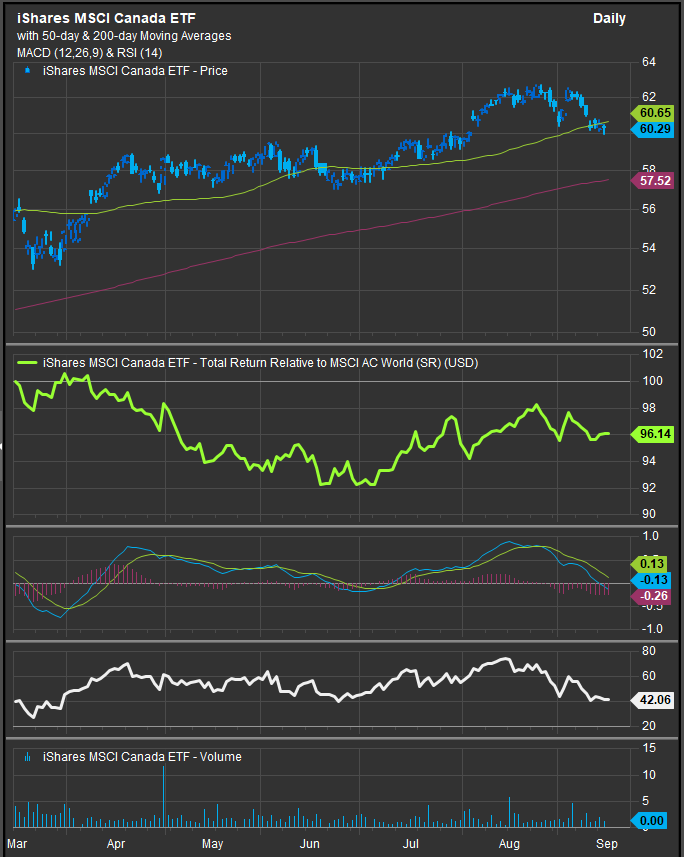
The attraction becomes clearer when looking inside the portfolio. Almost 40% of EWC is Financials, while Energy represents roughly 17% and Materials another 16%. Together those three sectors account for nearly three-quarters of the portfolio. Canada therefore combines bank exposure with some of the strongest direct developed-market exposure to oil, natural gas, metals and critical minerals at a time when energy security has moved back to the center of global economic policy.
Canada’s domestic backdrop is improving but not without risk. The Bank of Canada held its policy rate at 2.25% earlier this month and said economic growth had begun to recover after stalling, while warning that high energy prices and renewed trade frictions were raising inflation uncertainty. Its July forecast called for GDP growth of just 0.7% in 2026 but an acceleration to 1.8% in 2027. Statistics Canada meanwhile reported that real GDP increased 0.3% in June, its third consecutive monthly increase.
The more interesting forward catalyst is Canada’s attempt to diversify its economic relationships beyond the United States. European Commission President Ursula von der Leyen proposed Wednesday that Canada become the EU’s first “associate member,” potentially deepening cooperation in areas including energy, critical minerals, AI, defense and supply chains. The legal structure does not currently exist in EU treaties and details remain unresolved, so investors should treat the initiative as a strategic direction rather than an immediate earnings event.
For Canadian equities, however, the direction is potentially significant. A deeper European relationship could create additional markets for precisely the sectors EWC emphasizes—energy, minerals, financial services and industrial infrastructure. Canada also benefits more directly than most developed economies from elevated commodity prices, even as higher gasoline prices create domestic inflation pressure. That mix makes Canada one of the more differentiated DM exposures in the current environment.
China: Cheap Enough to Watch, Not Yet Strong Enough to Lead
China represents almost the opposite setup. MCHI is inexpensive, deeply out of favor and beginning to attract some capital, but the macroeconomic evidence does not yet support declaring a durable turn. The ETF has fallen 7.8% over six months and 3.7% over three months, while year-to-date fund flows remain negative by roughly $760 million. More recently, however, approximately $110 million has entered the fund over the latest month, and its RSI has fallen below 30.
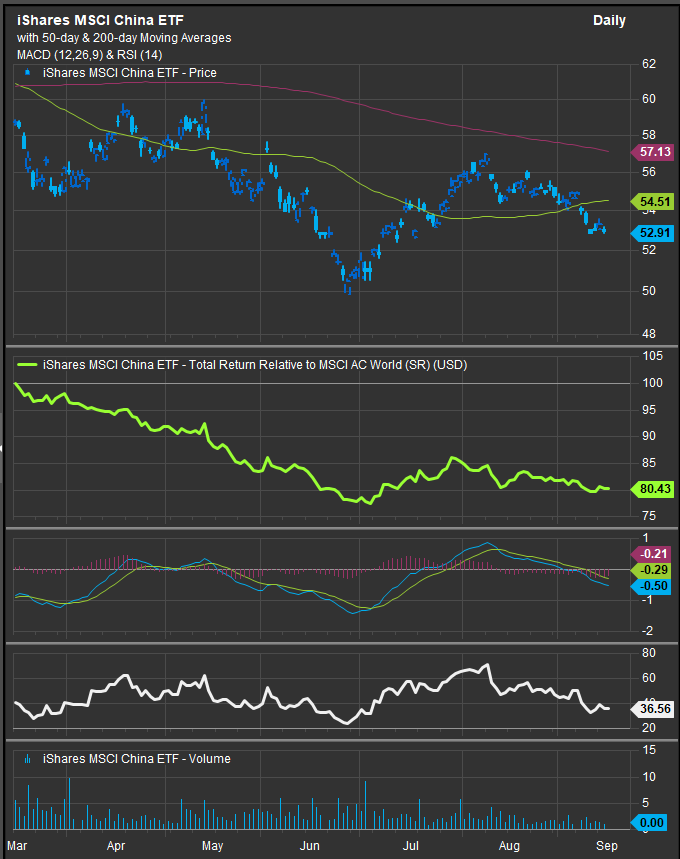
Valuation is the strongest argument. MCHI trades at approximately 13.6 times earnings and 1.65 times book value, a substantial discount to both EEM and EFA. Its composition also gives investors exposure to Consumer Discretionary, Financials, Communication Services and Information Technology rather than simply the old industrial-export China trade. If domestic activity eventually stabilizes, there is considerable room for both earnings recovery and multiple expansion.
The difficulty is that China’s latest economic data remain bifurcated. Industrial production accelerated to 5.2% year-over-year in August, helped by advanced manufacturing, AI-related investment, batteries and industrial robots. Retail sales, however, increased just 0.4%, fixed-asset investment fell 7.2% during the first eight months of the year, and property investment was down almost 20%. Credit data tell a similar story: loan demand remains weak, particularly among households, and the People’s Bank of China is increasingly describing slower loan growth as a structural feature rather than a temporary aberration.
Trade negotiations create the obvious near-term catalyst. Washington and Beijing are discussing potential tariff reductions ahead of the planned leaders’ meeting, while the broader U.S.-China trade truce remains under negotiation. A meaningful de-escalation could produce a sharp China rerating because valuations and positioning are already depressed. Until domestic consumption, housing and credit demand show clearer stabilization, however, China looks more like a high-optionality contrarian position than a replacement for a developed-market core allocation.
South Korea: The Best Earnings Story Comes With the Highest Beta
South Korea may be the most compelling example of why the EM-versus-DM debate needs to move down to the country level. EWY has gained an extraordinary 42.2% over six months, driven principally by the AI semiconductor boom, before falling 16.5% during the latest three months and 7.5% in the past week. Investors have withdrawn approximately $1.23 billion over one month, even though year-to-date inflows remain close to $8.9 billion.
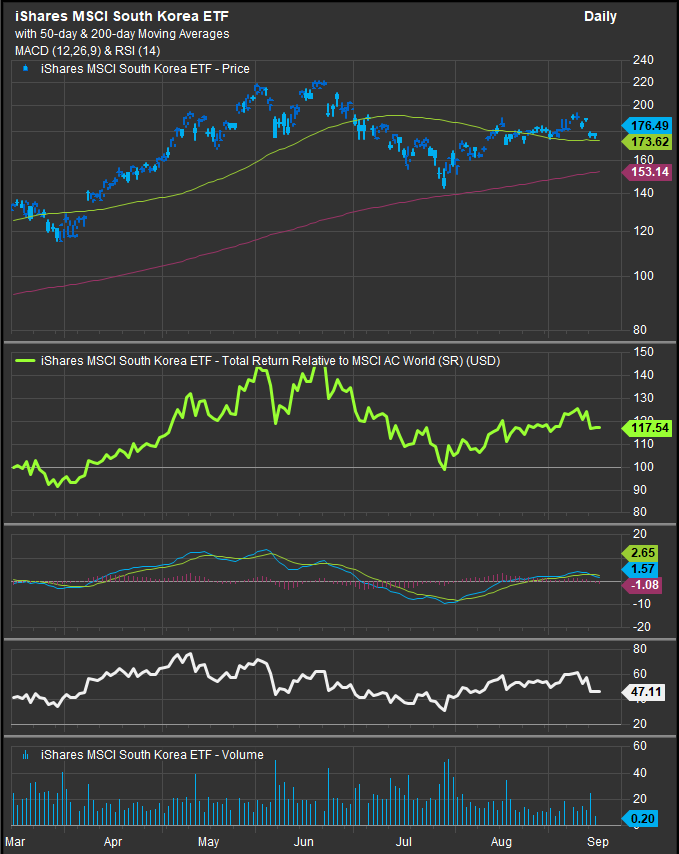
This is an extremely concentrated earnings trade. Information Technology represents approximately 52% of EWY, with Industrials contributing another 19%. The ETF therefore behaves less like a diversified national economy and more like a combined semiconductor, electronics, shipbuilding and industrial-export vehicle. That exposure has been exceptionally valuable during the AI capital-spending cycle: South Korean exports surged 68.7% year over year in August, extending export growth to a fifteenth consecutive month.
The underlying corporate story remains powerful. Samsung Electronics and SK Hynix have announced shareholder-return plans totaling roughly $97 billion for 2026, supported by the exceptional cash generation of the AI memory cycle. At the same time, investors continue to debate whether South Korea’s broader corporate-governance reforms will be sufficient to reduce the longstanding “Korea discount.” SK Hynix is also discussing potential U.S. memory-chip manufacturing with Intel in Ohio, which could deepen its position in the American AI supply chain, although no final arrangement has been announced.
The problem is that the valuation cushion has largely disappeared. EWY now trades near 22.8 times earnings, above both broad EAFE and emerging markets, while its three-year beta approaches 2.0. Korea therefore still offers one of the strongest earnings-growth engines in international markets, but investors are now paying for it. The recent $1.2 billion monthly ETF outflow looks like a positioning reset following an exceptional run rather than evidence that the semiconductor cycle has ended, but it also argues against treating Korea as low-risk EM beta.
The Worldwide Wednesday Signal
The broad allocation message this week is that developed markets have regained the better risk-reward balance at the index level. EM’s extraordinary 2026 performance has eliminated much of its traditional valuation advantage at the same time that U.S. monetary tightening, high oil prices and a still-firm dollar create a more difficult environment for broad emerging-market exposure. Developed markets also have more direct exposure to several of the dominant policy themes of the next year: infrastructure investment, defense spending, energy security, financial-sector profitability and supply-chain diversification.
That does not mean abandoning emerging markets. It means becoming much more selective. China offers the deepest valuation discount and the greatest upside to a policy or trade catalyst, but domestic fundamentals remain weak. South Korea offers substantially stronger earnings momentum, but it comes with concentrated technology exposure, a richer valuation and very high volatility. The two markets therefore offer potential for very different reasons—and neither makes a compelling case for simply buying broad EM beta.
Germany and Canada provide a more balanced setup. Germany offers an increasingly visible public-investment and industrial-capex cycle after years of stagnation, while Canada combines improving growth, energy and materials exposure, persistent ETF inflows and a potentially important strategic diversification toward Europe. Neither story is without risk, but both are easier to underwrite against current earnings and policy commitments than a broad bet on an EM macro acceleration.
For international sector investors, the conclusion is increasingly clear: use developed markets for the core and emerging markets for targeted catalysts. The next leg of international equity performance is unlikely to be defined simply by EM versus DM. It will be defined by which countries have the sector composition, fiscal capacity, earnings momentum and policy catalysts to convert global disruption into corporate cash flow.
Sources and Methodology
ETF returns, flows and technical readings are from Factset Research Systems Inc.. Macro and policy research incorporates primary data from Destatis, Statistics Canada, the Bank of Canada and European Commission, along with current company, trade and geopolitical reporting from Reuters.
Disclaimer: This material is provided for informational and educational purposes only and does not constitute individualized investment advice, a recommendation, or an offer to buy or sell any security. Country ETFs involve currency, geopolitical, market-concentration and other risks that may differ materially across markets.
