

Sector Outlook:
The latest sector ETF return and flow data confirms the message from the weekend news flow: investors are not abandoning equities, but they are becoming more selective. The AI trade is no longer being rewarded as one broad theme. Inflation and Fed uncertainty are keeping rate-sensitive sectors volatile. Geopolitical risk is giving Energy tactical support. At the same time, flows into Real Estate, Health Care, Financials, Industrials and selected Technology exposure suggest investors are still discounting a durable business cycle rather than a recession.
The strongest message from the 7/19 sector data is broadening. Equal Weight S&P 500 exposure outperformed cap-weighted exposure over the past month, with RSP up 2.49% versus VOO up 0.55%, while RSP attracted nearly $2.0B of 1-month inflows. Investors are looking beyond mega-cap concentration, even as the AI complex works through a sharp momentum unwind.
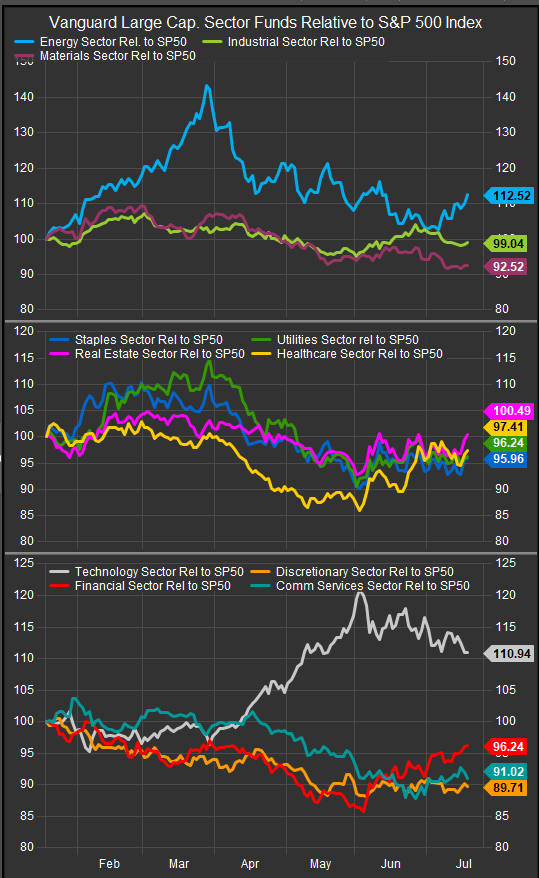
What the Flow Map Is Signaling
| Rank | Sector | Vanguard ETF | 1W Return | 1M Return | 1W Flow | 1M Flow | YTD Flow | Flow Signal |
| 1 | Real Estate | VNQ | 2.2% | 5.5% | -$24.8M | $466.0M | $1.33B | Strongest rate-relief accumulation |
| 2 | Industrials | VIS | -0.5% | -1.0% | -$6.9M | $249.0M | $817.6M | Buy-the-dip in AI buildout/capex |
| 3 | Information Technology | VGT | -2.1% | -3.2% | $46.0M | $226.2M | $2.99B | Selective buying of tech weakness |
| 4 | Financials | VFH | 0.5% | 4.9% | -$2.7M | $154.9M | -$354.2M | Recent rotation into banks/capital markets |
| 5 | Health Care | VHT | -0.1% | 7.9% | $15.4M | $146.7M | -$93.0M | Improving rotation, led by biotech/pharma |
| 6 | Communication Services | VOX | -1.4% | 1.6% | $33.5M | $107.0M | -$246.2M | Tactical rebound, not yet durable |
| 7 | Utilities | VPU | -1.1% | 2.0% | $25.3M | $42.8M | $387.8M | Modest support; rate-sensitive plus AI power demand |
| 8 | Materials | VAW | -0.5% | -4.4% | -$18.0M | -$17.2M | -$111.6M | Commodity/inflation hedge not confirming |
| 9 | Energy | VDE | 1.6% | 6.2% | -$15.8M | -$22.0M | $700.8M | Performance hedge, but not fresh accumulation |
| 10 | Consumer Staples | VDC | 0.5% | 2.0% | $7.2M | -$114.7M | $5.1M | Defensive bounce, weak flow support |
| 11 | Consumer Discretionary | VCR | -0.2% | 1.3% | -$70.4M | -$117.4M | -$250.6M | Consumer rally not flow-confirmed |
Technology: Buy AI Infrastructure, Not All Tech
The clearest change in the market is that investors are no longer treating every Technology pullback as an automatic buying opportunity. Buying tech weakness selectively means using the pullback to add exposure where fundamentals are still improving, not buying the whole sector simply because prices fell.
The strongest exposure remains in AI infrastructure: semiconductors, memory, chip equipment, networking, data-center hardware and hyperscale platforms. These are the areas where earnings visibility is still supported by compute demand, cloud capex, AI servers and data-center buildout. Examples include Nvidia, Broadcom, AMD, Micron, Applied Materials, Lam Research, KLA, Qualcomm, Microsoft, Meta, Alphabet and Amazon.
The 7/19 flow data supports that interpretation. Vanguard Information Technology (VGT) fell 3.16% over the past month but still attracted $226M of inflows. Fidelity MSCI Information Technology (FTEC) fell 3.15% and attracted $97M. That is not an exit signal. It says investors are willing to add diversified Technology exposure on weakness, but only where the earnings story remains credible.
Semiconductors show the same tension. SOXX pulled in $7.3B over one month despite falling 13.0%, while SMH lost $4.8B after falling 10.8%. The message is not that AI hardware demand is broken. It is that investors are rotating across vehicles, managing crowding, and becoming more disciplined after a sharp run.
The weaker exposure is in software and generic AI themes, where investors are questioning pricing power, customer ROI and the risk that AI itself disrupts existing business models. AIQ fell 8.75% and lost nearly $500M over one month. IGV gained 4.08%, but still lost $486M. That fits the weekend news flow around IBM’s software pressure, Oracle data-center cost overruns, open-source model competition from China and growing questions about enterprise software displacement.
For sector investors, that supports Vanguard Information Technology (VGT) and Fidelity MSCI Information Technology (FTEC), but with a bias toward AI hardware, cash-flow leaders and hyperscale platforms rather than broad software or speculative AI.
Industrials: The Best Physical AI Buildout Sector
Industrials are not showing strong near-term performance, but flows remain supportive. Vanguard Industrials (VIS) fell 1.05% over one month but attracted $249M. Fidelity MSCI Industrials (FIDU) fell 1.17% but attracted $63M. Infrastructure funds were even stronger from a flow perspective, with PAVE and IFRA attracting more than $650M combined over the month.
That matters because AI demand is moving deeper into the real economy. Data centers require grid access, transformers, cooling, engineering, power backup, construction, electrical equipment, industrial automation and transmission. The weekend headlines about data-center opposition and cost overruns do not kill the theme. They show that power and infrastructure are becoming constraints.
For sector investors, this supports VIS/FIDU and infrastructure-linked exposure. The better stock examples remain Eaton, Vertiv, Quanta Services, GE Vernova, Hubbell, Caterpillar, Emerson, Parker-Hannifin and select aerospace/defense names. The flow map is saying investors still want the AI buildout, but they increasingly want it through physical assets and order books rather than software multiples.
Financials: Bank Flows Confirm the Broadening Trade
Financials are one of the clearest confirmations that the market is rotating rather than de-risking. Vanguard Financials (VFH) rose 4.86% over one month and attracted $155M. Bank exposure was even stronger: KBWB gained 4.48% and pulled in $580M, while regional banks gained more than 8% over the month.
This aligns with the news flow. Big bank earnings were supported by capital markets, trading, investment banking, strong consumer spending and better delinquency trends. Higher rates remain a risk for long-duration growth and rate-sensitive sectors, but they can help banks, brokers, exchanges and insurers if credit remains stable.
Sector investors should treat VFH/FNCL as supported, with the best emphasis on large banks, brokers, exchanges and insurers. Examples include JPMorgan, Bank of America, Wells Fargo, Goldman Sachs, Morgan Stanley, CME, ICE, Chubb and Progressive. The risk is that expectations have risen, but the flow map is still constructive.
Health Care: Rotation Is Improving, But Providers Carry Policy Risk
Health Care has quietly become one of the strongest sector rotations. Vanguard Health Care (VHT) gained 7.91% over one month and attracted $147M. Fidelity MSCI Health Care (FHLC) gained 7.97% and attracted nearly $20M. Biotech was even stronger, with IBB up 9.41% and pulling in $503M.
That is a meaningful flow signal. Investors are using Health Care as a non-AI growth and defensive quality rotation. It also fits the M&A backdrop, where large-cap pharma and biotech deal activity remains active.
However, the sector is not clean. The weekend headlines around HCA and Intuitive Surgical showed that ACA subsidy expiration risk is beginning to matter. Worsening payor mix, higher uninsured volumes and softer procedure growth can pressure providers and med-tech. The best Health Care expression is therefore selective: VHT/FHLC for broad exposure, biotech and pharma for upside, and more caution around hospitals and procedure-sensitive providers.
Real Estate and Utilities: Rate Relief Is the Key
Real Estate has one of the clearest flow confirmations in the dataset. Vanguard Real Estate (VNQ) rose 5.53% over one month and attracted $466M. SCHH rose 5.91% and attracted more than $1.0B. That is a strong signal that investors are buying rate relief, income and real-asset exposure after cooler inflation data.
The caveat is that Real Estate remains a rate trade. A softer inflation path supports VNQ/FREL, but renewed oil pressure or hawkish Fed commentary could quickly cap multiples. Data-center REITs still have a secular demand story, but the news flow around opposition to data-center development and project cost overruns argues for more discipline.
Utilities are more mixed. Vanguard Utilities (VPU) gained 2.03% over one month and attracted $43M, while Fidelity MSCI Utilities (FUTY) gained 2.08% but saw small outflows. AI electricity demand supports the long-term case, but the sector still needs yields to cooperate. Utilities are improving, but the flow signal is not as strong as Real Estate.
Energy and Materials: Geopolitical Hedge, Not Broad Commodity Leadership
Energy has improved on performance, but flows are not fully confirming a durable overweight. Vanguard Energy (VDE) gained 6.23% over one month, and Fidelity MSCI Energy (FENY) gained 6.21%. Yet VDE saw modest outflows, while FENY had only modest inflows. Exploration and production stocks performed well, but XOP still saw $147M of 1-month outflows.
That is the classic profile of a hedge trade. Investors recognize the geopolitical upside from renewed US-Iran conflict and Strait of Hormuz risk, but they are not yet treating Energy as a durable leadership sector. VDE/FENY can work tactically if oil risk premiums rise, but the flow map is not giving the same conviction signal seen in Financials, Health Care, Real Estate or infrastructure.
Materials are weaker. Vanguard Materials (VAW) fell 4.35% over one month and saw outflows. Fidelity MSCI Materials (FMAT) fell 4.47% and also saw outflows. Gold miners, silver miners, uranium and lithium were all down sharply. That tells us investors are not buying a broad inflation-hedge or commodity supercycle narrative despite geopolitical risk. Materials should be limited to infrastructure-linked demand rather than broad resource beta.
Consumer Sectors: Selective, Not Convincing
Consumer Discretionary is not flow-confirmed. Vanguard Consumer Discretionary (VCR) rose 1.30% over one month but lost $117M. Fidelity MSCI Consumer Discretionary (FDIS) was also only modestly positive and saw essentially no inflow support. Homebuilders and retail participated in the broadening trade, but fund flows remain skeptical. That fits the news flow around high rates, affordability pressure and uneven consumer behavior.
Consumer Staples are defensive but not leadership. Vanguard Consumer Staples (VDC) rose 2.00%, but lost $115M over one month. Fidelity MSCI Consumer Staples (FSTA) saw modest inflows, but the overall sector signal is not strong. The headlines around big food stocks trading at a deep market discount, along with pressure on turnaround strategies, show why investors are not aggressively buying the group even when defensives outperform.
Investment Conclusion
Our Sector ETF flow database is signaling rotation, not recession. Investors are buying Real Estate, Health Care, banks, infrastructure and selected Technology weakness. They are not buying broad Materials, broad Consumer Discretionary, commodity hedges or generic AI. Energy is working as a tactical geopolitical hedge, but flows do not yet confirm durable leadership.
The strongest sector positioning remains selective:
Most supported: Vanguard Financials (VFH), Vanguard Health Care (VHT), Vanguard Real Estate (VNQ), Vanguard Industrials (VIS), and selective Vanguard Information Technology (VGT).
Supported, but conditional: Vanguard Utilities (VPU), especially if rates ease and AI electricity demand remains a long-term load-growth driver.
Tactical: Vanguard Energy (VDE), mainly as a Middle East/oil hedge.
Most vulnerable: Vanguard Materials (VAW), broad Vanguard Consumer Discretionary (VCR), expensive parts of Vanguard Consumer Staples (VDC), and software-heavy or generic AI exposure within Technology.
The sector message is clear: investors are still willing to take equity risk, but they want earnings visibility, rate sensitivity with a catalyst and real cash-flow support. The AI trade is not over, but it has become more selective. Buying tech weakness now means buying AI infrastructure and cash-flow leaders—not every software stock, generic AI fund or long-duration concept that happens to be down. The broadening trade is real, but it is not indiscriminate. Flows favor sectors that can benefit from cooler inflation, stronger bank earnings, Health Care rotation, infrastructure spending and AI-related physical buildout.
Disclaimer: This material is for informational and educational purposes only and should not be considered investment advice, a recommendation, or a solicitation to buy or sell any ETF, security, sector exposure, or investment strategy. Sector performance, ETF flows, inflation trends, earnings expectations and geopolitical risks can change quickly. Past performance is not indicative of future results. Investors should consider objectives, risk tolerance, liquidity needs and consult a qualified financial professional before making investment decisions.
