



April 10, 2026
Since late March, the bond market has been sending a clear message: the balance of risks for interest rates has shifted lower. The 10-year Treasury yield’s move from an intraday high of 4.48% to 4.29% reflects a market increasingly focused on restrictive policy, softer forward growth, and the view that the Federal Reserve is closer to its next cut than to any renewed tightening.
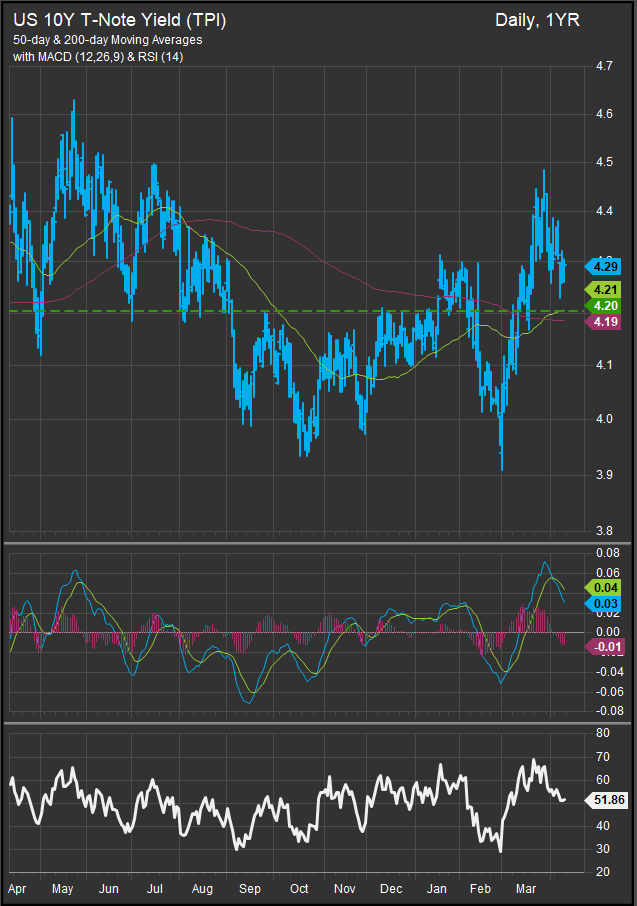
We think 4.2% is likely a key level for the 10yr Yield. Below that level, the Fed has more freedom to act.
That much is straightforward. What is more interesting is that rates do not move on macro data alone. The equity market itself can influence interest-rate dynamics, and that feedback loop helps explain why Treasury yields rarely fall in a straight line once investors begin pricing in easier policy.
The first phase of the current move has been classic. As investors grew more confident that policy was sufficiently restrictive and that growth was moderating, they began to price in higher odds of a Fed cut. That pushed Treasury yields lower and improved the backdrop for equities, especially in rate-sensitive areas. Lower yields support valuations, ease financing conditions, and encourage investors to move back into cyclical and long-duration assets.
But that is only the first step. Once equities rally on the prospect of lower rates, the rally itself can begin to reshape the macro narrative. Stronger risk appetite, tighter credit spreads, firmer cyclical leadership, and improved financial conditions can all reduce recession fears. At that point, the market may start to question how much easing the Fed will actually need to deliver. In that scenario, long-end yields can stabilize or even drift back higher — not because the market has abandoned the cut story, but because the equity response has made the economy look more resilient.
That feedback loop is central to the current setup. It suggests that while the near-term bias for yields remains lower, the path is unlikely to be linear or especially deep unless economic data deteriorate more meaningfully.
The ETF market helps illustrate this shift. Investors are not simply rotating defensively. They are reallocating toward the parts of the market that tend to work when yields peak, growth slows, and leadership broadens.
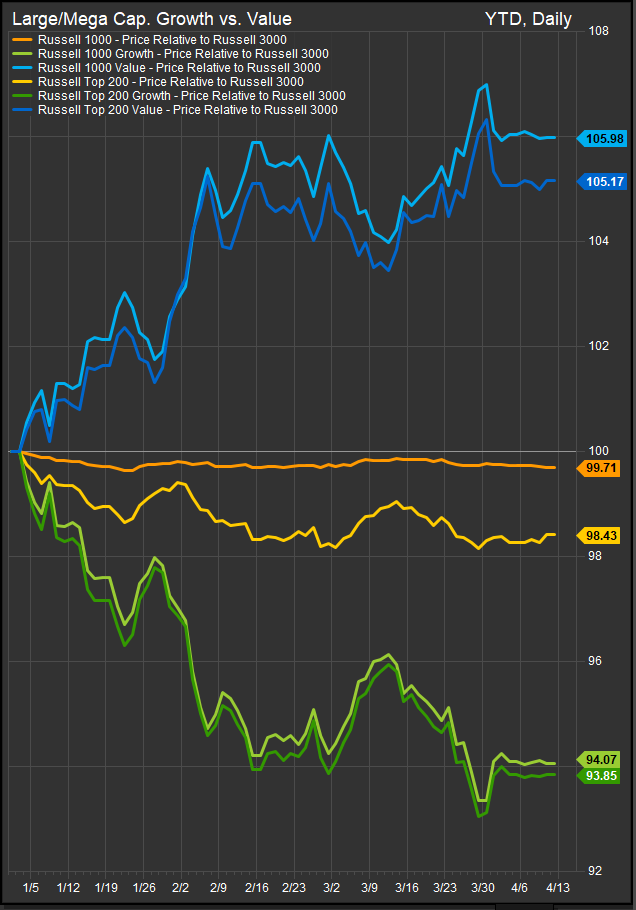
Growth and Value have been at equilibrium over the past 10 days after an initial bump for Growth stocks.
On the growth side, flows show that investors still want exposure to secular growth, but they are being highly selective. The strongest demand is going to semiconductors and AI infrastructure, where earnings visibility is stronger and spending demand is more tangible. SMH is up 9.7% over one week and 9.1% over one month, with roughly $3.7 billion of inflows year-to-date. SOXX has gained 11.5% over one week and 12.6% over one month, with more than $1.5 billion of inflows year-to-date. That is a clear sign that investors are embracing lower-rate sensitivity where it is paired with real earnings power.
At the same time, broader AI remains bifurcated. BAI has taken in more than $1.1 billion over one month and $1.8 billion year-to-date, while posting a 10.1% one-month gain. Yet software and cloud remain much weaker. IGV has attracted more than $1.3 billion over one month and $5.3 billion year-to-date, but performance remains poor at -12.6% over one month and -27.0% over three months. That suggests investors are willing to re-enter growth, but not indiscriminately. They prefer the segments where lower yields amplify a fundamentally durable story, rather than merely rescue stretched valuations.
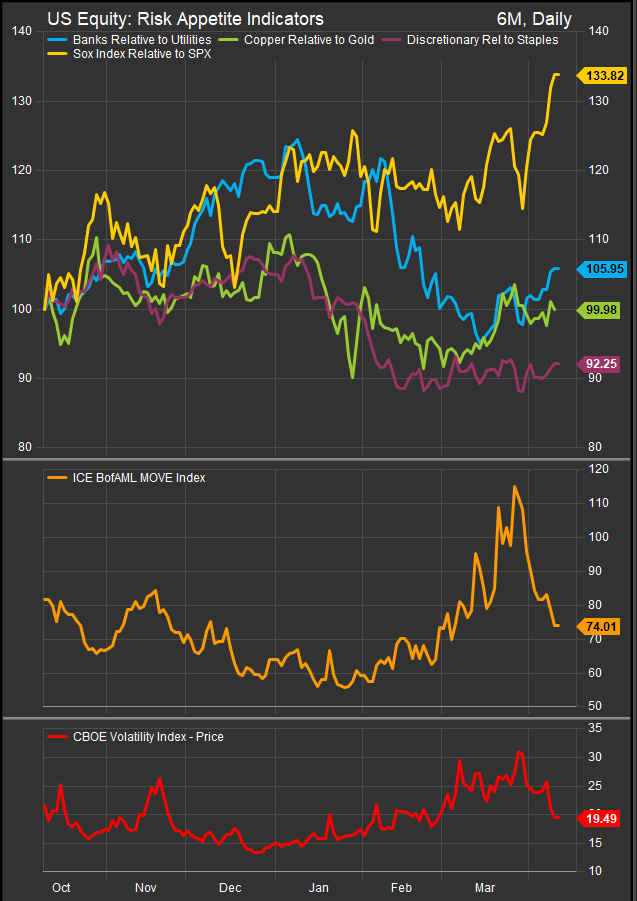
Risk gages are swinging towards “Risk on” in the near-term which could mean renewed pressure on long yields despite lower crude prices.
On the value side, flows are even more revealing. Capital is moving toward dividend strategies, infrastructure, energy, and selective real assets — areas that benefit from easing financial conditions but do not depend on a full-blown economic reacceleration. SCHD has attracted nearly $5.8 billion year-to-date, while VYM has brought in roughly $1.8 billion. That is not a panic bid for safety. It reflects a preference for cash flow, quality, and income at a point in the cycle when investors want to stay invested but grow more selective.
Infrastructure tells a similar story. PAVE is up 8.9% over three months and has attracted more than $1.1 billion year-to-date, while IGF has added more than $500 million. These are classic beneficiaries of a lower-yield environment: asset-heavy, cash-generative, and linked to durable spending rather than speculative enthusiasm.
Energy and real assets remain part of the mix as well. XOP is up more than 32% over three months and has attracted nearly $930 million year-to-date, while midstream and natural-resource funds continue to show steady demand. That tells us the market is not abandoning inflation hedges entirely. Instead, investors are building a barbell: selective growth on one side, cash-generative value and real assets on the other.
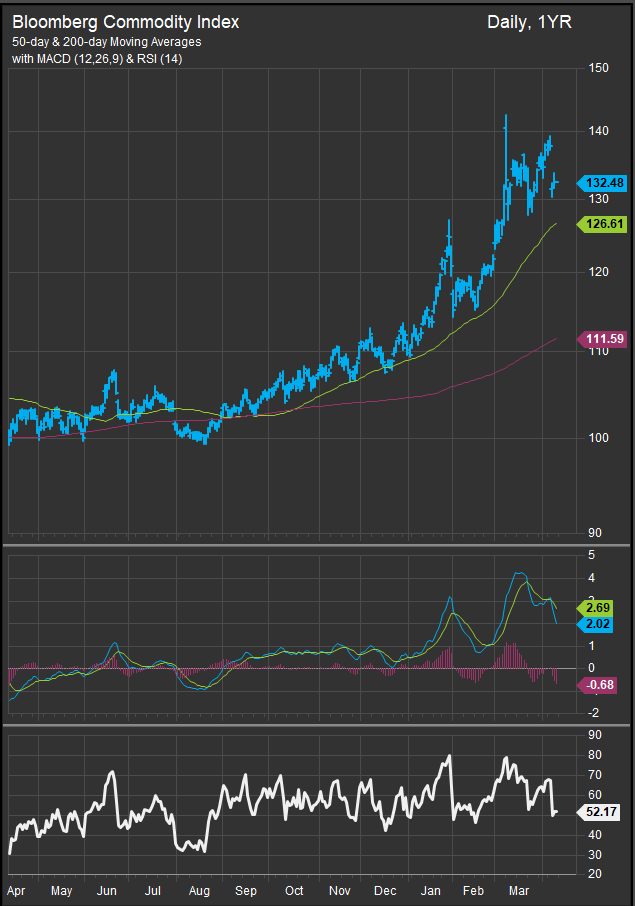
BCOM moving below its 50-day moving average would support lower rates in the near-term.
Real estate and housing-sensitive exposures help complete the picture. SCHH has posted positive monthly and year-to-date flows, while ITB has drawn roughly $70 million over one month. These are still early signs, but they are consistent with a market beginning to test the view that the worst of the rate shock may be behind us.
Taken together, the ETF data support a nuanced conclusion. Investors are behaving as though yields are likely to move lower in the near term, but they are also positioning for the possibility that lower yields will revive risk appetite and stabilize growth expectations. That is why the leadership profile is broadening beyond pure defensives and beyond the narrow mega-cap growth winners of the last cycle.
So where does that leave the 10-year Treasury from here? The case for modestly lower yields still looks stronger than the case for a renewed breakout higher. Restrictive policy, softer growth, and increasing confidence in eventual Fed easing all argue for that direction. But the equity market’s response matters. If falling yields continue to fuel inflows into semiconductors, infrastructure, dividends, housing, and other cyclical or rate-sensitive themes, financial conditions may ease enough to put a floor under how far rates can fall.
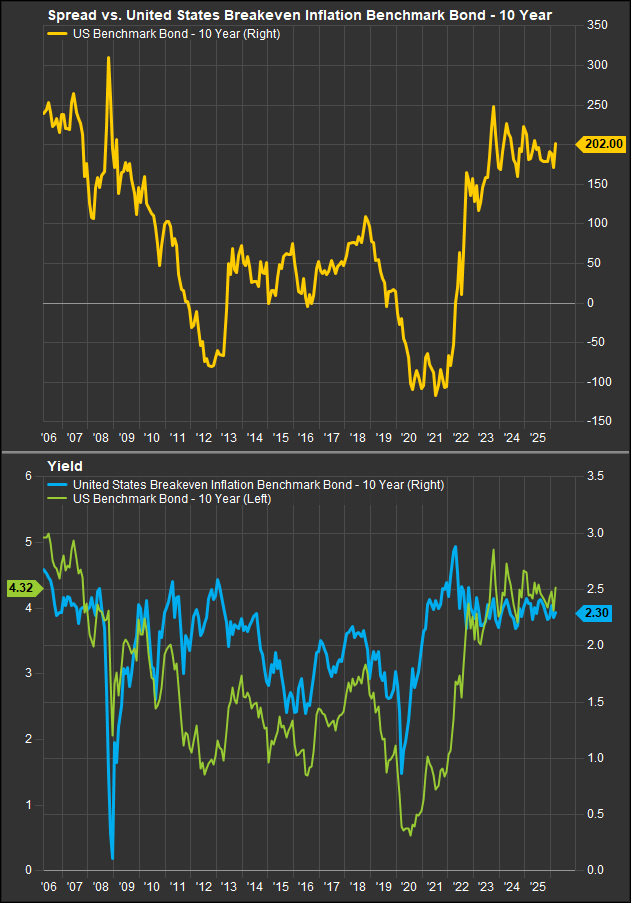
Real Yields are at the higher end of their 20yr range. Higher from here would likely be a headwind to Growth.
That is the key tension in the current market. Lower yield expectations are driving an equity rotation, but that same equity rotation could eventually limit the bond rally. For now, the first half of that sequence is winning: yields are falling, and capital is rotating accordingly. The next question is whether the resulting improvement in sentiment and risk appetite becomes strong enough to slow or partially reverse that move.
The broader message is that investors are no longer waiting for the first cut. They are already reallocating for it. And in doing so, they may also be helping define where yields settle once the initial optimism is fully priced in.
Sources:
- CNBC — Fed decision / Treasury yield context
- CNBC — March Treasury/yield and Fed meeting coverage
- Advisor Perspectives — March 2026 10-year Treasury yield perspective
- BlackRock / iShares — 2026 ETF market trends and flows
- YCharts — value ETF flow and rotation commentary
Additional charts and data sourced from FactSet Research Systems Inc.
