


The AI capital-spending boom has survived a 5% Treasury yield because earnings and credit remain strong. The next phase gets harder: inflation is keeping rates high just as AI infrastructure becomes more dependent on debt. The real tipping point may arrive when higher yields finally begin widening credit spreads.
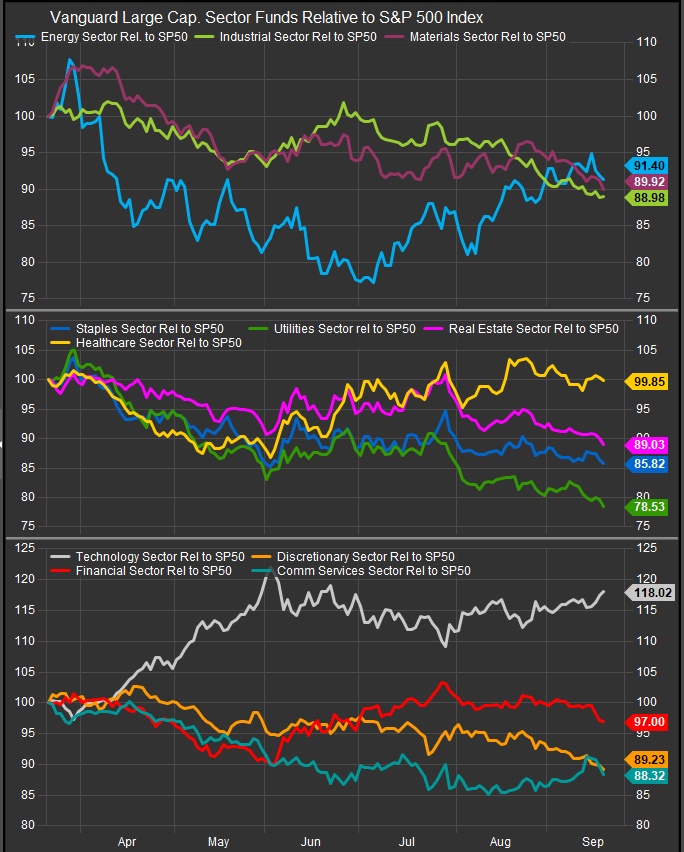
For most of 2026, investors have been willing to make a remarkable trade: finance one of the largest capital-expenditure cycles in modern market history while simultaneously accepting a steadily rising cost of capital. Vanguard Information Technology ETF (VGT) has outperformed the S&P 500 by > 18% in 2026, while nearly every other large-cap sector lags.
That is not the sector profile of a market already pricing recession or a broken credit cycle. It is the profile of a market still willing to pay for exceptional earnings growth while penalizing businesses that are either economically sensitive, financing intensive or valued primarily for yield. Technology remains the market’s preferred answer to higher rates because investors still believe the AI investment cycle can generate returns above an increasingly expensive cost of capital. The question for the next several months is where that calculation stops working.
AI Has Passed the 5% Test—So Far
The 10-year Treasury yield reaching roughly 5% has clearly tightened financial conditions, but it has not yet broken either Technology leadership or the corporate credit market. That distinction matters. Reuters reported last week that the move to 5% has remained unusually orderly: rate volatility is substantially lower than when yields approached the same level in 2023, corporate spreads remain narrow, and investors continue to interpret much of the rise in yields as a function of stronger growth and a higher equilibrium policy rate rather than an impending funding crisis. (Reuters)
Credit markets reinforce that message. As of September 17, the ICE BofA U.S. Corporate Index option-adjusted spread was only 78 basis points, while BBB spreads were about 95 basis points. High-yield spreads were roughly 270 basis points, with single-B credit near 277 basis points. Those are not levels consistent with investors broadly discounting a material deterioration in corporate credit quality. (FRED)
That is why 5% should be viewed as a test rather than the tipping point. Higher Treasury yields increase the hurdle rate for every new AI data center, semiconductor fab, power project and private-market financing, but strong earnings and tight spreads are still offsetting the damage. The Fed itself continues to describe economic activity as expanding at a solid pace, with resilient spending, strong productivity and robust capital investment, even as it raised the policy range to 3.75%-4.00%. Its September projections put the median appropriate fed-funds rate at 4.1% at both year-end 2026 and year-end 2027. (Federal Reserve)
The market is effectively saying that the economy—and particularly the AI economy—can fund itself at these rates. For now.
The AI Boom Is Becoming a Credit Story
The more consequential weekend development may not have been another AI model announcement. It was the growing evidence that AI investment is migrating from corporate cash flow into increasingly complicated financing structures. Weekend reporting highlighted estimates that large Technology companies have provided as much as $300 billion of guarantees supporting debt used for AI projects, allowing portions of the infrastructure buildout to sit outside conventional corporate balance sheets. Separate reports continue to highlight extraordinary prospective cash requirements across the AI ecosystem, including data centers, GPUs and power infrastructure. The Financial Times reported that residual-value guarantees and similar structures are increasingly being used to finance chips and data-center assets through special-purpose vehicles. (Financial Times)
This is the point where the macro story and the Technology story begin to converge. The first stages of the AI boom were funded primarily by some of the richest balance sheets in the world. That gave investors considerable protection from rising rates. Microsoft, Alphabet, Amazon and Meta could increase investment without behaving like traditional leveraged cyclicals. The next stage is different. As spending expands into power generation, transmission infrastructure, data centers, semiconductor manufacturing and privately owned AI platforms, the marginal dollar increasingly has to come from banks, bond investors, private credit, structured finance or asset-backed vehicles. That makes AI capex progressively more sensitive to the absolute level of borrowing costs. The relevant question is therefore no longer whether Nvidia can afford another GPU order. It is whether the marginal AI project still clears its return hurdle after the risk-free rate, credit spread and construction cost are added together.
Where Is the Tipping Point?
There is no single Treasury yield at which the AI cycle suddenly stops. A much better framework is to think of a tipping zone in which the cost of capital begins changing corporate behavior. At roughly 5% on the 10-year, that has not happened broadly. Earnings remain strong and spreads remain exceptionally contained. My working threshold would put the more dangerous zone around a sustained 5.25%-5.50% 10-year Treasury yield, particularly if the Fed simultaneously pushes the policy rate beyond the roughly 4.1% path currently embedded in its projections. The extra 25 or 50 basis points by themselves would not cause the damage. What matters is whether they cause the second leg of the transmission mechanism: credit spreads begin widening at the same time.
A 5.4% Treasury yield plus today’s 78-basis-point investment-grade spread still produces manageable financing conditions for elite borrowers. A 5.4% Treasury yield accompanied by a meaningful repricing of credit is an entirely different environment. Once BBB spreads move materially above today’s roughly 95 basis points and high-yield spreads begin moving decisively away from today’s 270-basis-point neighborhood, project finance, leveraged borrowers and lower-quality corporate balance sheets start absorbing both a higher risk-free rate and a larger credit premium. That is the point where the market would begin moving from discounting expensive money to discounting credit damage. These are monitoring levels rather than precise market forecasts. The key signal is the combination, not an exact number: another sustained 25-50 basis points higher in long Treasury yields plus a visible break wider in corporate spreads would be much more significant than a brief Treasury move through 5.25% with credit remaining calm.
Utilities Are Already Showing Us the Problem
One of the most revealing lines in the attached sector chart is not Technology. It is Utilities. The AI infrastructure thesis should theoretically be extraordinarily bullish for electricity demand. Data centers require immense quantities of power, grid upgrades and generation capacity. Yet Vanguard Utilities sits at approximately 78.5 relative to the S&P 500, making it the weakest sector on the chart by a wide margin. That divergence captures the entire tension in the current market. AI creates enormous demand for power infrastructure, but power infrastructure is capital intensive. Utilities need financing. New generating capacity, transmission networks and grid modernization require billions of dollars of long-lived capital. When Treasury yields rise toward 5%, the financing cost of delivering the electricity demanded by AI increases at precisely the same time as Technology companies accelerate their spending.
In other words, the AI boom itself is helping create the conditions that could eventually constrain it. Technology demand drives investment. Investment drives borrowing. Borrowing competes with enormous Treasury issuance for capital. Higher required returns push financing costs upward, which eventually raises the hurdle rate for the next data center. That feedback loop does not have to end the AI cycle. It does mean the next phase becomes increasingly sensitive to capital-market conditions.
Real Estate Is Sending the Same Message
Real Estate, at roughly 89 relative to the S&P 500 on the supplied chart, provides another early warning. Commercial property and data-center infrastructure are not identical investments, but both involve long-lived assets whose economics are heavily influenced by financing rates.
Traditional REITs have already been forced to adjust to higher borrowing costs and a more competitive Treasury yield. The same mathematics increasingly applies to infrastructure supporting the AI boom. At a sufficiently high required return, developers either need higher rents, greater utilization, stronger residual values or more favorable financing structures to justify construction.
That is why the growing use of guarantees matters. Financial engineering can extend a capital-spending cycle, but it does not eliminate the underlying cost of capital. It redistributes it.
Technology Leadership Says the Earnings Case Is Still Winning
None of this means the market has turned against Technology. The attached chart argues precisely the opposite.
Technology’s 118 relative reading towers over every other large-cap sector. More importantly, market breadth beneath the index has deteriorated while Technology has remained unusually resilient. In Friday’s data, only about 27.8% of S&P 500 companies were above their 50-day moving averages, while 48% had fallen below their 200-day averages. Yet only 4% of Technology companies were making four-week lows, compared with 55% of Consumer Discretionary companies, 48% of Utilities and 43% of Communication Services companies.
That is a narrow market, but it is also a revealing one. Investors are not indiscriminately buying Growth. They are concentrating capital where earnings visibility remains strongest.
The weekend AI news still gives them fundamental reasons to do so. The investment cycle remains enormous, AI revenue growth remains rapid, and the debate over slowing frontier-model development has not translated into a clear pullback in compute requirements.

The risk is that this very concentration raises the importance of the AI capex cycle to aggregate earnings. If financing conditions finally force capex growth lower, the effect would no longer be confined to Technology. Industrials, Utilities, power equipment, construction, semiconductors, infrastructure and portions of Financials increasingly depend on the same spending ecosystem.
Energy Is the Other Side of the Equation
Inflation determines how much room the Fed has to tolerate that investment boom, and Energy remains the key swing variable. The weekend brought conflicting signals. Energy shipments through the Strait of Hormuz have improved, but fighting in the region continues and the global refining system remains strained. Reuters also reported renewed regional escalation over the weekend, including Houthi attacks involving Riyadh, while broader disruptions continue to affect energy supply and transportation. (Reuters)
This matters because higher energy prices create a uniquely difficult policy problem. They raise headline inflation and filter into transportation, agriculture and manufactured goods, but higher interest rates cannot create diesel fuel or reopen a shipping route. The Fed nevertheless has to prevent those price increases from spreading into broader inflation expectations. Minneapolis Fed President Neel Kashkari said Sunday that inflation pressures extend beyond oil and remain too high across the economy. (Reuters)
Energy therefore determines how aggressively monetary policy has to push against the AI capex cycle. If oil and refined-product prices ease, the Fed gains room to let productivity-enhancing investment run. If energy inflation remains persistent, the policy rate and long-term yields may remain higher for longer—and the financing arithmetic becomes progressively less forgiving.
The Credit Market Is the Alarm Bell
This leaves us with a fairly straightforward framework for the coming weeks. The 10-year Treasury yield is the pressure gauge, but credit spreads are the alarm bell. At 5% yields and 78-basis-point investment-grade spreads, investors are still telling us that corporate America can handle the financing burden. Reuters’ rates-market reporting reaches essentially the same conclusion: yields are high, but the move remains orderly and credit markets have not displayed panic. (Reuters)

If Treasuries move somewhat higher while spreads stay contained, Technology’s earnings engine can probably continue financing the capex boom. The sector chart could remain narrow, uncomfortable and Technology-led. If Treasury yields rise while credit spreads widen simultaneously, the narrative changes. The market would begin asking whether expected AI returns justify the full cost of debt rather than merely whether AI demand remains strong. Projects on the margin would be delayed, financing structures would become more expensive, leveraged borrowers would face refinancing pressure and banks would begin tightening standards.
That would be the point at which the AI capex cycle stops being purely an equity-growth story and becomes a credit-cycle story.
Narrations of a Sector ETF Operator: Watch the Second Derivative
The market has already absorbed a great deal. The Fed has started hiking again. The 10-year Treasury yield has reached 5%. Energy inflation remains elevated. AI spending continues at an extraordinary pace. Yet corporate spreads remain tight, Technology continues to dominate sector relative performance and investors still show little sign of rotating wholesale into traditional defensives. That tells us the tipping point has not yet arrived. But it also tells us exactly where to look for it.
The next 25 basis points in Treasury yields matter less than what happens alongside them. If earnings remain strong, oil stabilizes and investment-grade and high-yield spreads remain contained, the economy may continue financing AI at rates that would once have looked prohibitive. If the 10-year moves into roughly the 5.25%-5.50% zone and credit risk begins repricing at the same time, the calculation changes. That is where the marginal data center, power project and leveraged borrower begin competing not merely against a higher Treasury yield, but against a rising required credit premium as well.
The AI boom can live with expensive money for longer than many investors expected. What it cannot indefinitely absorb is expensive money plus deteriorating credit. For the Sector ETF Operator, that is the line worth watching.
Sources
The sector-relative analysis uses the supplied Vanguard Large Cap Sector Funds Relative to the S&P 500 Index chart sourced from FactSet Research Systems Inc.
Additional research sources include the Federal Reserve September FOMC statement and Summary of Economic Projections; Federal Reserve Bank of St. Louis/FRED ICE BofA investment-grade, BBB and high-yield credit-spread data; and Reuters reporting on Treasury-market volatility, credit conditions and current Middle East energy developments. (Federal Reserve)
Disclaimer: This material is provided for informational and educational purposes only and does not constitute investment advice, a recommendation, or an offer to buy or sell any security. Sector relationships, credit spreads, interest rates and financing conditions can change rapidly, and the yield levels discussed are analytical monitoring zones rather than forecasts or guaranteed market thresholds.
