
This week’s top news stories point to a market that remains selectively risk-on. Investors are still willing to fund AI, mega-cap innovation and capital-market activity, but they are becoming more sensitive to valuation, inflation and the question of who ultimately earns the profit from AI adoption.
The strongest macro signal remains the resilience of the AI infrastructure trade. SpaceX’s $75B IPO, priced at a roughly $1.77T valuation and closing its first trading day around $2.1T after a 19% gain, showed that institutional demand for large-scale innovation assets remains powerful. OpenAI and Anthropic are also expected to pursue major listings, reinforcing the market’s willingness to capitalize the next generation of AI platforms.
That said, the AI story is becoming more complicated. The latest headlines included Anthropic regulatory scrutiny, OpenAI safety subpoenas, Meta’s AI execution challenges, Adobe’s pressure from AI-first competition and investor concern around Oracle’s heavy AI capex plans. The implication is clear: AI demand remains strong, but investors are beginning to separate infrastructure beneficiaries from application-layer companies that still need to prove pricing power and margin durability.
That distinction is important for leadership. The AI infrastructure complex—semiconductors, memory, storage, data centers, networking, cooling, power equipment and grid services—still has the clearest earnings pathway because it is tied to physical bottlenecks and visible capex. The profitability risk is higher in AI software and application platforms, where token-price competition, freemium models and rising compute costs could pressure margins even as usage grows.
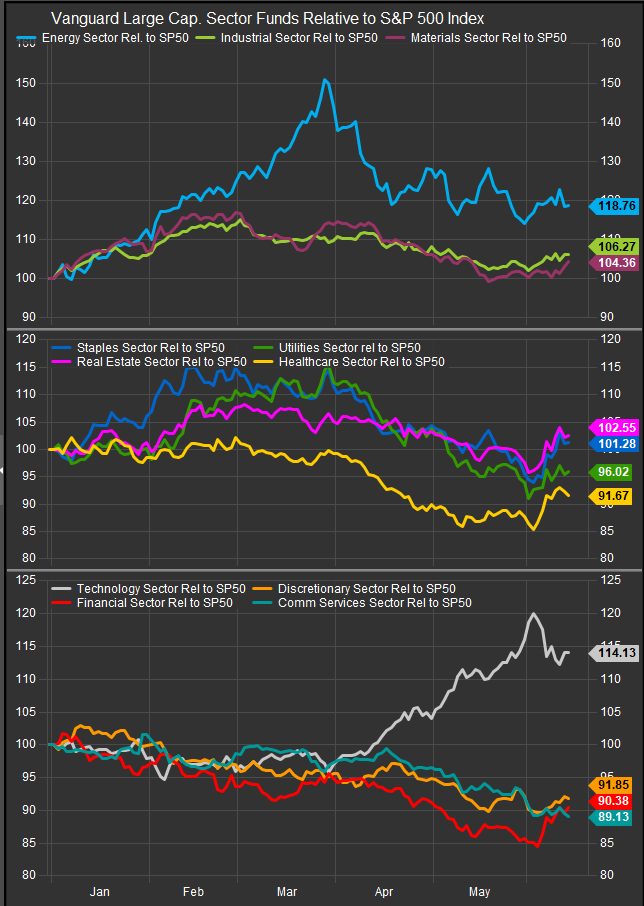
Chart: Low vol. sectors have outperformed in the very near-term while Technology shares see some profit-taking.
The macro backdrop is also supportive, but not without risks. Optimism around a potential US-Iran memorandum of understanding helped push oil lower and reduced market-implied Fed tightening expectations to roughly 17 bp of hikes this year, down from around 25 bp before the latest de-escalation headlines. A reopening of the Strait of Hormuz would reduce near-term energy tail risk, but inflation has not disappeared. Energy accounted for roughly 60% of May’s headline CPI increase, and headline PPI rose 1.1% month-over-month, with final-demand goods up 2.8% and energy prices up 10.7%.
The better inflation news is that core pressures have not yet broadened meaningfully. Core CPI rose 0.2% versus expectations for 0.3%, while core PPI also came in below consensus. Consumer inflation expectations also eased, with year-ahead expectations slipping to 4.6% from 4.8% and long-run expectations falling to 3.4% from 3.9%. That gives the market some room to look through the energy shock, but not enough for the Fed to declare victory.
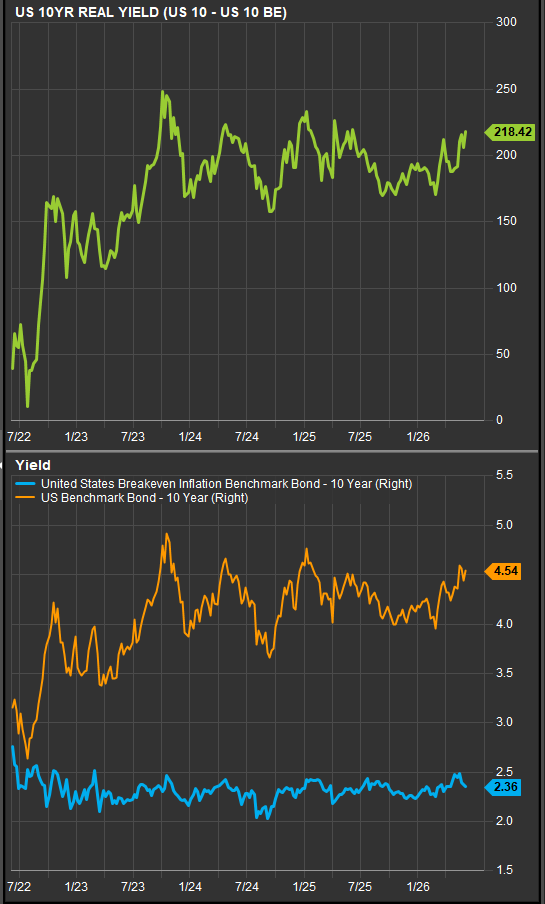
Chart: If real rates roll over on easing US-Iran tensions, we’d expect cyclicals and risk-on exposures to benefit.
The consumer and labor backdrop is more fragile. Preliminary June consumer sentiment improved to 48.9 from May’s record-low 44.8, helped by some relief in gasoline prices. However, jobless claims rose to 229K, the highest since February, and small-business optimism fell to its lowest level since October 2024. This is not a recessionary signal yet, but it does suggest the economy is absorbing higher prices and policy uncertainty unevenly.
If the AI profitability story comes into question, investors are unlikely to abandon AI altogether. The more likely rotation is within AI: away from speculative application-layer names and toward the infrastructure bottlenecks that support the entire ecosystem. Semiconductors, memory, storage, data-center equipment, power infrastructure and networking should remain relatively better positioned than AI software stories dependent on aggressive pricing or uncertain monetization.
Outside AI, rotation candidates include dividend quality, financials, infrastructure, healthcare and select value cyclicals. Financials benefit from capital-market activity and the reopening IPO window. Dividend strategies provide cash-flow ballast if volatility rises. Infrastructure and industrial automation retain exposure to AI capex without relying entirely on software multiples. Energy and materials would regain relevance if inflation or geopolitical risks prove more durable than currently priced.
The key takeaway is that the bull case is still intact, but the market is applying higher standards. AI infrastructure remains the strongest secular growth engine because it is backed by capital spending, scarcity and visible demand. The risk is not that AI adoption fades. The risk is that investors begin to question whether AI will change profitability and prosperity dynamics in a way that is commensurate with premium valuations and as a straight-forward growth catalyst. If we get disruption and shrinking employment without the emergence of a new ramps to prosperity, we could see more profit-taking. The biggest key is demonstrating how AI practices can augment and improve what we do in a practical way. The capital is being committed, the partnerships have been formed.
