



October 12, 2025
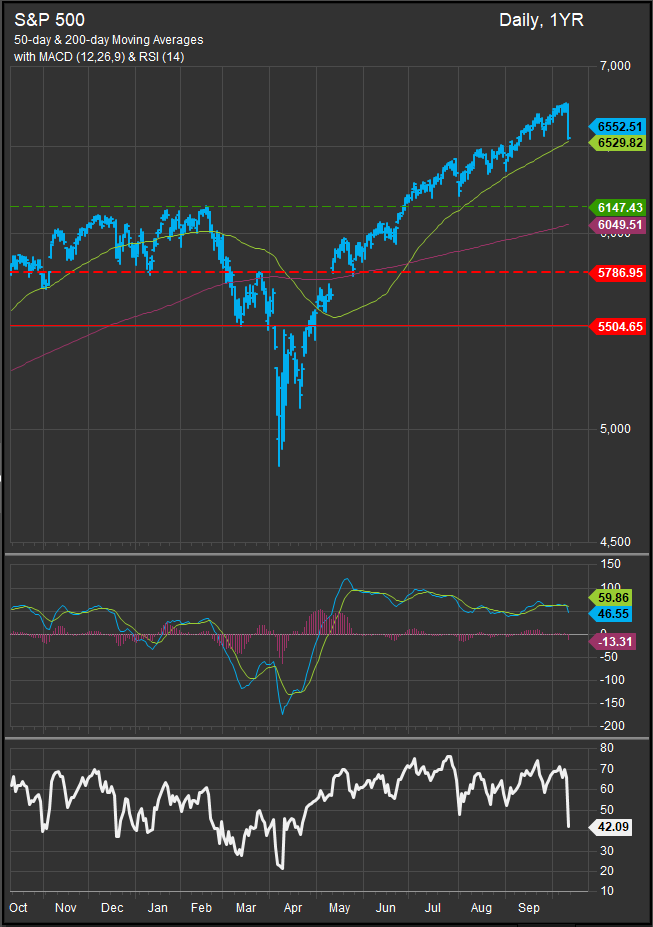
U.S. equities finished sharply lower on Friday as investors reacted to a re-escalation in trade and technology tensions between Washington and Beijing. The S&P 500 (chart below) fell roughly 2.7%, the Nasdaq Composite dropped 3.5%, and the Dow Jones Industrial Average lost 879 points (-1.9%), erasing several weeks of gains. The sell-off was broad-based, led by declines in large-cap growth and semiconductor names. Amazon and Nike each fell about 4%, while Apple, NVIDIA, and UnitedHealth all declined more than 3%, dragging heavily weighted indices lower. The downdraft marked one of the worst single-day performances since April and capped a volatile week for global markets.
S&P 500
AMZN

The catalyst was President Trump’s announcement that the United States will impose a 100% tariff on Chinese imports beginning November 1, alongside fresh restrictions on advanced technology exports—particularly semiconductor components, AI processors, and software tools. The threat represented a major policy reversal from prior signals of détente, surprising markets that had largely priced in stability in trade relations. The White House justified the move on grounds of “strategic reciprocity,” but investors interpreted it as a clear signal of renewed escalation ahead of the APEC summit. China’s Ministry of Commerce quickly responded by defending its own export controls on rare earth materials—critical for chipmaking—and pledged “corresponding measures.”
This trade confrontation lands at the intersection of global supply chains and emerging technologies. China controls over 90% of global gallium and germanium supply, two metals essential for advanced chip production. Since mid-2024, Beijing has restricted exports of these materials, tightening availability for U.S. and Taiwanese chip producers. Meanwhile, U.S. lawmakers revealed that loopholes in export-control enforcement allowed Chinese entities to acquire nearly $38 billion worth of chipmaking tools through indirect channels since 2022, eroding the intended leverage of U.S. controls. These developments deepened investor fears that semiconductor supply chains could be disrupted just as global AI investment continues to surge.
Data suggest that the semiconductor supply network is already under strain. According to McKinsey, lead times for imported components have increased by 21 days on average since 2019, contributing to an estimated 1.8% rise in global manufacturing prices and a 7.3% output loss in affected supply chains. Tariffs on Chinese intermediate goods would exacerbate these delays by rerouting logistics and raising costs for U.S. manufacturers. The Information Technology & Innovation Foundation (ITIF) estimates that a 25% tariff on U.S. semiconductor imports could reduce U.S. GDP growth by 0.18 percentage points in the first year and 0.76 points after a decade, while even a 10% tariff could trim output by 0.06 points initially. With the U.S. running an $11 billion trade surplus in semiconductors, any disruption could weaken one of the country’s few export strengths.
SOX Index

TSMC

Fundamental conditions amplified the shock. The S&P 500 had gained roughly 13% year-to-date through September, with valuations approaching 21x forward earnings—well above the 10-year median of ~17x. That left markets highly sensitive to policy shocks and vulnerable to a round of profit-taking. Treasury yields have stayed elevated, with the 10-year note hovering near 4.6%, compressing the present value of long-duration growth assets. Meanwhile, the partial U.S. government shutdown limited access to key economic data such as the September CPI report, adding another layer of uncertainty for investors and risk models. These factors combined to create a “perfect storm” of valuation risk, policy uncertainty, and technical momentum selling that accelerated as trading algorithms triggered stop-losses and risk-parity deleveraging.
The implications of the renewed tariffs are substantial. Higher import duties will raise input costs for U.S. manufacturers, potentially stoking a second-round inflation effect just as the Federal Reserve prepares to cut rates. Companies dependent on Chinese inputs—especially in electronics, machinery, and auto parts—face margin compression. The threat of retaliatory measures, such as Chinese limits on rare-earth exports or reduced purchases of U.S. agricultural goods, compounds downside risk for cyclical sectors. Longer term, the trade escalation is likely to accelerate “China + 1” and reshoring strategies, leading to a partial fragmentation of global supply chains. Although this may strengthen domestic manufacturing and logistics industries, it will also impose higher fixed costs and capital expenditures across multiple sectors.
Beyond the trade channel, fundamental headwinds persist. Corporate margins have come under pressure as input inflation and wage growth outpace pricing power. Analysts have begun revising 2025 S&P 500 earnings-per-share estimates modestly lower, from $260 to $255, citing weaker guidance from industrial and tech firms. Leverage ratios among smaller-cap and cyclical companies remain elevated, and with real borrowing costs near cycle highs, refinancing risk is rising. The index’s concentration risk also remains a structural vulnerability: the seven largest tech names still account for roughly 33% of S&P 500 market capitalization, magnifying the market’s exposure to volatility in a handful of stocks.
Looking ahead, markets face a challenging environment of elevated policy risk and tightening liquidity. A full-blown tariff implementation could slow global trade growth by as much as 0.5 percentage points in 2026, according to WTO modeling. Supply shortages in semiconductors or rare earths could drive further production delays, especially in EVs and AI infrastructure. On the other hand, select opportunities may emerge. Domestic manufacturers, logistics operators, and automation firms stand to benefit from accelerated reshoring. Companies with robust balance sheets and pricing power—especially in infrastructure, energy transition, and healthcare—may provide defensive exposure. Meanwhile, any pullback in overvalued AI and software names could create tactical buying opportunities for investors with longer time horizons.
Ultimately, Friday’s sell-off was more than a short-term correction—it was a repricing of policy and supply-chain risk in an increasingly fragmented global economy. As U.S.–China relations reenter a more adversarial phase, the interplay between trade policy, technology competition, and inflation will shape market dynamics into year-end. Investors need to be aware that changing tone around tariff negotiations could have an outsized impact on the AI trade, given the nature of momentum and crowd dynamics. Our current outlook remains constructive on AI and equities, With the S&P 500 touching its 50-day moving average after Friday’s corrective action, we will get an early look at whether investors will accumulate weakness aggressively, or if there is a broader shift a foot. We currently are of the belief that enthusiasm for the AI trade remains high and near-term weakness is likely to be accumulated adroitly.
Bibliography
- Financial Times, “U.S. stocks close sharply lower after Trump threatens new China tariffs,” October 10 2025.
- Barron’s, “Review & Preview: Tariff Tumble,” October 11 2025.
- MarketWatch, “Dow down nearly 650 points on losses in shares of Amazon.com Inc., Nike,” October 10 2025.
- Reuters, “Wall Street sells off as Trump hits China with more tariffs,” October 10 2025.
- Reuters, “Beijing blames U.S. for raising trade tensions, defends rare-earth curbs,” October 12 2025.
- Politico, “China signals defiance to Trump’s 100% tariff threat,” October 12 2025.
- McKinsey & Company, The Effects of Tariffs on the Semiconductor Industry, 2025.
- Information Technology & Innovation Foundation (ITIF), Short-Circuited: How Semiconductor Tariffs Would Harm the U.S. Economy, May 2025.
- Capital Flows Research, “The Impact of Tariffs on Macro Liquidity,” October 2025.
- arXiv Preprint, Global Supply Chain Reallocation and Shift under Triple Crises: A U.S.–China Perspective, 2025.
- arXiv Preprint, The Cost of Delivery Delays, 2025.
- Edward Jones, Weekly Market Update, October 2025.
- WTO Trade Forecast, Global Trade Outlook and Statistics 2025.
- U.S. Department of Commerce, Semiconductor Trade Data Summary, September 2025.
Data sourced from FactSet Research Systems Inc.
