


The latest sector ETF data shows investors are not positioning for recession. They are discounting a stronger business cycle, lower oil-driven inflation pressure, continued AI infrastructure spending, and a broadening trade that is no longer limited to mega-cap technology. However, the tape is not simply risk-on. Sector flows show investors are becoming more selective, buying banks, REITs, health care, infrastructure, and parts of technology while avoiding energy beta, miners, software, China internet, and some of the more crowded AI-adjacent trades.
The business cycle looks stronger than it did a month ago. Flash manufacturing and services PMIs surprised to the upside, with manufacturing expanding for an 11th straight month and hitting its strongest level in more than three years. New orders and output accelerated, while services posted the best reading since February. Q1 GDP was revised higher, personal income and spending both rose 0.7% in May, initial claims fell to 215K, and core durable goods orders rose 1.6%. Those are not recessionary inputs. They describe an economy with firm demand, solid labor-market conditions, and enough operating leverage to support earnings.
Investors are also discounting relief from lower oil. Crude fell back near pre-conflict levels as Hormuz flows improved and Persian Gulf crude exports recovered to at least 75% of pre-war levels. That helps consumers, lowers immediate inflation risk, and supports cyclicals, travel, homebuilders, REITs, and equal-weight exposure. The problem is that lower oil is bad for Energy leadership, and geopolitical risk has not disappeared. Weekend headlines still included renewed US strikes, a tenuous ceasefire, tanker attacks, mining concerns in the Strait of Hormuz, and unresolved disputes around Iran’s control of shipping lanes.
The AI story is equally split. Micron’s results and guidance reinforced the AI capex narrative, especially memory pricing, take-or-pay customer agreements, and tight supply into 2027. Qualcomm’s data-center ambitions added to the view that AI infrastructure demand is broadening. But the weekend packet also flagged open-source and Chinese-model competition, hyperscaler capex ROI concerns, possible OpenAI IPO delay, policy restrictions, and positioning stress in semiconductors and leveraged tech products. Investors still want AI exposure, but the flows show they are rotating within the theme rather than blindly adding to every AI-linked sector.
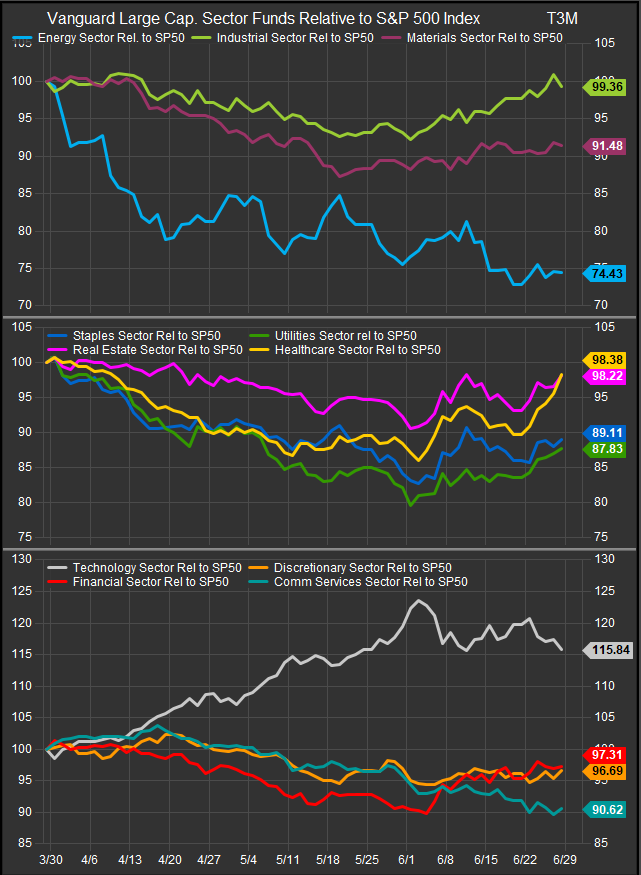
Chart: Technology shares have consolidated in June while low vol. exposures have benefitted from falling Crude prices and lower rates.
Sector ETF Flow and Performance Signals
| Sector / ETF | 1W Return | 1M Return | 1M Flow | YTD Flow | Sector message |
| Equal Weight S&P 500 (RSP) | 0.3% | 1.7% | $2.07B | $8.94B | Broadening trade has flow support |
| Technology (VGT) | -5.4% | -3.4% | $1.48B | $3.17B | Investors buying tech weakness |
| Semiconductors (SOXX) | -9.9% | 3.5% | $2.83B | $6.17B | AI chip demand intact, but crowded |
| Industrials (VIS) | -0.7% | 3.3% | $124M | $639M | Cycle and infrastructure support |
| Infrastructure (PAVE) | -0.7% | 4.5% | $403M | $2.11B | Capex/reshoring/grid theme confirmed |
| Banks (KBWB) | 0.0% | 7.6% | $806M | $43M | Financials bid is bank-specific |
| Health Care (VHT) | 6.9% | 9.1% | $45M | -$239M | Tactical rebound; flows improving |
| Biotech (IBB) | 5.9% | 10.6% | $334M | -$139M | Risk appetite returning to biotech |
| REITs (VNQ) | 3.1% | 2.4% | $840M | $1.22B | Rate relief and income bid |
| Utilities (VPU) | 3.2% | 2.2% | -$53M | $331M | Performance positive, flows cautious |
| Consumer Discretionary (VCR) | 0.5% | -1.8% | $48M | -$125M | Consumer trade selective |
| Homebuilders (ITB) | 7.8% | 14.1% | -$135M | -$97M | Rally not flow-confirmed |
| Staples (VDC) | 2.8% | 2.0% | $29M | $114M | Defensive participation, not leadership |
| Energy (VDE) | -0.4% | -6.5% | -$35M | $781M | Oil relief hurts sector beta |
| Oil Services (OIH) | -3.4% | -15.3% | -$117M | $214M | Energy-risk unwind still pressuring |
| Materials (VAW) | -0.4% | 0.5% | $14M | -$85M | Broad sector stable, miners weak |
| Gold Miners (GDX) | -5.5% | -13.0% | -$348M | $260M | Risk hedges being unwound |
| Communication Services (VOX) | -0.6% | -7.9% | $58M | -$336M | Platform exposure losing leadership |
The clearest positive signal is broadening. Equal Weight S&P 500 (RSP) gained 1.7% over the month and attracted more than $2B of 1-month inflows. That aligns with the macro narrative: lower oil, lower rates on the week, stronger PMIs, stronger personal spending, resilient claims, and rising earnings estimates are encouraging investors to look beyond the mega-cap AI complex. The broadening trade is not theoretical anymore; it is showing up in flows.
The strongest sector confirmation is in Real Estate, Financials, Health Care, Infrastructure, and selective Technology. REITs are seeing clear demand, with Real Estate (VNQ) attracting $840M of 1-month inflows and SCHH adding more than $1B. That suggests investors are buying income and rate sensitivity after the oil-driven rate reprieve. The message is not that the property cycle is fixed; it is that lower yields and lower energy costs make REIT cash flows more attractive.
Financials are also improving, but the flows are specific. Broad Financials (VFH) lost $154M over the month, while Banks (KBWB) gained $806M and Regional Banks (IAT) rose 8.6%. Investors are buying bank earnings leverage, stress-test confidence, and capital-return upside, not the entire Financials sector. That distinction matters. Broker-dealers and exchanges were weaker, while large banks and regionals benefited from the broadening/cyclical trade.
Health Care is becoming more important as a second-half rotation candidate. Health Care (VHT) gained 9.1% over the month, Biotech (IBB) gained 10.6%, and Health Care Providers (IHF) gained 11.8%. The flow picture is improving, especially in biotech and providers. That suggests investors are willing to add exposure to areas that lagged earlier in the year but now offer earnings stability, policy catalysts, M&A potential, and less direct dependence on the AI trade.
Technology remains complicated. Broad Technology (VGT) fell 3.4% over the month but still attracted $1.48B of inflows. Semiconductors (SOXX) gained 3.5% and pulled in $2.83B, while SMH saw massive weekly outflows despite positive monthly flows. Investors are buying the AI compute cycle, but also trimming crowded winners and avoiding weaker parts of the tech stack. Software (IGV) fell 6.2% and lost $608M, while China Internet (KWEB) dropped 12.2% and lost more than $1B. The sector message is clear: own AI hardware, memory, and infrastructure enablers; be cautious on software, internet platforms, and China tech.
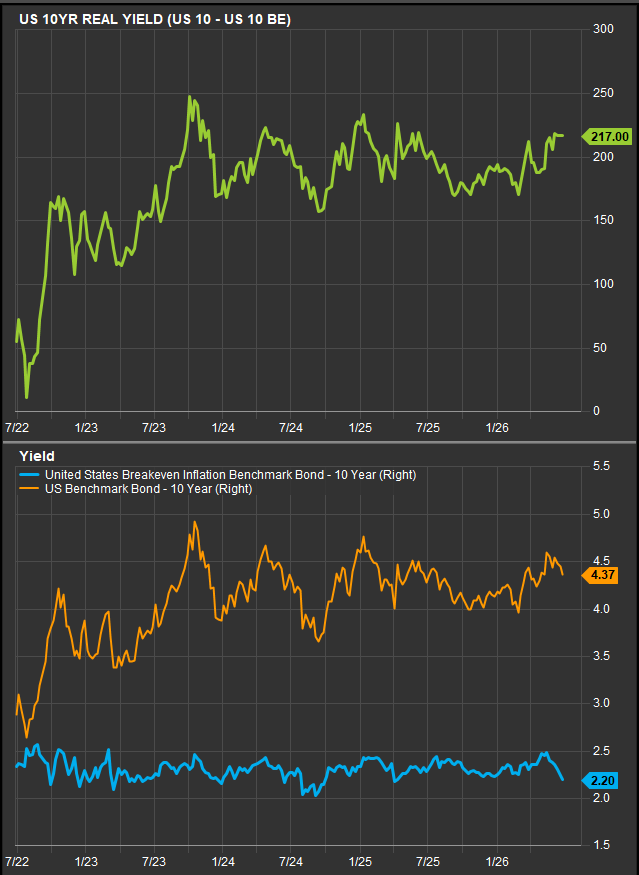
Chart: One of the complicating factors for the bull market, real yields have remained high despite the absolute level of yields falling in the near-term. As we’ve noted in the past, a hawkish Fed often leads to LOWER rates.
Industrials remain one of the best sector expressions of the current cycle. Industrials (VIS) gained 3.3% over the month and attracted $124M, while Infrastructure (PAVE) gained 4.5% and attracted $403M. That aligns with the news flow around AI data centers, power demand, infrastructure spending, reshoring, defense, and stronger PMIs. The best industrial exposure is not necessarily broad defense, where some flows were negative. It is machinery, electrical equipment, engineering, construction services, automation, grid, and infrastructure.
The weakest sector signal is Energy. Energy (VDE) fell 6.5% over the month, Oil Services (OIH) dropped 15.3%, Exploration & Production (XOP) lost 6.4%, and Natural Gas (FCG) lost 8.0%. Flows were negative across much of the complex. Lower oil is a macro tailwind for consumers, rates, and cyclicals, but it is a direct headwind for Energy sector leadership. Midstream held up better, with EMLP positive on the month, but broad Energy beta no longer has strong flow or price confirmation.
Materials are mixed but not compelling. Broad Materials (VAW) was slightly positive, but miners, uranium, lithium, and inflation beneficiaries were hit hard. Gold Miners (GDX), Junior Gold Miners (GDXJ), Silver Miners (SIL), Lithium (LIT), and Uranium/Nuclear (NLR) all saw steep monthly losses. This is consistent with a market unwinding war-risk hedges and inflation-protection trades as oil falls. Select infrastructure-linked materials can still work, but broad resource exposure is no longer leading.
Consumer Discretionary is more tactical than durable. Homebuilders (ITB) surged 14.1% over the month but saw $135M of outflows. That means investors are not fully trusting the rally, which makes sense given weak new home sales, affordability stress, and seller concessions. Lower oil and policy support help the consumer, but the sector still needs lower mortgage rates and better housing activity to sustain leadership. Broad Discretionary (VCR) remains a mixed signal.
The business cycle looks firm, not fragile. The strongest evidence is in PMIs, personal spending, claims, GDP revisions, core capital goods, earnings upgrades, M&A activity, and sector broadening. However, it is also a late-cycle, inflation-constrained expansion. Prices remain sticky, the Fed reaction function is hawkish, private-credit redemptions are rising, leverage is elevated, and AI concentration remains a market-structure risk. Investors are discounting nominal growth and earnings resilience, but not a clean disinflationary easing cycle.
Disclaimer: This material is for informational and educational purposes only and should not be considered investment advice, a recommendation, or a solicitation to buy or sell any ETF, security, or strategy. Sector performance and fund-flow trends can change quickly and may reflect short-term positioning rather than durable investor conviction. Past performance is not indicative of future results. Investors should consider their objectives, risk tolerance, liquidity needs, and consult a qualified financial professional before making investment decisions.
