




Financing costs, restricted cash and contract mismatches are creating different risks across the AI supply chain—and sector diversification may conceal shared exposure.
For those who need to stay invested, the latest earnings cycle presents a more specific challenge than deciding whether AI valuations are excessive. Companies continue to report substantial demand, but fulfilling that demand requires financing, equipment and power commitments whose economics can change before revenue arrives. A growing backlog supports future sales; it does not guarantee attractive margins, cash conversion or shareholder returns.
That distinction matters as leadership broadens beyond Mega Cap. technology. A portfolio can reduce its Technology weight while retaining exposure to the same investment cycle through electrical equipment, utilities and data-center real estate. The relevant portfolio question is how much depends on projects being completed on time, financed economically and operated at the utilization rates assumed when commitments were signed.
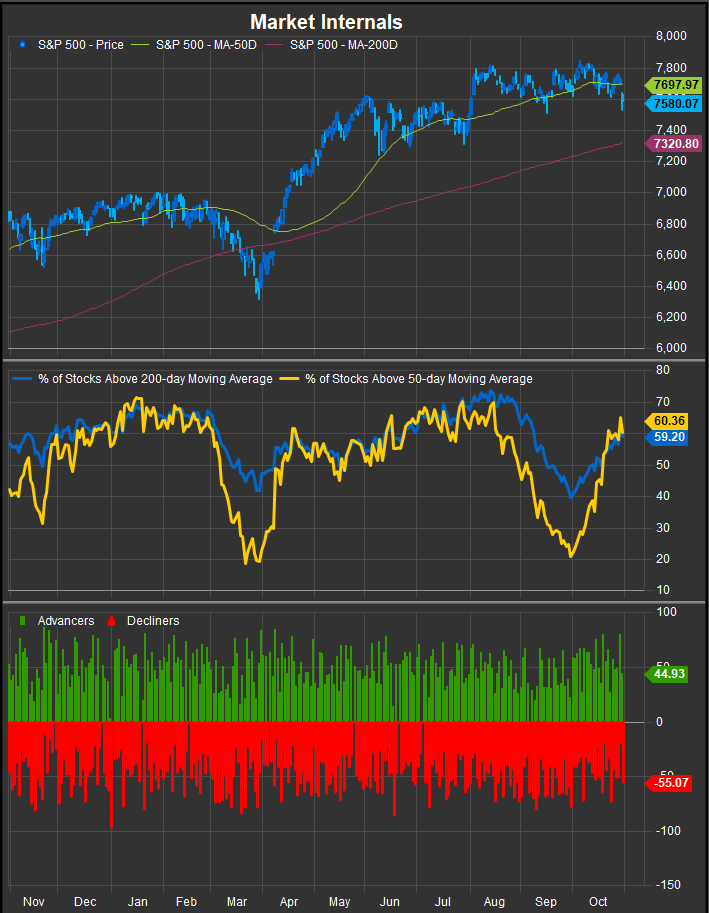
Chart: S&P 500 Breadth has rebounded from the beginning of October, but while more companies are appreciating, Mega Cap. weakness is dragging down the index.
Borrowing costs vary substantially across that ecosystem. Amazon’s $17.5 billion term loan, drawn in September, carries a floating rate of SOFR plus 0.625%–0.875%. CoreWeave’s August infrastructure facility priced at SOFR plus 5.50%. These are different borrowers and financing structures, so the comparison does not establish a pricing anomaly. It does demonstrate why a hyperscaler’s access to inexpensive capital should not be extrapolated to its developers, counterparties or infrastructure providers.
The project-financing evidence is more consequential. On October 16, Morgan Stanley reported that highly rated data-center bonds were yielding approximately 7%, compared with below 5% earlier in the year. The broad investment-grade corporate index yielded 5.86% that day. Differences in maturity, structure and risk prevent a direct comparison, but a broad corporate-rate benchmark clearly does not capture every project’s funding economics.
The pressure emerges when revenues are committed before financing costs are finalized. Data-center developers may sign long-term leases before securing permanent financing. If borrowing costs subsequently rise, contracted rental income does not automatically adjust. Morgan Stanley identifies this mismatch as an increasing constraint on issuance. Developers may need additional equity, lower leverage or reduced return expectations—even when facilities have tenants and electricity connections. For equity investors, the risk can appear first as dilution, delayed development or lower returns rather than a default.
A stabilization in market yields would not immediately stabilize corporate financing expenses. Amazon’s quarterly interest expense increased from $538 million to approximately $1.7 billion year over year, reflecting debt issuance and finance leases. Microsoft’s quarterly finance-lease interest rose approximately 41%, from $546 million to $769 million. Those increases do not demonstrate that either company is borrowing above its public-market pricing; larger obligations and funding timing also matter. The portfolio implication is that earnings estimates can remain under pressure after Treasury yields stop rising, as previously committed investment continues to require funding.
Liquidity deserves similar scrutiny. Meta disclosed $10.8 billion of money-market assets restricted in escrow under infrastructure purchase agreements, with release expected between 2028 and 2030 as obligations are satisfied. That cash remains an asset but is unavailable for general corporate use. Microsoft disclosed $364.6 billion of leases that had not yet commenced, beginning across fiscal 2027–2034. Those aggregate commitments are neither current debt nor an immediate cash requirement. They nevertheless show why outstanding bonds and headline cash balances provide an incomplete picture of future financial flexibility.
Contract duration introduces another vulnerability. CoreWeave’s August facility has an approximately five-year maturity, while the underlying customer contracts average approximately three years. The structure expands financing flexibility, but it also requires capacity to be renewed or re-leased while financing remains outstanding. Future utilization, rental pricing and equipment competitiveness therefore influence debt coverage before repayment is complete. A long financing term can reduce near-term refinancing risk while leaving meaningful customer-renewal risk.
Technology earnings are also revealing uneven pressure from scarce inputs. Intel reported Data Center and AI revenue growth of 78%, alongside a 5% decline in Client Computing and Physical AI revenue. Management expects the PC slowdown to persist at least through the first half of next year, while its disclosures flag memory and substrate shortages. These results illustrate why strong AI demand need not produce uniformly strong technology earnings. Component suppliers may benefit from scarcity while hardware manufacturers face higher costs and customers confront reduced affordability.
For advisors, these developments should change the questions asked during portfolio reviews. Across Technology (VGT), Communication Services (VOX) and Consumer Discretionary (VCR), assess overlapping exposure to the largest AI spenders and the suppliers dependent on their budgets. Within Industrials (VIS), distinguish backlog supported by deposits, enforceable commitments and cost protection from orders vulnerable to delays or renegotiation. For Utilities (VPU), examine who finances grid expansion and bears the risk if expected customer demand fails to materialize. Within Real Estate (VNQ), contracted rents must be evaluated against development costs, financing requirements and tenant concentration.
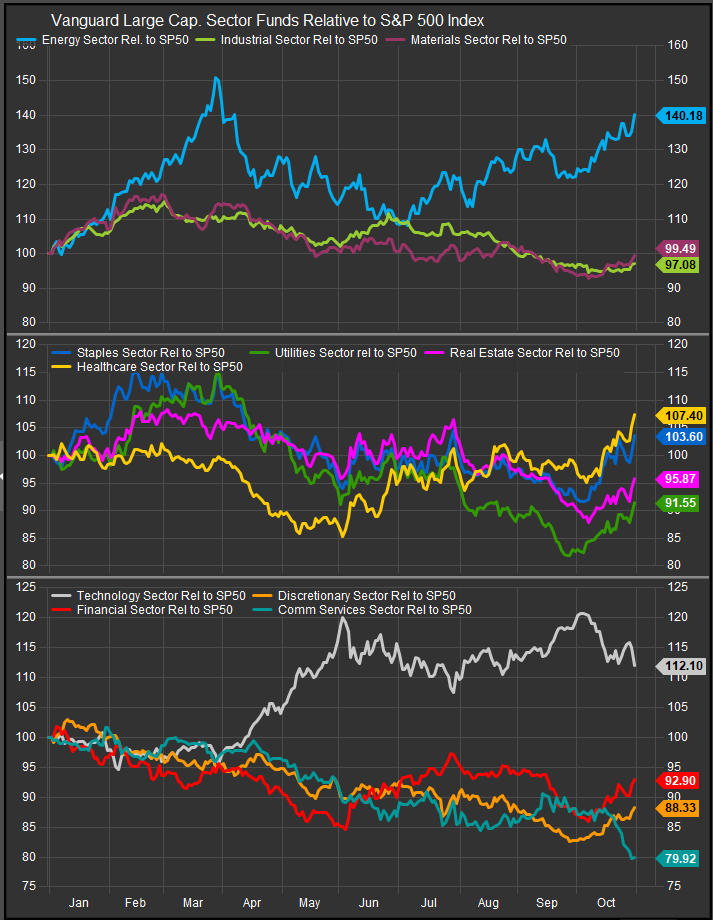
Chart: Large Cap. Sector Performance has oscillated between the AI trade and everything else.
These are different contractual exposures to a shared economic cycle. Rebalancing among their sector labels may change volatility and valuation characteristics without materially reducing dependence on AI investment. Position sizing should therefore reflect both direct holdings and common customer exposure, particularly where a portfolio already combines growth funds, semiconductor exposure and electrification themes.
The evidence does not establish a generalized funding crisis or widespread borrowing above comparable public-market rates. It identifies a more useful distinction for active allocation: companies with strong demand can still experience weaker equity economics when funding costs, cash commitments and delivery obligations become less favorable. Advisors should give greater weight to unrestricted liquidity, cash generation after lease payments, customer funding strength and contract protection. The most durable exposure is to businesses able to deliver committed growth without repeatedly asking shareholders to finance the difference.
Sources
- Amazon—September 30, 2026 Form 10-Q.
- Microsoft—September 30, 2026 Form 10-Q.
- Meta Platforms—September 30, 2026 Form 10-Q.
- CoreWeave—August 10 financing announcement.
- Morgan Stanley—October 16 data-center financing analysis.
- Federal Reserve Bank of St. Louis—ICE BofA U.S. Corporate Index Effective Yield.
- Intel—third-quarter 2026 earnings release.
Disclaimer: This commentary is for informational and educational purposes only and does not constitute investment advice or a recommendation to buy or sell any security. Opinions reflect the publication date and may change without notice. Information is drawn from sources believed reliable, but accuracy and completeness are not guaranteed. Past performance does not guarantee future results. Investing involves risk, including loss of principal.
