


The AI investment cycle is entering a more demanding phase. Demand for compute remains strong, hyperscaler capital spending continues to rise and data-center construction is still driving investment across semiconductors, electrical equipment, power generation and industrial infrastructure. But the weekend headlines point to a new constraint: capital is becoming more expensive at the same time that the AI buildout requires more of it.
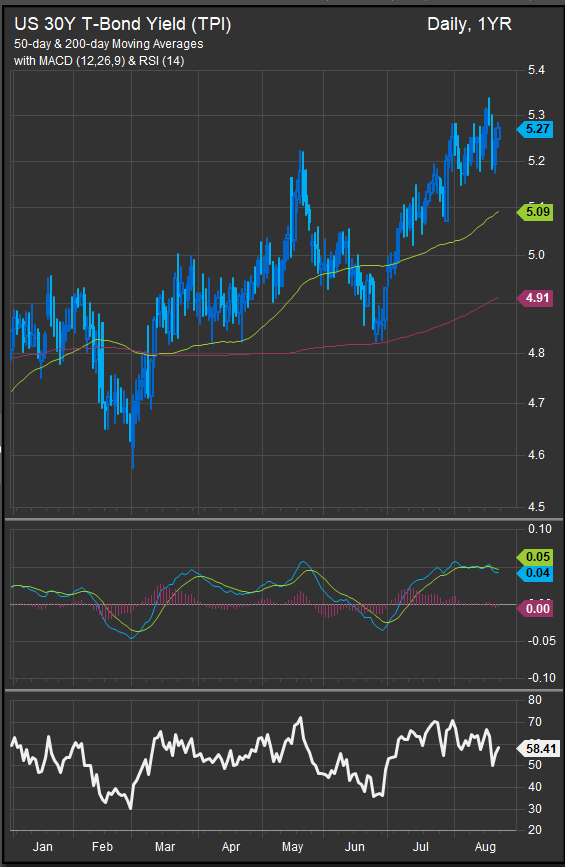
Long-term Treasury yields remain elevated despite Treasury’s expanded bond-buyback program, which produced only temporary relief. Investors continue to focus on fiscal deficits, heavy government issuance and the growing supply of corporate debt associated with AI investment. At the same time, Nvidia is reportedly preparing AI-server price increases of more than 15% because of rising memory costs, while OpenAI is cutting model prices and Anthropic customers are experimenting with cheaper alternatives. Hyperscaler capital-spending estimates for next year have climbed above $1 trillion, and technology companies are increasingly tapping credit markets to fund the buildout. That creates the central sector question for the second half of 2026:
Which parts of the market earn returns on AI investment—and which are simply absorbing its rising capital costs?
The Sector Map
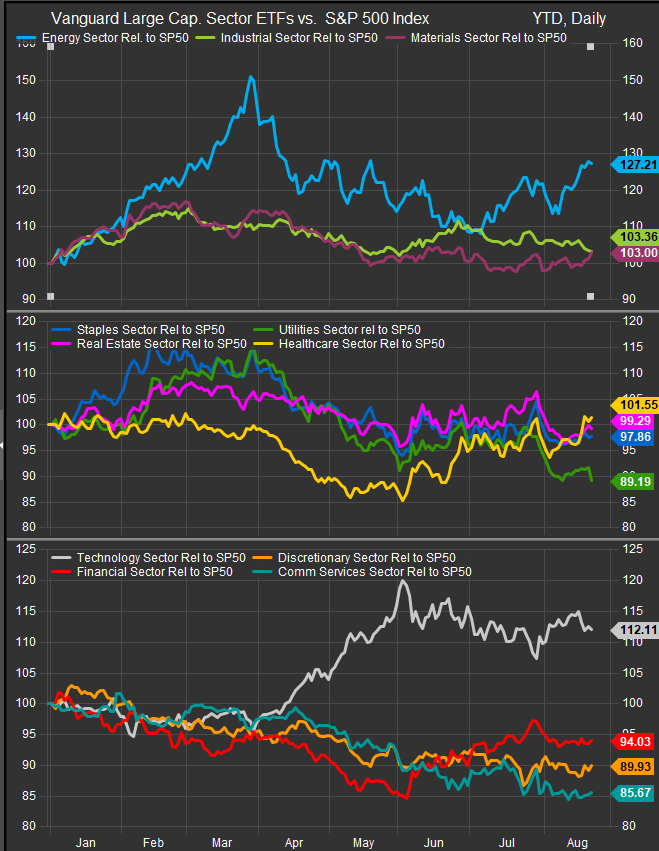
| Sector | Current View | Primary Driver |
| Information Technology – VGT | Constructive, selective | AI demand strong; valuation and financing discipline rising |
| Communication Services – VOX | Constructive | AI monetization and falling inference costs |
| Financials – VFH | Improving | Financing AI infrastructure and capital-markets activity |
| Industrials – VIS | Positive | Data-center equipment, defense and manufacturing demand |
| Utilities – VPU | Positive fundamental / rate-sensitive | Structural power demand versus financing costs |
| Energy – VDE | Positive tactical hedge | Iran, Hormuz and diesel-price risk |
| Health Care – VHT | Improving | Innovation plus defensive earnings |
| Consumer Discretionary – VCR | Selective | Consumer bifurcation and borrowing costs |
| Consumer Staples – VDC | Neutral / defensive | Stable demand but limited cyclical upside |
| Materials – VAW | Selectively positive | Grid, construction and commodity demand |
| Real Estate – VNQ | Rate-constrained | High financing costs offset data-center opportunities |
Information Technology: AI Demand Is No Longer Enough
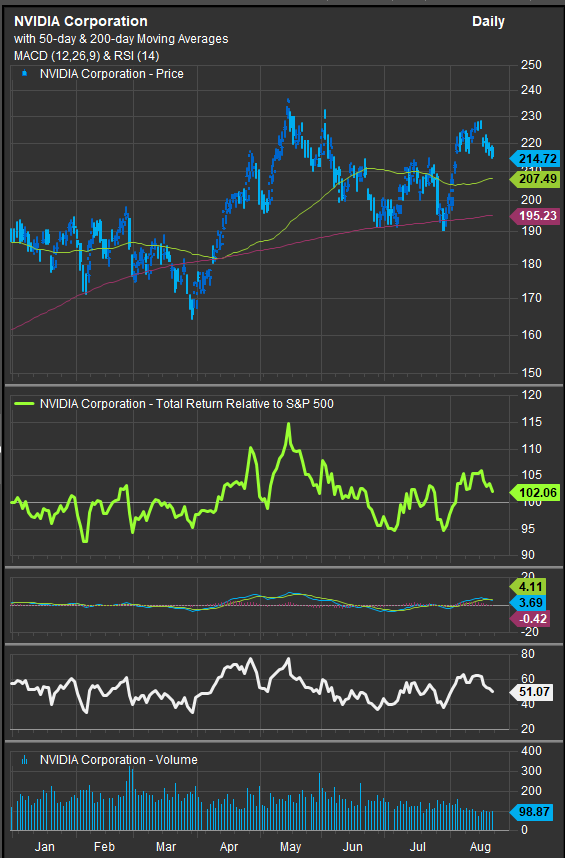
The AI spending thesis remains fundamentally intact, but investors are beginning to demand evidence that spending generates returns. Nvidia’s reported server price increases illustrate one side of the problem: the cost of adding compute continues to rise. The other side is increasingly aggressive competition among AI models. OpenAI plans to reduce developer pricing by more than 20%, while some Anthropic customers are migrating workloads toward cheaper alternatives. That is good for AI adoption but raises the hurdle for infrastructure economics.
For VGT, the preferred exposure is increasingly companies with pricing power, strong balance sheets and enough internal cash generation to fund investment without depending excessively on external capital. Nvidia earnings this week will be an important test—not simply of GPU demand, but of the financing arrangements supporting that demand.
Communication Services: Falling AI Costs Can Be a Feature
Communication Services sits differently in the AI value chain. For digital platforms, falling model and inference prices can improve economics. Companies that use AI to improve advertising, search, customer engagement and content creation may benefit from lower compute costs without bearing the same infrastructure burden as data-center developers. That keeps VOX relatively attractive if AI gradually shifts from infrastructure buildout toward monetization. The principal risk is competitive disruption. Lower-cost open-weight models make AI capabilities easier to replicate, meaning investors should favor platforms with distribution, proprietary data and existing cash-generating businesses.
Financials: The AI Boom Runs Through the Capital Markets
If capital is becoming the binding constraint, Financials (VFH) become part of the AI trade. The first phase of the buildout was funded largely by hyperscalers with enormous internal cash flow. The next phase increasingly requires outside financing for data centers, utilities, semiconductor capacity, power projects and specialized infrastructure.
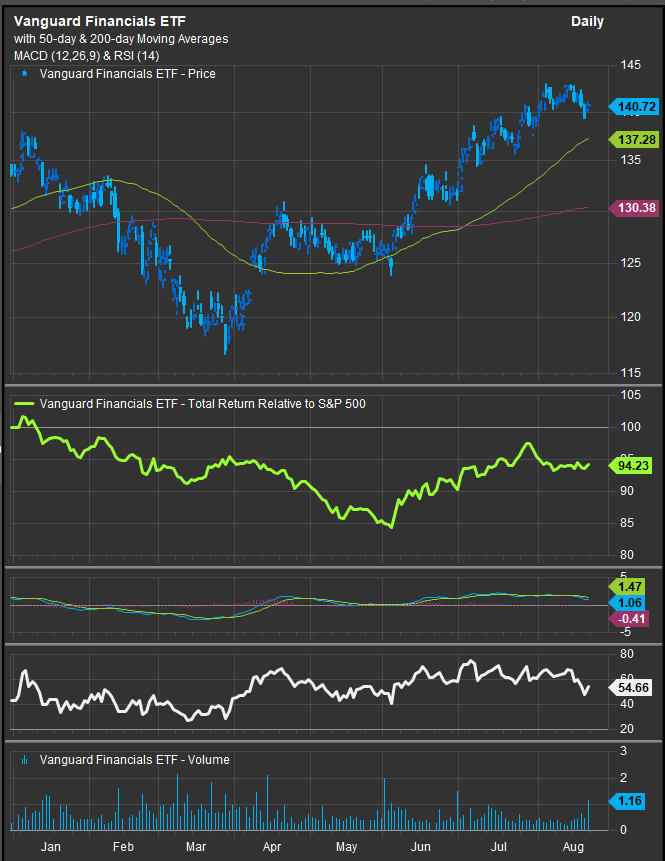
Banks provide loans and underwriting. Private-credit firms finance projects traditional lenders may not want to hold. Insurers and asset managers absorb long-duration debt. Capital-markets firms earn fees from bond issuance, securitization, equity offerings and refinancing activity. The opportunity is substantial as AI-related financing expands. But Financials also provide an important warning mechanism. With long Treasury yields around 5%, project borrowing costs can easily move into the 6%–8% range after spreads and financing premiums. Those yields are attractive to lenders—but only as long as borrowers continue generating returns comfortably above their cost of capital. Rapidly widening credit spreads, tougher covenants or lenders demanding greater equity contributions would be among the clearest signs that financing costs are beginning to constrain the AI expansion.
Industrials: One of the Cleanest AI Exposures
Industrials remain one of the strongest ways to participate in the AI cycle without underwriting frontier-model economics. Data centers require transformers, cooling equipment, generators, electrical systems, construction machinery and physical infrastructure regardless of which AI platform wins. The macro backdrop also remains supportive. August flash PMIs showed stronger-than-expected overall activity and accelerating services demand, while recent regional manufacturing surveys strengthened materially. That keeps VIS attractive. The new risk is trade. The collapse of U.S.-Canada negotiations and prospective 50% tariffs could raise input costs across steel, autos, appliances and industrial supply chains.
Utilities: Great Demand, Expensive Capital
Few sectors have a stronger long-term demand story than Utilities. AI data centers require enormous amounts of electricity, supporting investment in generation, transmission and grid modernization. But utilities must often spend years building infrastructure before earning a full return. That makes VPU unusually sensitive to long-term rates. The sector’s fundamental outlook can improve while its equity valuation struggles if Treasury yields remain elevated. Utilities become considerably more attractive if long-term real yields turn decisively lower.
Energy: Still the Portfolio Hedge
Iran remains a major macro wildcard. Diplomatic progress is limited, Washington is preparing additional economic pressure and regional shipping remains disrupted. Iran has allowed some Iraqi tankers through Hormuz, but Saudi Arabia is being forced to diversify routes amid Red Sea threats.
That supports VDE tactically.
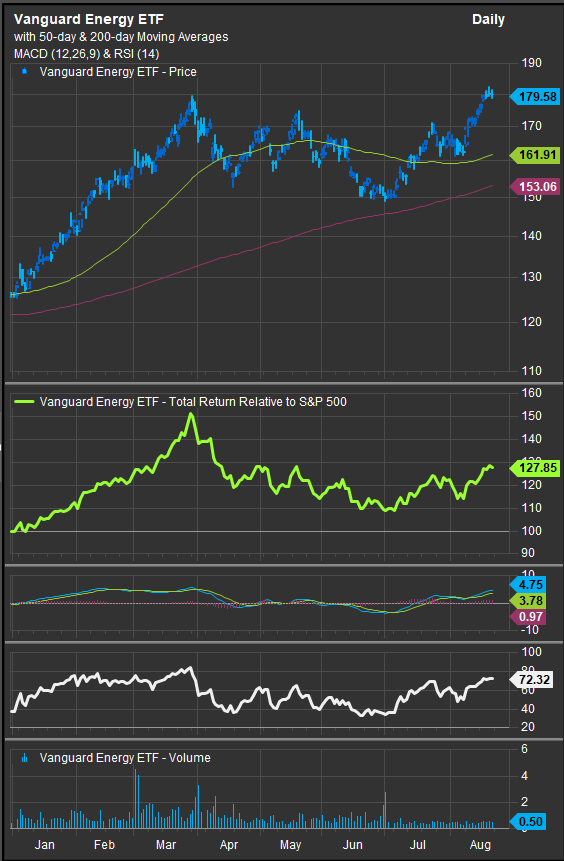
Energy also affects every other sector through inflation. Persistent oil and diesel pressure can keep long-term rates elevated, making Energy both a beneficiary of the geopolitical shock and a source of valuation pressure for Technology, Utilities and Real Estate.
Health Care: Growth Without AI-Capex Dependence
Health Care received an important innovation catalyst last week as Moderna and Merck reported encouraging personalized cancer-vaccine results. The reaction provided broader validation for the mRNA oncology platform. That makes VHT increasingly useful as an alternative Growth exposure. Health Care offers innovation, earnings durability and relatively little direct dependence on AI infrastructure financing. If rates remain high while investors continue seeking Growth, Health Care could become increasingly attractive.
When Does Capital Actually Stop the AI Boom?
There is no specific Treasury yield at which the expansion suddenly ends. The critical threshold arrives when a new project’s expected return on invested capital approaches its financing cost.
At a 5%-plus long Treasury yield, marginal corporate and project debt can easily cost 6%–8% or more. Every additional percentage point of borrowing cost adds $1 billion of annual interest expense for each $100 billion of debt-financed investment. That remains manageable for projects expected to earn 20% or more. It becomes much harder when utilization assumptions weaken, model pricing falls, construction costs rise or projects take longer to produce revenue. And those pressures are beginning to appear simultaneously.
AI-server prices are rising. Model prices are falling. Political opposition can delay construction. Debt requirements are increasing. The AI cycle therefore does not end when companies stop wanting more compute.
It slows when the marginal project stops earning enough to justify the capital required to build it.
The Sector Operator’s Take
The AI boom is evolving from a technology story into a market-wide capital-allocation cycle. Technology creates the demand. Industrials and Materials provide the physical infrastructure. Utilities and Energy supply the power. Financials determine which projects receive funding and at what cost. Communication Services can benefit as AI becomes cheaper to deploy. Real Estate feels the financing burden directly. Health Care offers a separate source of Growth if investors want innovation without AI-capex exposure. And Consumer sectors reveal whether high rates and energy prices are beginning to weaken household demand.
For now, the buildout remains intact. But the investment hierarchy is changing. The next phase should favor sectors and companies that either generate capital internally, earn attractive returns on the capital they deploy, or collect fees and revenues from supplying the buildout without assuming excessive financing risk. If AI’s next bottleneck is capital, the most important signals may no longer come only from semiconductor orders. They may come from the bond desk.
Sources
- August flash PMI data and economic commentary.
- Political and regulatory developments affecting U.S. data-center construction.
- U.S. Treasury nominal and real Treasury yield data.
- Reuters, Bloomberg, Financial Times, New York Times and Politico reporting referenced in the supplied headline package.
Disclaimer: This commentary is for informational and educational purposes only and does not constitute investment advice, an offer to sell or a solicitation to purchase any security. Sector ETF performance, capital-market conditions, interest rates and geopolitical risks can change materially. Investors should consider their objectives, risks, charges and expenses before investing.
