


The Fed has restarted tightening, but investors are not making the textbook rotation into Value. Instead, the first post-hike session suggests a preference for profitable Growth, secular earnings visibility and balance-sheet strength—while leveraged cyclicals, banks, housing and bond-proxy sectors absorb the pressure.
The Federal Reserve’s first rate hike in three years was supposed to create a straightforward playbook for sector investors: higher rates favor Value, banks and near-term cash flows, while long-duration Growth stocks lose some of their valuation support. The market’s first reaction looked almost nothing like that textbook scenario. The Fed raised the federal-funds target range by 25 basis points to 3.75%-4.00% in a unanimous decision, describing economic activity as solid, domestic spending as resilient and capital investment as robust while emphasizing that inflation remains elevated. More importantly, the September projections showed a median year-end policy rate of 4.1%, with 16 of 18 participants projecting at least one additional increase this year. The median rate projection also remains 4.1% through the end of 2027, a meaningful hawkish shift from June.
Yet the market did not respond by abandoning Growth. In the supplied ETFThemes.com data, Vanguard Growth ETF (VUG) finished essentially unchanged Wednesday while Vanguard Value ETF (VTV) declined 0.93%. QQQ gained 0.03%, Vanguard Information Technology ETF (VGT) advanced 0.11%, while the broader SPY declined 0.44%. Growth also retains the stronger six-month trend, with VUG up 14.7% versus 11.0% for VTV.
That divergence is the key Thematic Thursday signal. The Fed has begun tightening, but the market is interpreting the move less as the beginning of a conventional Growth-to-Value rotation and more as a quality filter. Companies capable of financing themselves from strong existing cash flows are being treated very differently from companies whose investment cases depend on cheap capital. That distinction cuts across both Growth and Value and could be more important for sector selection than the style labels themselves.
Why Growth Held Up Better Than Value
Part of the answer lies in the bond market. The Fed’s hawkish message pushed short-term yields higher, but longer-term yields were much more stable, producing a flatter curve. Reuters described Thursday’s reaction as a rise in shorter-term Treasury yields accompanied by modest declines farther out the curve, suggesting investors interpreted the Fed’s action as increasing the probability that inflation will ultimately be contained rather than simply allowing long-term inflation expectations to rise.
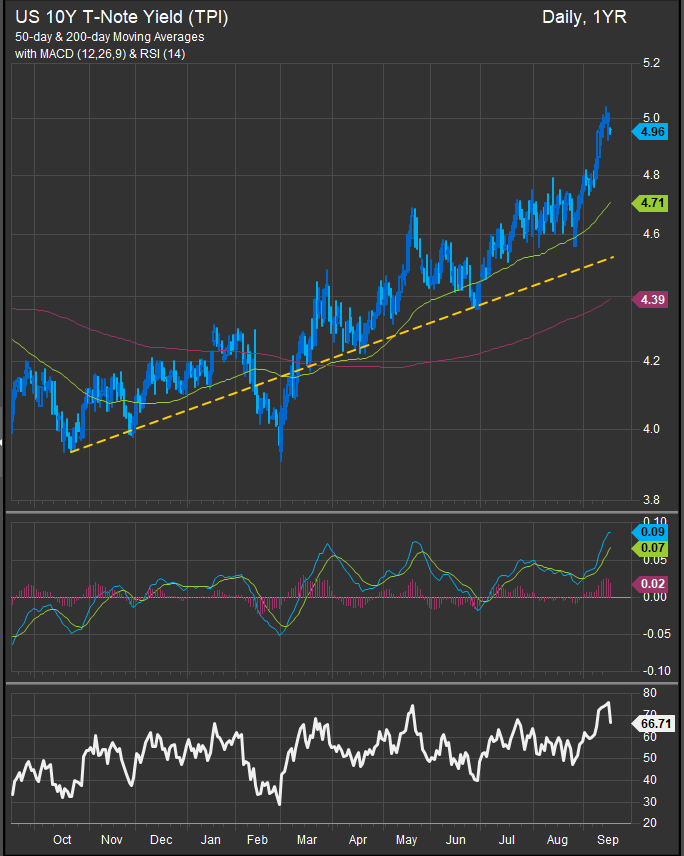
Chart: Equity investors are feeling relief that the 10yr yield has retreated below 5%, however, the longer-term trend for rates remains higher. 4.8% is setting up as a key pivot point.
That curve shape matters enormously for sector leadership. Growth stocks are often described as “long-duration” equities because a larger proportion of their expected value comes from earnings farther into the future. Their valuations are particularly vulnerable when long-term discount rates rise. A Fed hike that lifts the front end without producing another major surge in 10- and 30-year yields is therefore much less damaging to large-cap Growth than a generalized bond-market selloff would be.
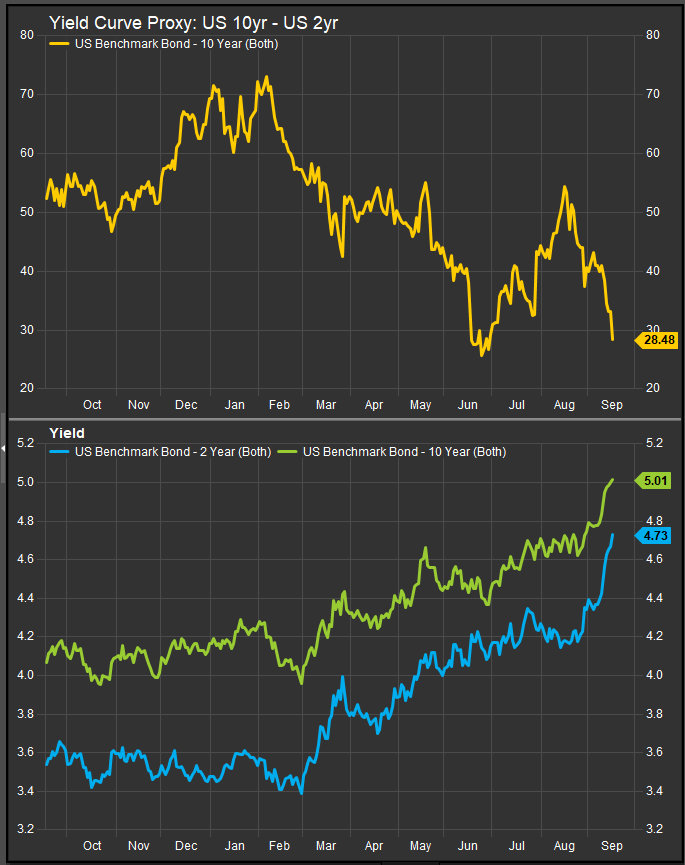
Chart: Despite a bullish reaction to the Fed’s hike, the 10yr -2yr spread is back near lows for the year. A negative spread has historically been a pre-cursor to recession.
The other factor is earnings quality. Today’s large-cap Growth universe bears little resemblance to the highly levered technology complex of earlier tightening cycles. Many of the dominant companies in Technology and Communication Services generate enormous cash flows, maintain strong balance sheets and can fund capital spending internally. Higher overnight rates matter far less to a cash-rich hyperscaler than to a homebuilder, regional bank borrower, speculative clean-energy developer or early-stage technology company that repeatedly needs external financing.
This does not mean Growth has been immunized from tighter money. VUG is still down 2.6% over the latest month, QQQ is down 3.6%, and VGT has lost about 3%. The market is repricing Growth—but it is doing so selectively rather than indiscriminately.
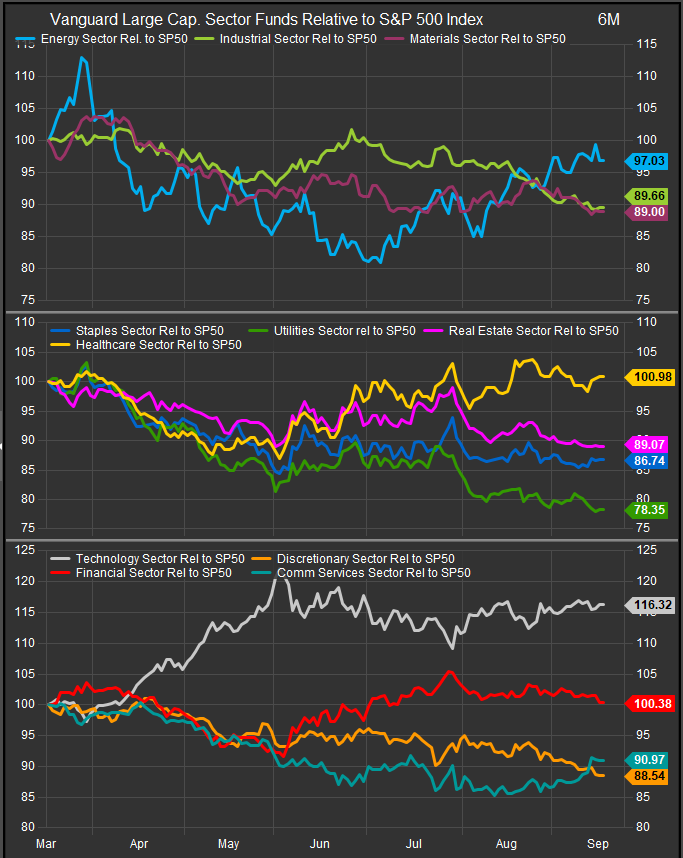
Chart: Technology shares have been resilient despite higher rates. Industrials, Utilities, and Consumer exposures remain pressured.
Technology: Higher Rates Are Separating the Funders From the Funded
Technology offers the clearest example of that distinction. Semiconductor ETFs actually rallied after the Fed announcement: SMH and SOXX each gained 0.64%, PSI advanced 0.98% and SOXQ rose 0.65%. That strength came despite meaningful one-month drawdowns across the group, including declines of 7.2% for SMH, 8.7% for SOXX and more than 15% for PSI. Investors have also continued to commit substantial capital to portions of the complex, with SOXX attracting roughly $2.68 billion over the latest month. The implication is not that higher rates are bullish for semiconductors. It is that investors are still willing to underwrite the AI compute cycle when they believe the earnings opportunity is strong enough to overcome a higher discount rate. The current news tape reinforces that argument: Arm continues to express confidence in its data-center AI ambitions, a consortium of banks has arranged roughly $22 billion of financing for a major AI cloud venture, and demand for GPU capacity remains strong enough for reports of higher on-demand pricing.
At the same time, the financing side of the AI boom is becoming more important. Higher borrowing costs increase the hurdle rate for data-center projects, startups and infrastructure companies, while regulatory scrutiny of data-center electricity costs is increasing. Virginia is reviewing restrictions on new data-center applications, Congress is scrutinizing electricity infrastructure costs, and Holtec reportedly delayed its IPO amid changing sentiment around the AI data-center economy. For sector investors, that argues for distinguishing cash-generative Technology from capital-hungry Technology. The former can continue to work in a tightening cycle if earnings growth remains strong. The latter increasingly has to demonstrate that projected returns exceed a materially higher cost of capital.
Software tells a similar story. The group remains strong over the latest week—cybersecurity ETFs such as BUG and HACK are up 10.6% and 8.1%, respectively—but most software ETFs slipped on the Fed day itself. IGV fell 0.56%, CIBR declined 0.69% and HACK lost 0.94%. The group has benefited from the recent shift toward cybersecurity and AI governance, but the Fed hike reminds investors that high recurring revenue alone is not enough; valuation and financing sensitivity still matter.
Financials: Higher Rates Are Not Automatically Good for Banks
If Wednesday challenged one of the market’s most persistent rules of thumb, it was the idea that higher rates necessarily benefit Financials. Bank ETFs were among the clearest losers following the Fed decision. KBWB declined 2.88% and the iShares Regional Banks ETF (IAT) fell 3.50%, while broker-dealer ETF IAI lost 2.2%. The reason is the yield curve. Banks generally benefit most when longer-term lending rates rise relative to shorter-term funding costs. Wednesday produced something closer to the opposite: the Fed increased short rates while the long end stabilized. A flatter curve compresses the incremental benefit banks receive from higher policy rates, while continued tightening increases credit risk and slows loan demand.
That does not eliminate the longer-term case for Financials. KBWB has still gained nearly 22% over six months, and investors added roughly $147 million to the fund over the latest week despite the price decline. But the initial reaction suggests the sector needs more than simply “higher rates.” A better environment for banks would combine healthy nominal growth with a steeper yield curve, stable credit quality and stronger loan demand. If the Fed keeps tightening while housing and other interest-sensitive areas weaken, that combination becomes harder to achieve. Insurance appears somewhat better positioned. KIE declined only 0.79% Wednesday and remains positive over the latest week and three months. Unlike banks, insurers can benefit from higher reinvestment yields without relying as heavily on a favorable lending spread, making the industry one of the more plausible Value beneficiaries of a sustained higher-rate regime.
Energy: The Fed Matters, but Oil Matters More
Energy delivered another reminder that sector performance does not occur in a monetary-policy vacuum. XOP fell almost 4% Wednesday, OIH declined 2.8% and natural-gas-focused FCG lost 5.6%. Those moves contributed materially to Value’s underperformance because Energy remains an important component of many Value strategies. The immediate catalyst was not the Fed alone. Oil prices have retreated as Saudi Arabia offered additional crude through Oman and optimism increased that damaged pipeline capacity could gradually return. Reuters reported Thursday that crude extended its decline as supply fears eased, although prices remained above $100 per barrel and the broader Middle East situation remains highly uncertain.
That creates an interesting style implication. Energy had been one of the strongest arguments for Value during the inflation shock because higher oil prices simultaneously lifted sector earnings and pressured long-duration Growth multiples. If oil continues to fall while the Fed convinces investors that inflation can be contained, that two-sided advantage weakens. Energy still offers strong cash flows and geopolitical scarcity value, but its near-term sector leadership now depends more on the commodity tape than on the Fed cycle itself.
Housing and Real Estate: The Most Direct Casualties of Tightening
Housing remains the clearest sector where the implications of the Fed’s new tightening cycle are unambiguously negative. ITB fell another 1.12% Wednesday and is now down 10.0% over the latest month. XHB has lost more than 11% during that period, while PKB is down almost 13%. The fundamental news supports the price action. Lennar reported weaker revenue, a 9% year-over-year decline in new orders and a smaller backlog, while reducing its full-year delivery forecast. The company’s results arrive alongside builder confidence near its weakest level since 2021, widespread use of sales incentives and mortgage rates near 7%. Interestingly, investors are beginning to buy the weakness. ITB attracted roughly $249 million in one-day inflows and $277 million over the latest month despite the price deterioration. That looks more like contrarian positioning than confirmation that the fundamental turn has arrived. Until long-term borrowing costs decline materially, housing remains among the sectors most exposed to further tightening.
REITs tell a similar story. VNQ, XLRE and IYR all fell about 0.6%-0.7% Wednesday and are down roughly 5.4% over the latest month. RSI readings across the group are deeply oversold, and VNQ has continued to receive some flows, but the basic problem remains: higher Treasury yields increase financing costs while simultaneously raising the yield investors can obtain from risk-free securities. For Real Estate, the Fed’s restart therefore represents a genuine fundamental headwind rather than merely a valuation adjustment.
Industrials and Infrastructure: Higher Rates Versus Secular Spending
Industrials occupy a more complicated middle ground. Infrastructure ETFs were generally only modestly lower Wednesday, with PAVE down 0.17%, IGF off 0.21% and IFRA down 0.14%. Yet the group has endured significant one-month weakness, with PAVE down almost 10%. Investors nevertheless added approximately $426 million to PAVE over the latest month and more than $2.4 billion year to date.
That combination reflects the competing forces facing the sector. Higher rates raise the hurdle rate for long-duration capital projects and make highly leveraged infrastructure less attractive. At the same time, defense spending, manufacturing localization, grid investment, data-center construction and public infrastructure remain durable secular drivers. The Fed cycle therefore increases the premium on project economics. Companies with funded backlogs, visible government spending and strong balance sheets should be better positioned than businesses relying on speculative future projects or continuous capital-market access. Boeing’s warning that 737 Max production stabilization is taking longer than expected is another reminder that execution still matters even when the macro spending backdrop is supportive.
Defense also showed relative resilience Wednesday, with ITA, PPA and XAR all positive despite steep one-month drawdowns. The sector’s unusually depressed technical readings suggest much of the recent pressure is positioning and valuation-related rather than a collapse in the spending thesis.
Defensives Are Not an Automatic Refuge Either
Traditional defensive strategies also struggled after the hike. USMV and SPLV each declined roughly 0.7%, while high-dividend/low-volatility ETF SPHD fell 1.27%. Dividend strategies such as SCHD, VYM and DGRO also declined roughly 1%-1.4% on the day. This is another important distinction for sector investors. A hawkish Fed does not automatically make bond-proxy sectors attractive. Utilities, Staples, REITs and high-dividend strategies must compete with higher yields available in Treasuries. When the risk-free rate rises, a slow-growing equity offering a 3%-4% dividend becomes less compelling unless its earnings outlook also improves.
The income trade has not disappeared—SCHD has attracted more than $3.4 billion over the latest month—but the price response shows investors are distinguishing between yield and cash-flow growth. That distinction likely favors dividend growers and companies capable of increasing free cash flow over businesses valued primarily for their current distribution yield.
Health Care: Defensive Cash Flow With a Growth Option
Health Care may occupy one of the more interesting positions in the new regime. Biotechnology ETFs were broadly positive Wednesday: IBB gained 0.20%, FBT rose 0.77% and several genomics strategies advanced. The group has also produced strong three-month returns, with IBB up 18%, FBT up 17% and IDNA nearly 30%. Higher rates remain a legitimate risk for smaller biotech companies that depend on external financing. But profitable pharmaceutical, medical-device and health-services companies offer something the market increasingly appears to value: current cash flow combined with idiosyncratic growth drivers that do not depend directly on the economic cycle.
That makes Health Care somewhat different from the classic defensive trade. Its appeal in a tightening cycle may come less from recession protection and more from earnings independence—clinical catalysts, product cycles and demographic demand that can continue even if monetary policy stays restrictive.
The Growth-versus-Value Debate Has Changed
The most important conclusion from the first post-Fed session is that investors should be cautious about applying the traditional tightening-cycle playbook mechanically. Value is not automatically winning because rates are going higher, and Growth is not automatically losing. The market is instead differentiating according to the source and durability of cash flows. Cash-rich Technology companies and semiconductor leaders can absorb higher rates if earnings growth remains strong. Banks can struggle even with a higher fed-funds rate if the curve flattens. Energy can weaken despite inflation if crude prices retreat. Dividend and low-volatility stocks can lose ground when Treasury yields become more competitive. Housing and REITs, by contrast, face direct and immediate fundamental pressure from higher borrowing costs. That suggests the emerging sector hierarchy is less Growth versus Value than self-funded growth versus rate-dependent growth, and cash-generative cyclicals versus leveraged cyclicals.
The theme data reinforce that interpretation. Growth outperformed Value on the Fed day, Technology held up better than the broad market, and semiconductors bounced. At the same time, banks, Energy, housing, Real Estate and traditional dividend strategies all weakened. The Fed has begun tightening, but it has not yet created a conventional Value regime. For sector investors, the first message of this new policy cycle is more selective: the cost of capital is rising, and the market increasingly wants companies that do not need cheap money to deliver their earnings story.
Sources and Methodology
Federal Reserve policy details and economic projections are sourced from the Federal Reserve Board’s September 16 FOMC statement and Summary of Economic Projections. Market and commodity context is supplemented with Reuters reporting on the post-FOMC Treasury reaction and the September 17 decline in oil prices. ETF flow and performance data sourced from FactSet Research Systems, Inc.
Disclaimer: This material is provided for informational and educational purposes only and does not constitute investment advice, a recommendation, or an offer to buy or sell any security. ETF prices, fund flows, economic conditions and interest-rate expectations can change rapidly. Investors should evaluate sector exposure in light of their own objectives, risk tolerance and investment horizon.
